
An epidural steroid injection is an outpatient, image-guided procedure that places anti-inflammatory medication near an irritated spinal nerve root. It may help adults with radiating neck, arm, back, or leg pain from a disc herniation, spinal stenosis, or foraminal narrowing. Board-certified pain specialists at California Pain Consultants in San Diego evaluate whether an epidural injection fits your diagnosis and perform it as part of a broader recovery plan.
An epidural steroid injection is an image-guided procedure for selected neck, back, arm, or leg pain caused by inflammation around a spinal nerve root. Common clinical situations include disc herniation, radiculopathy, and spinal stenosis.
The injection places corticosteroid into the epidural space, often with local anesthetic or saline. It aims to calm inflammation; it does not repair a disc, remove a bone spur, or treat every type of axial spine pain.
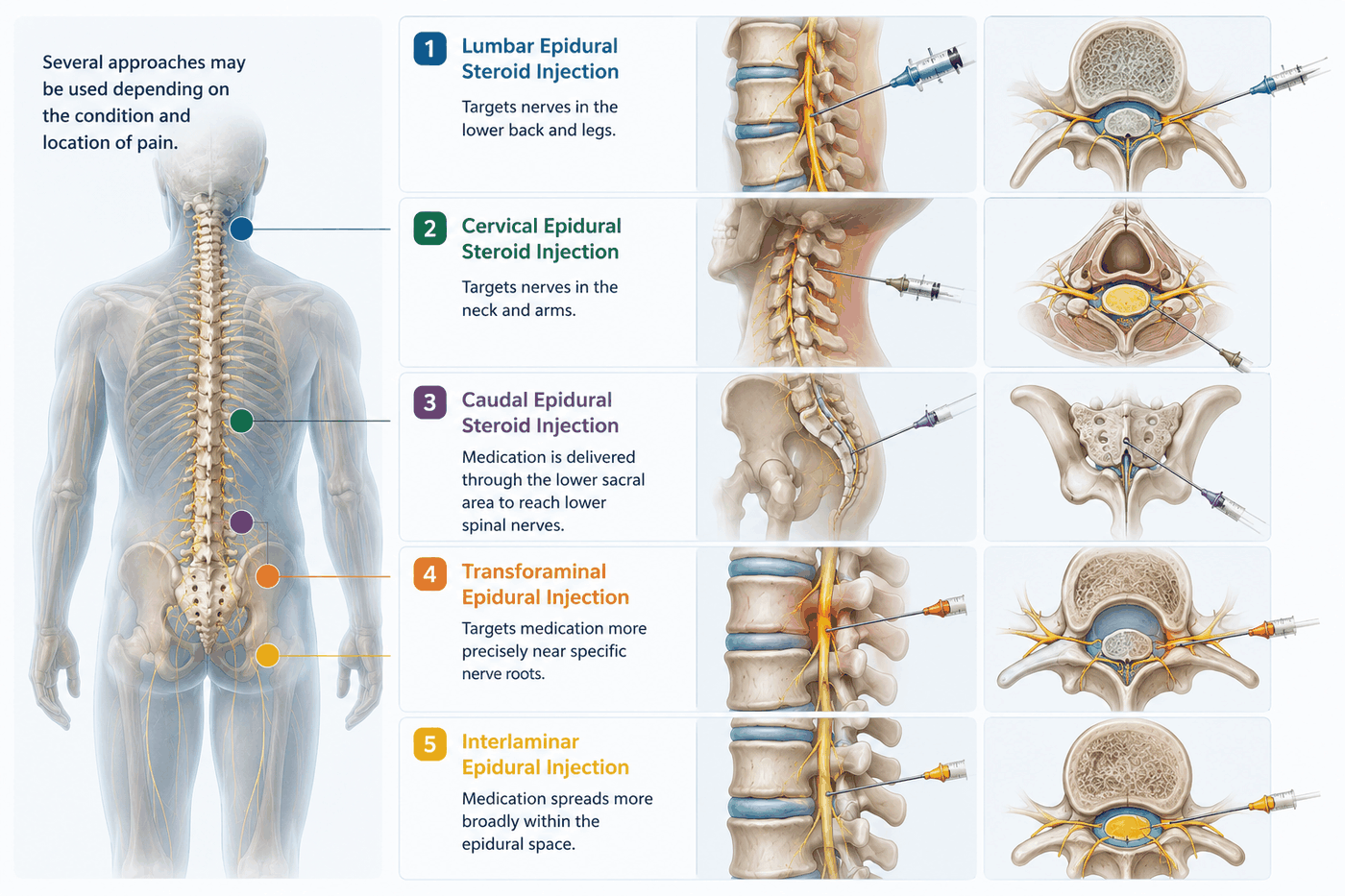
The route—interlaminar, transforaminal, or caudal—is chosen according to the diagnosis, target, anatomy, prior surgery, and safety profile.
Epidural steroid injection delivers anti-inflammatory medication into the epidural space under fluoroscopy and contrast confirmation for selected radicular pain.
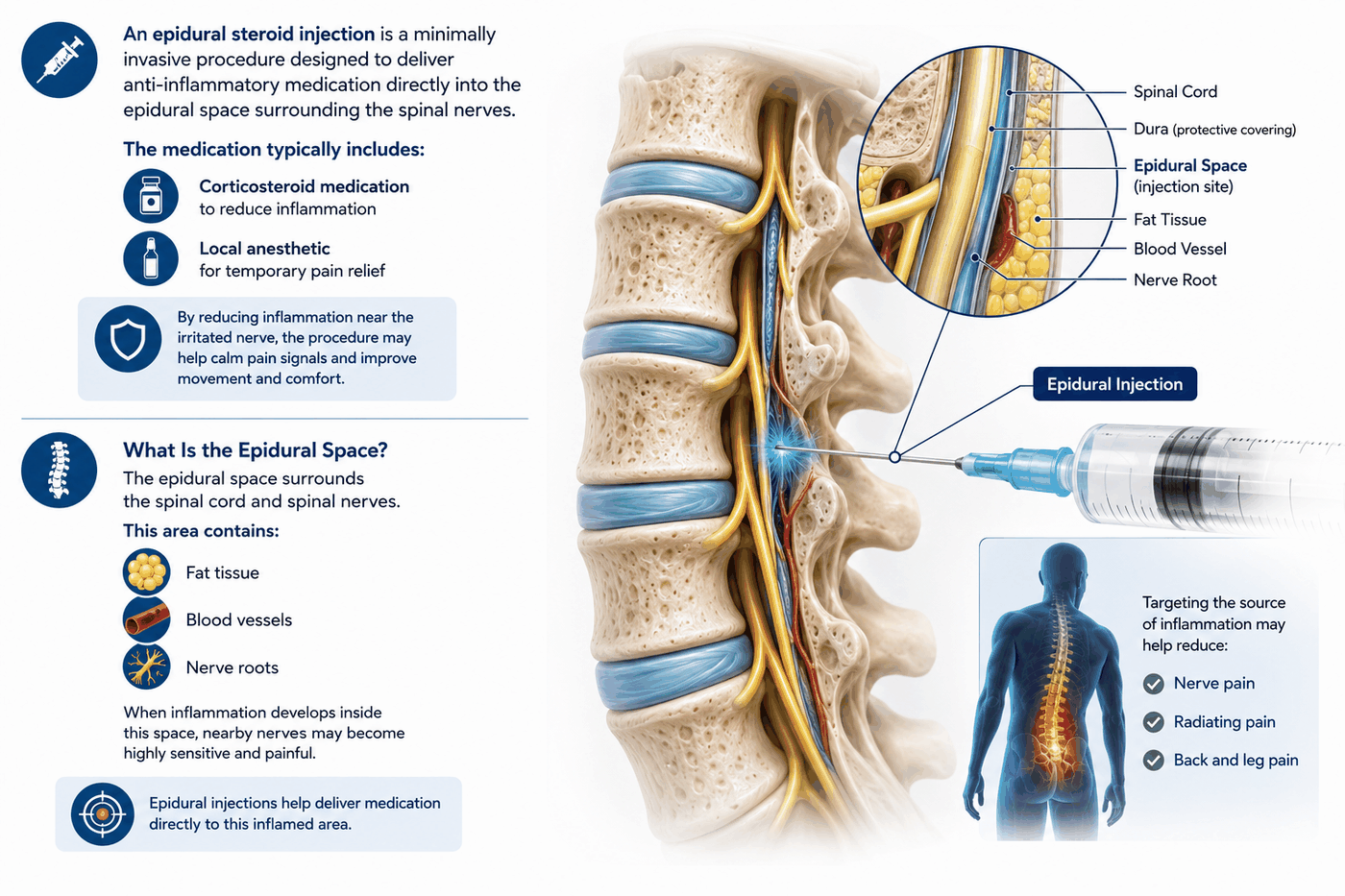
What Is an Epidural Steroid Injection?
The epidural space surrounds the spinal cord covering and nerve roots. Corticosteroid reduces inflammatory signaling in this space for a limited period.
A transforaminal injection targets the area where a specific nerve exits. An interlaminar injection enters between adjacent laminae for broader epidural spread. A caudal injection enters through the sacrum and may be useful for lower lumbar or postsurgical patterns.
Fluoroscopy and contrast are standard safety and accuracy tools unless a documented contraindication changes the plan. Injection should complement active conservative care rather than replace rehabilitation.
How Widely It Is Used
Epidural steroid injections are among the most common interventional spine procedures. Cleveland Clinic reports that approximately 9 million are performed each year in the United States.
Conditions That May Be Treated
The clearest role is radicular pain supported by the history, examination, and imaging—not nonspecific back pain alone.
Disc Herniation and Radiculopathy
Disc material and inflammation may irritate a cervical, thoracic, or lumbar nerve root, producing radiating pain, tingling, or numbness.
Spinal Stenosis
Narrowing may cause arm or leg pain, heaviness, or reduced walking tolerance. Injection may reduce inflammation but cannot widen the canal. Learn more about spinal stenosis.
Degenerative Foraminal Narrowing
Arthritis and disc-height loss can narrow a nerve exit, sometimes producing a consistent radicular pattern. See degenerative disc disease for related information.
Persistent Postsurgical Nerve Pain
Selected patients may be considered after imaging and evaluation exclude instability, infection, major recurrent compression, or another cause.
Symptoms That May Support Epidural Treatment
A clinician looks for a nerve-root pattern and for functional limitations that may improve if inflammation is reduced.
- Pain traveling from the neck into an arm or from the back into a leg
- Burning, shooting, stabbing, or electric nerve pain
- Tingling or numbness in a consistent dermatome
- Pain aggravated by spinal position, coughing, or straining
- Leg symptoms with standing or walking from stenosis
- Sleep, work, or rehabilitation limited by radicular pain
- Imaging findings that match the affected nerve and side
- Inadequate improvement with an appropriate conservative plan
How Candidacy Is Evaluated
The evaluation confirms a treatable radicular diagnosis and reviews whether injection risk is acceptable.
History and Functional Goals
Your clinician reviews where symptoms begin, whether pain travels, how long it has been present, what worsens or relieves it, and how it affects walking, work, sleep, and daily activity.
Focused Physical Examination
Strength, sensation, reflexes, movement, tenderness, gait, and nerve-tension signs help distinguish joint, disc, nerve, muscle, and other potential pain sources.
Imaging and Prior Records
MRI, CT, or X-rays are reviewed when results are likely to clarify anatomy or change the plan. Prior procedure reports and treatment responses may also be important.
Medication and Health Review
Blood thinners, diabetes, allergies, infection risk, pregnancy, implanted devices, and other medical conditions are discussed so benefits and risks can be considered safely.
The Epidural Steroid Injection Procedure
Specific positioning, approach, and medication differ by spinal region and target. A predetermined series is not required. Cleveland Clinic notes that a lumbar epidural injection takes 15 to 30 minutes in most cases.
Step 1: Preparation
Fasting and medication instructions are confirmed, monitoring is applied, and the injection area is cleaned and numbed.
Step 2: Fluoroscopic Guidance
The physician advances a needle toward the intended epidural space or nerve-root region while viewing the anatomy in real time.
Step 3: Contrast Confirmation
Contrast verifies epidural spread and helps detect vascular or incorrect placement before steroid is injected.
Step 4: Medication Delivery
Corticosteroid, often with local anesthetic or saline, is delivered slowly using the lowest effective dose appropriate to the plan.
Step 5: Observation
The patient is monitored for weakness, numbness, dizziness, reaction, or other concerns and receives discharge instructions.
Recovery and Response After Injection
The local anesthetic and steroid have different timelines. Early numbness may fade before anti-inflammatory benefit begins. According to Cleveland Clinic, epidural steroid injections typically start working within two to seven days, and pain may feel worse for two to three days before it begins to improve.
First-Day Safety
Arrange transportation and avoid driving or risky activity while sensation, strength, alertness, or balance is altered.
Possible Pain Flare
Temporary soreness or increased symptoms can occur. Use the approved comfort plan and call if pain is severe or rapidly worsening.
Rehabilitation
If symptoms improve, resume a graded program focused on mobility, strength, nerve tolerance, walking, and return to meaningful activity.
Outcome Measurement
Track radiating pain, walking, sleep, work, medication use, and functional goals. Repeat treatment is based on meaningful, sustained benefit and cumulative risk.
Potential Benefits and Realistic Expectations
An epidural steroid injection may provide temporary symptom reduction and a rehabilitation window. Some people improve substantially, some partially, and some not at all.
- Targets spinal nerve inflammation under imaging guidance
- May reduce selected arm or leg radicular pain
- Offers several approaches for different targets and anatomies
- Can make activity and physical therapy more tolerable
- Uses an outpatient, minimally invasive technique
- Provides response information for future treatment planning
How Long Relief May Last
Results vary widely. Cleveland Clinic reports that approximately 50 percent of people experience temporary pain relief from epidural steroid injections, and that relief may last for weeks to months but rarely up to a year. For lumbar injections specifically, Cleveland Clinic cites research in which up to 70 percent of people with disc-related radicular pain felt at least 50 percent better at one to two months, and 40 percent felt better at 12 months.
Epidural Injection Risks and Warning Signs
Risks include bleeding, infection, dural puncture headache, medication reaction, temporary pain increase, elevated blood sugar, nerve injury, and rare serious neurologic or vascular complications. Cleveland Clinic notes that a spinal fluid leak causing a severe headache occurs in less than 1 percent of people.
- Report blood thinners, diabetes, infection, pregnancy, glaucoma, allergies, and contrast reactions
- Do not stop anticoagulants without a coordinated medical plan
- Call for fever, drainage, severe positional headache, or rapidly worsening pain
- Seek urgent care for new weakness, saddle numbness, or loss of bladder or bowel control
- Monitor blood sugar as directed after steroid exposure
- Repeat injections should follow documented benefit and the lowest reasonable cumulative steroid exposure
Call 911 for stroke symptoms, major weakness, breathing difficulty, a severe allergic reaction, or another life-threatening emergency.
Epidural Steroid Injection in Comprehensive Spine Care
Injection is most useful when it serves a defined rehabilitation or functional goal and the likely pain source has been identified.
Physical Therapy
A graded program can address mobility, strength, endurance, nerve tolerance, and movement confidence when symptoms allow.
Medication
Nonopioid, anti-inflammatory, or nerve-pain medication may be used based on diagnosis, risks, and response.
Other Procedures
Facet treatment, sacroiliac care, adhesiolysis, or another targeted option may be appropriate when a different mechanism is identified.
Surgical or Neuromodulation Review
Progressive neurologic deficit, major compression, instability, or persistent disabling neuropathic pain may require another specialty pathway.
See Whether an Epidural Steroid Injection Fits Your Diagnosis
California Pain Consultants can review your radiating symptoms, neurologic examination, imaging, medication risks, and prior treatment to choose the safest, most appropriate next step.
Epidural Injections at California Pain Consultants
Your care team at California Pain Consultants evaluates radiating neck, arm, back, and leg pain at clinics in Kearny Mesa, Rancho Bernardo, La Mesa, and Chula Vista. When an epidural steroid injection is appropriate, it is performed under imaging guidance at the Comprehensive Pain ASC in Rancho Bernardo or the EPC Surgery Center in La Mesa. We accept most insurances. You can request your appointment online or call (858) 571-3630.
Book Your AppointmentTrusted Information and Related Care
Medical references: CMS: Epidural steroid injections for pain management · NIAMS: Back pain diagnosis and treatment.
Related California Pain resources: Caudal steroid injections · Cervical steroid injection · All treatment options.
This article is for general education and does not replace an individualized medical evaluation. Recommendations depend on the diagnosis, health history, current medications, imaging, examination, and personal goals.
Frequently Asked Questions About Epidural Steroid Injection
Find clear, medically responsible answers about Epidural Steroid Injection, who may be a candidate, what to expect, and when to contact your healthcare team.
What is an epidural steroid injection, and how does it work?
An epidural steroid injection places anti-inflammatory medication into the epidural space around irritated spinal nerves. Fluoroscopy and contrast are commonly used to confirm the intended medication spread.
What conditions or symptoms may an epidural steroid injection help address?
It may be considered for radicular pain caused by a disc herniation, spinal stenosis, or inflammation around a cervical, thoracic, or lumbar nerve root. It is less likely to help pain that does not involve nerve irritation.
Who may be a candidate for an epidural steroid injection?
A candidate has a compatible symptom pattern, examination, and imaging when appropriate, along with no active infection or unsafe bleeding risk. The spinal region, anatomy, prior surgery, and treatment goals help determine the safest approach.
How should I prepare for an epidural steroid injection?
Tell the team about blood thinners, diabetes medicines, allergies, pregnancy, infection, and prior steroid or contrast reactions. Follow fasting and transportation instructions, and only change prescribed medication under coordinated medical guidance.
What happens during an epidural steroid injection?
The physician guides a needle to the selected epidural location, injects contrast to verify positioning, and then delivers local anesthetic and steroid. The exact interlaminar, transforaminal, or caudal approach depends on the diagnosis and anatomy.
Does an epidural steroid injection hurt?
Most people feel pressure and brief discomfort rather than severe pain. The skin is numbed before the needle is placed, and the procedure is performed under imaging guidance. Some soreness at the site or a short-term pain flare can occur afterward. Ask your care team whether light sedation is appropriate for your approach and health history.
What is recovery like after an epidural steroid injection?
Temporary soreness, numbness, heaviness, flushing, or a brief pain flare can occur. Most patients go home the same day and resume activity gradually according to their discharge instructions.
Can I drive after an epidural steroid injection?
Plan to have someone drive you home. Local anesthetic can temporarily affect sensation, strength, or balance in the arms or legs, and sedation affects alertness. Avoid driving or risky activity until sensation and strength are back to normal, and follow the specific discharge instructions your care team provides.
What are the possible risks or side effects of an epidural steroid injection?
Possible risks include bleeding, infection, dural puncture headache, steroid effects, temporary blood-sugar elevation, nerve injury, or allergic reaction. Rare serious neurologic complications are possible and vary by spinal level and approach.
How long does an epidural steroid injection take to work?
Epidural steroid injections usually start working within two to seven days, according to Cleveland Clinic. The local anesthetic may give brief numbness right away, and some people notice more pain for two to three days before the steroid takes effect. Track your arm or leg pain, walking, and sleep so your care team can judge the response.
How long does relief from an epidural injection last?
Relief varies from person to person. Cleveland Clinic reports that relief may last for weeks to months but rarely up to a year, and that approximately half of people experience temporary relief. The injection works best when it opens a window for physical therapy and activity, which may help extend the benefit. The response helps determine whether rehabilitation or another step is appropriate.
How many epidural steroid injections can I have in a year?
There is no single rule, but Cleveland Clinic notes that most healthcare providers limit people to two to three epidural steroid injections per year. Repeat treatment should be based on meaningful, documented benefit from the prior injection and on keeping cumulative steroid exposure as low as reasonably possible. Your clinician will review your history before scheduling another.
How does an epidural steroid injection fit into a broader treatment plan?
The injection may create a window for movement, sleep, and physical therapy, but it does not repair a disc or remove stenosis. It is usually combined with rehabilitation, medication review, and reassessment of the underlying cause.
What if the epidural injection does not help?
If an injection does not help, that result is useful information. Your pain specialist may reconsider the pain source, review imaging, or try a different approach. Other options may include facet treatment, adhesiolysis, nerve-pain medication, neuromodulation, or referral for a surgical opinion when nerve compression or weakness is significant.
When should I call my healthcare team or seek urgent care after an epidural steroid injection?
Call promptly for fever, drainage, increasing redness, a severe positional headache, or steadily worsening symptoms. Seek emergency care for progressive weakness, new bowel or bladder dysfunction, saddle numbness, breathing difficulty, chest pain, or a severe allergic reaction.