
The FAST procedure is a minimally invasive, ultrasound-guided treatment that removes damaged tendon or fascia tissue through a tiny incision. It may help adults with chronic tendon pain, such as tennis elbow, Achilles or patellar tendinopathy, or plantar fasciitis, that has not improved with months of well-designed rehabilitation. Board-certified pain specialists at California Pain Consultants in San Diego evaluate candidacy and perform the FAST procedure for carefully selected patients.
The FAST procedure is a minimally invasive, ultrasound-guided treatment that uses ultrasonic energy to break up and remove selected damaged soft tissue. The technology is commonly associated with percutaneous ultrasonic tenotomy for chronic tendinopathy.
It may be considered when a focused tendon or fascia problem remains painful despite an appropriate course of activity modification, rehabilitation, and other conservative care. It is not a first-line treatment for every tendon symptom.
A successful plan depends on the correct diagnosis, precise ultrasound targeting, realistic expectations, and progressive rehabilitation after the procedure.
The FAST procedure uses real-time ultrasound and a small ultrasonic instrument to debride selected degenerative tendon or fascia tissue through a tiny incision.
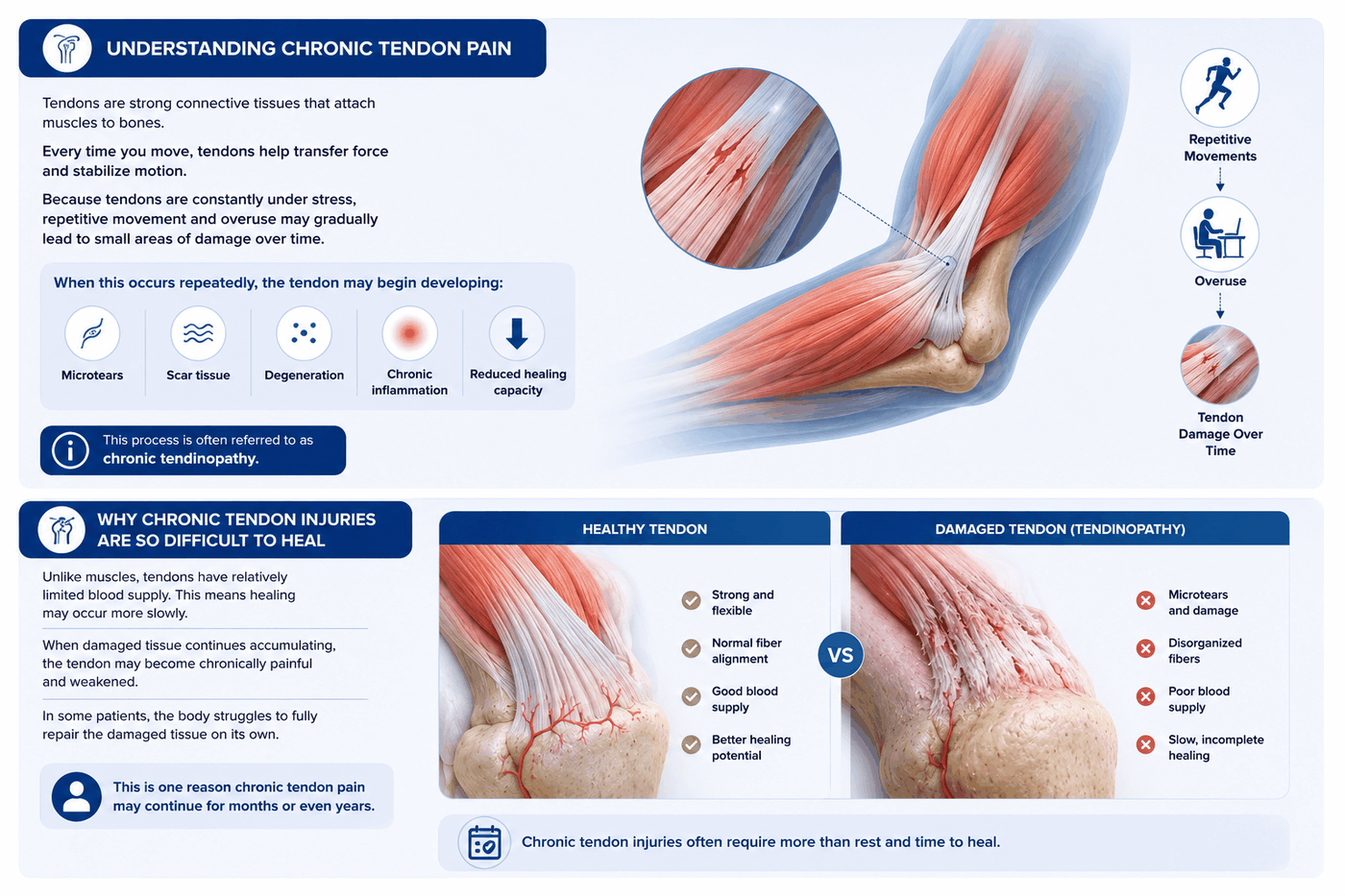
What Is the FAST Procedure?
FAST is a focused percutaneous procedure. Through a very small incision, an ultrasonic tip fragments and aspirates selected abnormal tissue while ultrasound displays the target.
Tendinopathy is not simply acute inflammation. Chronic tendon pain may involve disorganized collagen, thickening, small tears, impaired healing, or altered loading. These changes must be interpreted with the examination because ultrasound abnormalities can exist without pain.
The procedure is designed to remove a limited painful tissue target while preserving surrounding structures. It does not replace the progressive strengthening and load management needed for long-term tendon function.
Conditions That May Be Treated with FAST
Candidacy depends on a clearly localized, imaging-supported chronic tendon or fascia problem that has not improved enough with well-designed conservative care.
Elbow Tendinopathy
Lateral epicondylitis, often called tennis elbow, and selected medial epicondylitis may be considered when symptoms remain focal and persistent.
Most tennis elbow improves without a procedure. AAOS reports that approximately 80 to 95% of patients have success with nonsurgical treatment, that most people affected are between 30 and 50, and that a procedure may be considered when symptoms do not respond after 6 to 12 months of nonsurgical care.
Achilles or Patellar Tendinopathy
Chronic painful tendon degeneration at selected lower-limb sites may be evaluated after rehabilitation and load modification have been optimized.
Plantar Fascia Pain
Selected chronic plantar fasciopathy may be considered when diagnosis is confirmed and conservative treatment has been adequately tried.
Plantar fasciitis is very common, and most cases settle with simple measures. According to AAOS, approximately 2 million patients are treated for it every year, more than 90% improve within 10 months of starting simple treatment, and surgery is generally reserved for people who have not improved after 12 months of aggressive nonsurgical treatment. FAST may be discussed for the smaller group whose heel pain persists.
Other Focal Tendon Disorders
Certain rotator cuff or other superficial tendon targets may be considered only when anatomy, severity, and evidence support a safe approach.
Signs of Chronic Tendon or Fascia Pain
A complete evaluation distinguishes tendinopathy from a full rupture, arthritis, nerve pain, stress fracture, infection, and referred pain.
- Focal pain at a tendon or fascia attachment
- Pain during gripping, lifting, running, jumping, pushing, or pulling
- Stiffness after rest or early in activity
- Tenderness and thickening at a specific site
- Symptoms lasting for months despite appropriate rehabilitation
- Reduced strength, endurance, or confidence with loading
- Ultrasound findings that match the painful region
- A clear goal for return to work, sport, or daily activity
How Candidacy Is Evaluated
The clinician confirms the tissue target, assesses the quality of prior rehabilitation, and rules out a condition that requires different care.
History and Load Review
The evaluation covers training, work demands, symptom behavior, prior injury, medication, smoking, diabetes, and how load has been progressed or reduced.
Focused Examination
Strength, motion, tenderness, kinetic-chain mechanics, joint function, and pain with specific resisted movements help localize the source.
Diagnostic Ultrasound
Ultrasound can display tendon thickness, disorganization, tears, calcification, blood flow, and nearby nerves or vessels in real time.
Conservative Treatment Review
Candidacy includes a review of progressive loading, therapy technique, activity modification, bracing, and other treatments before an invasive step.
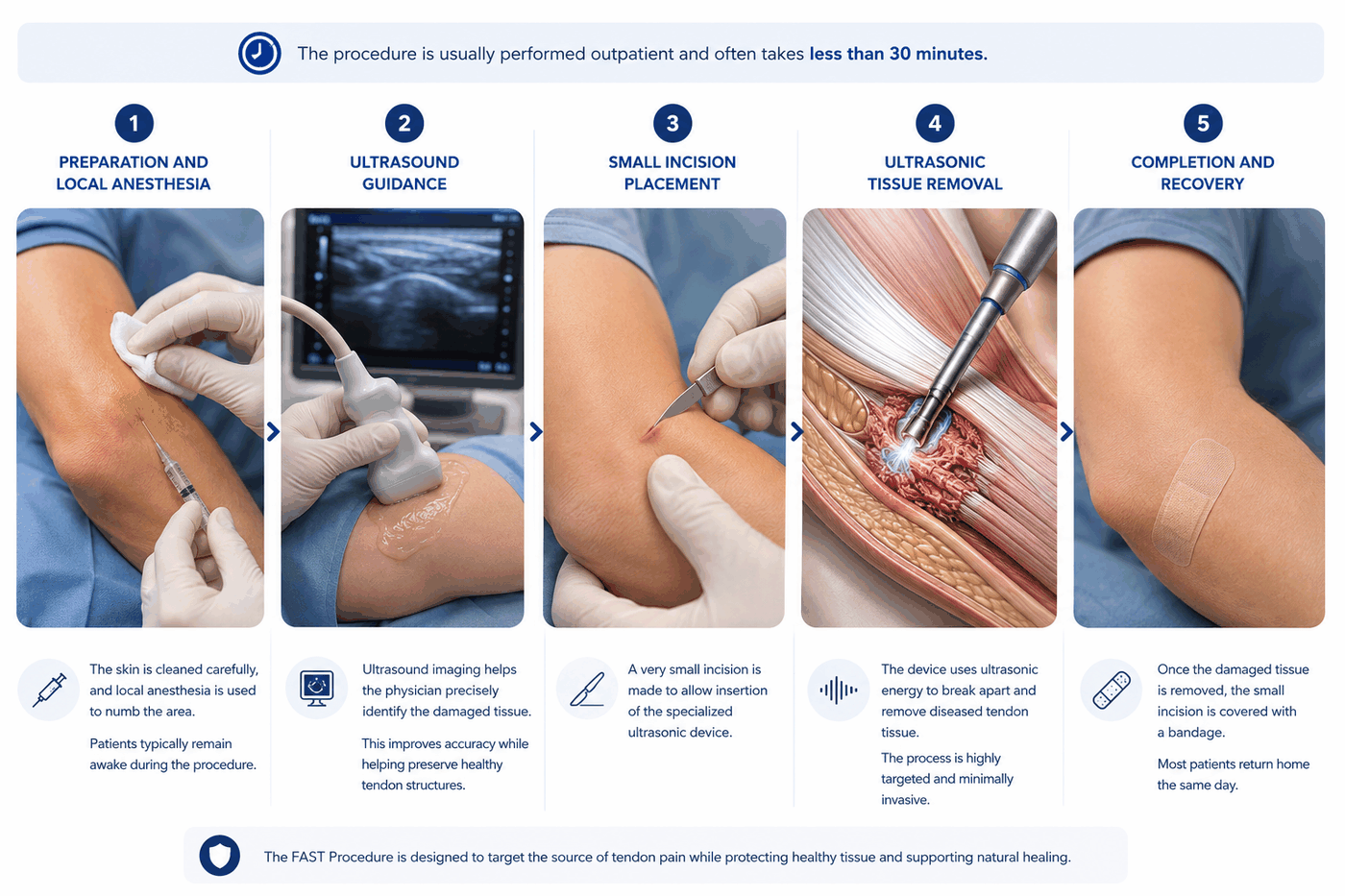
The FAST Procedure Step by Step
Technique varies with the target. The following describes the general process for ultrasound-guided percutaneous ultrasonic debridement.
Step 1: Target Confirmation
The painful structure and abnormal tissue are identified with examination and ultrasound, and the treatment plan is confirmed.
Step 2: Local Anesthesia
The skin and access path are cleaned and numbed. The patient is positioned to display the tendon and protect nearby structures.
Step 3: Tiny Incision
A small opening allows the ultrasonic instrument to reach the selected tissue under continuous ultrasound visualization.
Step 4: Ultrasonic Debridement
The tip fragments and aspirates targeted degenerative tissue while the clinician preserves healthy tendon and surrounding anatomy.
Step 5: Dressing and Recovery Plan
The instrument is removed, a small dressing is applied, and the patient receives instructions for protection, weight bearing, exercise, and follow-up.
Recovery After the FAST Procedure
Removing abnormal tissue is only the start. The tendon must be protected initially and then exposed to progressively greater load so it can regain capacity.
Early Protection
A brace, boot, crutches, or activity restriction may be used depending on the target. Follow incision, bathing, and medication instructions.
Gradual Motion
Gentle range of motion often begins before strengthening, but timing and limits depend on the tendon and extent of treatment.
Progressive Loading
Therapy advances from controlled isometrics and basic strengthening toward endurance, speed, and sport- or work-specific tasks.
Return to Activity
Return is based on tissue healing, pain response, strength, and task demands—not a calendar alone. Improvement may continue for several months.
Potential Benefits and Realistic Expectations
FAST offers a small-incision option for selected chronic soft-tissue disease, but outcome depends on diagnosis, tissue quality, rehabilitation, and health factors.
- Uses real-time ultrasound to define the treatment target
- Removes selected abnormal tissue through a tiny incision
- Preserves surrounding anatomy when performed appropriately
- May reduce chronic tendon pain for selected patients
- Can shorten recovery compared with a more extensive open procedure
- Creates a structured pathway back to progressive rehabilitation
Results and How Long Relief May Last
The aim of FAST is lasting improvement in tendon pain and function, not temporary numbing. Because the procedure removes abnormal tissue and is followed by rebuilding, results tend to unfold over months rather than days.
- Early soreness at the treatment site is expected for several days.
- Many patients progress through protected movement and then progressive loading over the following weeks.
- Improvement may continue for several months as the tendon remodels and regains capacity.
- The durability of benefit depends on rehabilitation, load management, and health factors such as diabetes and nicotine use.
Results vary, and some patients need additional rehabilitation or another treatment approach. Your care team tracks pain with loading, strength, and return to your target activities to judge progress.
FAST Procedure Risks and When to Call
Risks include bleeding, infection, nerve or vessel injury, incomplete tissue removal, tendon weakening or rupture, persistent pain, scar sensitivity, and need for another procedure.
- Report blood thinners, infection, diabetes, poor circulation, allergies, and smoking or nicotine use
- Follow weight-bearing, bracing, lifting, and exercise restrictions
- Call for fever, drainage, spreading redness, or increasing wound pain
- Seek urgent care for a sudden pop, major loss of strength, deformity, or inability to use the limb
- Do not accelerate loading because the incision is small; deeper tissue still needs time to heal
- Persistent symptoms may reflect another pain source or require a different treatment pathway
Call 911 for uncontrolled bleeding, severe allergic reaction, loss of circulation, or another life-threatening emergency.
FAST Within a Tendon-Recovery Plan
Long-term success depends on restoring the tendon’s ability to tolerate work, sport, and daily load.
Rehabilitation
Progressive resistance, mobility, kinetic-chain strength, and task-specific training help convert tissue recovery into durable function.
Load Management
Training volume, work technique, recovery time, footwear, equipment, and sudden workload changes are adjusted to reduce repeated overload.
Health Factors
Diabetes control, nutrition, sleep, nicotine avoidance, and medication review can influence tendon healing and recovery.
Alternative Care
Continued rehabilitation, injection in selected conditions, shockwave therapy, or surgical referral may be discussed when FAST is not appropriate.
Explore a Focused Option for Chronic Tendon Pain
California Pain Consultants can confirm the tissue source, review your rehabilitation history, and explain whether the FAST procedure or another treatment best supports your return to activity.
Treatment at California Pain Consultants
At California Pain Consultants, your evaluation begins with a focused examination and diagnostic ultrasound to confirm that a specific tendon or fascia target matches your pain. Your care team reviews the rehabilitation you have already completed and checks for conditions that call for different care, such as a full tendon rupture or nerve entrapment. Depending on findings, your plan may include continued guided loading, PRP injection therapy for selected tendon problems, or the FAST procedure. Practical self-care resources, such as our guides to elbow pain and plantar fasciitis stretches, support the plan between visits.
We see patients at four clinics across San Diego County:
San Diego, CA 92123Get Directions
San Diego, CA 92128Get Directions
La Mesa, CA 91942Get Directions
Chula Vista, CA 91911Get Directions
Procedures are performed at the Comprehensive Pain ASC in Rancho Bernardo and the EPC Surgery Center in La Mesa. We accept most insurances. Call (858) 571-3630 or request your appointment to learn whether FAST fits your chronic tendon pain.
Book Your AppointmentTrusted Information and Related Care
Medical references: FDA: Tenex Health TX System · AAOS: Cortisone shot and tendon considerations.
Related California Pain resources: Shoulder pain · Foot pain · Knee pain.
This article is for general education and does not replace an individualized medical evaluation. Recommendations depend on the diagnosis, health history, current medications, imaging, examination, and personal goals.
Frequently Asked Questions About FAST Procedure
Find clear, medically responsible answers about FAST Procedure, who may be a candidate, what to expect, and when to contact your healthcare team.
What is the FAST procedure, and how does it work?
The FAST procedure is a minimally invasive, ultrasound-guided treatment that removes small areas of damaged or degenerative tendon tissue through a tiny incision. The goal is to reduce a chronic pain generator while preserving healthy tendon.
What conditions can the FAST procedure treat?
The FAST procedure may treat selected chronic tendon and fascia problems, including tennis elbow, golfer’s elbow, Achilles and patellar tendinopathy, plantar fasciitis, and certain other superficial tendon disorders. Candidacy requires focal pain that matches ultrasound findings and symptoms that have not improved enough with a structured rehabilitation program. It is not a first-line treatment.
Who may be a candidate for the FAST procedure?
A candidate has localized tendon pain supported by examination and imaging, persistent symptoms despite rehabilitation or activity modification, and anatomy that can be treated safely. Complete tendon rupture, infection, or another dominant diagnosis may require a different approach.
How should I prepare for the FAST procedure?
Review blood thinners, allergies, infection, and medication instructions with the team. Wear practical clothing, arrange transportation if sedation is planned, and ask when to pause anti-inflammatory medication if the clinician believes it could affect healing.
What happens during the FAST procedure?
Ultrasound identifies the abnormal tissue and guides a small instrument through a tiny skin opening. The device breaks up and removes targeted diseased tissue while the clinician monitors nearby healthy structures.
How long does the FAST procedure take?
The procedure itself is usually brief and is performed with local anesthesia through a tiny incision. Most of your visit time goes to target confirmation with ultrasound, preparation, and recovery instructions. You typically go home the same day with a small dressing and, depending on the treated area, a brace, boot, or activity restrictions.
Is the FAST procedure painful?
Local anesthesia numbs the skin and treatment path, so most patients feel pressure rather than sharp pain during the procedure. Soreness is common for several days afterward and is usually managed with the comfort plan your care team provides. Tell your team about any increasing pain, redness, drainage, or fever after treatment.
What is recovery like after the FAST procedure?
Temporary soreness, swelling, and protection of the treated tendon are expected. A brace or crutches may be recommended, followed by a staged rehabilitation program rather than an immediate return to full loading.
How soon can I return to sports or work after FAST?
Return depends on the tendon treated, your job or sport, and how your tissue responds to loading. Light daily activity often resumes early, while strenuous activity is reintroduced gradually over weeks to months. Your care team bases each step on strength, pain response, and task demands rather than on the calendar alone.
What are the possible risks or side effects of the FAST procedure?
Possible risks include bleeding, infection, nerve or vessel injury, persistent pain, tendon weakening or rupture, and incomplete removal of abnormal tissue. No tendon procedure can guarantee full recovery.
How soon might I notice a change, and how long might it last?
The tissue-healing response is gradual, so improvement is usually assessed over weeks to months rather than days. Results depend on the tendon, severity, rehabilitation, health factors, and adherence to loading restrictions.
How is FAST different from tendon surgery?
FAST uses real-time ultrasound and a small ultrasonic instrument to remove selected damaged tissue through a tiny incision, while open surgery uses a larger incision to reach and repair the tendon. The smaller approach may shorten recovery for selected patients. Open surgery may still be appropriate for large tears or complex structural problems.
Should I try other treatments before the FAST procedure?
Yes, for most people. Many tendon problems improve with load management and progressive strengthening, and AAOS reports that most tennis elbow and plantar fasciitis cases respond to nonsurgical treatment. FAST is generally considered after a well-designed conservative program over several months has not produced enough improvement and imaging confirms a focal target. Postprocedure progressive loading, biomechanical correction, and management of contributing health or activity factors remain central to recovery.
When should I call my healthcare team or seek urgent care after the FAST procedure?
Call promptly for fever, drainage, increasing redness, severe swelling, new numbness, or pain that is escalating rather than settling. Seek urgent care for sudden loss of function, a new tendon rupture sensation, chest pain, or trouble breathing.