
When Surgery Leaves You Stiff: How Stretching Can Help You Heal
Dealing with this in San Diego? Same-day appointments are often available at our 4 clinics.
Stretching exercises for chronic post-surgery pain are one of the most effective, non-pharmacological tools available to help you regain mobility, reduce stiffness, and get back to daily life after surgery.
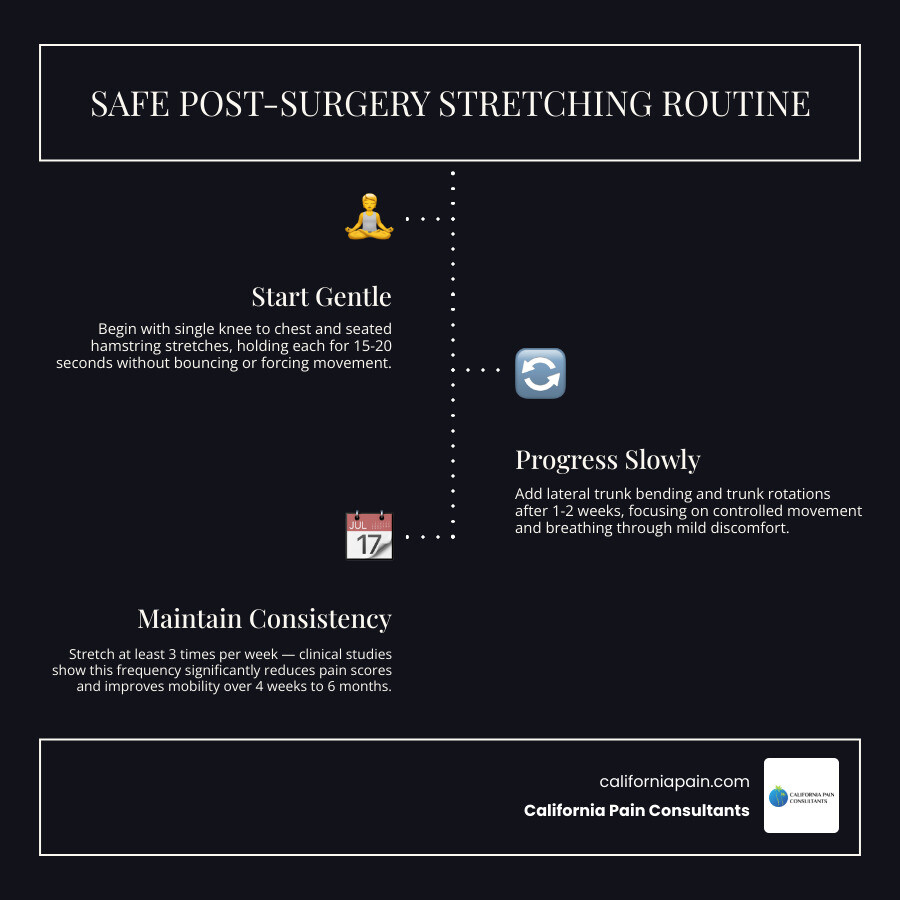
Here are the most effective post-surgery stretches to start with:
- Single knee to chest – Lie on your back, pull one knee gently toward your chest, hold 20 seconds
- Seated hamstring stretch – Extend one leg forward while seated upright, hold 15 seconds
- Lateral trunk bending – Stand upright, slowly bend to one side, hold 10-15 seconds
- Trunk rotation – Stand upright, rotate slowly toward the unaffected side, hold 10-15 seconds
- Hip flexor stretch – Step one foot forward into a lunge position, gently lower hips, hold 15-20 seconds
Key rule: Aim for at least 3 sessions per week. Research shows this frequency produces significantly better pain relief than stretching less often.
Surgery fixes the problem — but it often leaves something behind: pain, tightness, and stiffness that linger long after the incision heals.
In fact, chronic post-surgical pain affects a significant portion of patients following major procedures like joint replacement, spine surgery, and thoracic surgery. And for many people, the frustration isn’t just the pain itself — it’s feeling like nothing is moving them forward.
The good news? Movement is the medicine. A structured stretching routine, started at the right time and progressed carefully, can reduce stiffness, break down scar tissue, and — according to clinical research — even help patients reduce their reliance on opioid pain medications.
Five out of six clinical studies found a significant reduction in pain scores following stretching programs lasting just 4 weeks to 6 months. That’s a meaningful result for anyone stuck in a cycle of discomfort and limited mobility.
I’m Dr. Zach Cohen, double Board Certified in Anesthesiology and Chronic Pain, with advanced fellowship training in Chronic Pain Medicine at UC San Diego — and helping patients navigate stretching exercises for chronic post-surgery pain is a core part of my practice at California Pain Consultants. In this guide, I’ll walk you through exactly how to stretch safely, what the science says, and how to build a routine that actually works for your recovery.
Stretching Exercises For Chronic Post-Surgery Pain terms at a glance:
- Stretching Exercises For Chronic Nerve Pain
- Stretching Exercises For Chronic Osteoarthritis Pain
- dynamic stretching exercises
Understanding Chronic Post-Surgical Pain and Movement-Evoked Pain
When we talk about recovery, we often think of pain as a single, static sensation. However, chronic post-surgical pain (CPSP) is complex and multifaceted. It is generally defined as pain that persists for more than three to six months after a surgical procedure and cannot be explained by other causes. Within this umbrella, we must distinguish between pain at rest and movement-evoked pain (MEP)—the sharp or aching discomfort triggered specifically by physical activity, walking, or stretching.
MEP is a major hurdle in postoperative rehabilitation. Because it hurts to move, many patients instinctively choose to stay still. This protective mechanism, while natural, is highly counterproductive. Prolonged immobility triggers a cascade of physical complications: muscles begin to atrophy, joints stiffen, and the body’s overall physical conditioning rapidly declines.
Furthermore, patients undergoing extensive operations frequently experience “non-surgical site pain” (NSSP). This is severe aching and stiffness in areas of the body completely distant from the surgical incision. For example, clinical data shows that up to 62% of patients undergoing long reconstructive surgeries (lasting 7 to 12 hours) suffer from intense NSSP, particularly in the lower back, shoulders, and elbows, simply from lying completely still on a hard operating table.
To break this cycle of stiffness, we must look to structured physical activity. According to A systematic review of physical activity-based interventions to prevent or reduce chronic post-surgical pain, physical exercise can serve as an effective non-pharmacological shield against long-term disability. By analyzing data from 13 clinical studies representing 1,155 patients, researchers found that targeted, post-operative movement programs can produce pain reductions that meet or exceed minimal clinically important differences (MCIDs).
By utilizing active movement, we can prevent the transition from acute post-operative soreness to a permanent chronic condition. To learn more about how we manage these complex recovery pathways, explore our Post-Surgical Pain Treatment Complete Guide.
The Science Behind Stretching Exercises For Chronic Post-Surgery Pain
How exactly does stretching change the physical landscape of a healing body? When a surgeon cuts through skin, fascia, and muscle, the body repairs itself by laying down collagen fibers in a disorganized, chaotic pattern. This is scar tissue. Left unaddressed, scar tissue contracts, binds to surrounding nerves, and severely limits your range of motion.
Applying stretching exercises for chronic post-surgery pain works via two primary physiological mechanisms:
- Passive Tissue Compliance: Chronic static stretching reduces the physical stiffness of both muscles and deep fascial networks. This allows the tissues to act as passive shock absorbers, protecting sensitive joints and surgical sites from external physical forces.
- Neurological Desensitization: Stretching directly reduces muscle spindle activity—the sensory receptors inside muscles that control muscle tone and trigger painful spasms. Additionally, targeted stretching has been shown to reduce sciatic nerve stiffness, easing direct physical pressure on spinal nerves.
The scientific evidence supporting these mechanisms is highly encouraging. A comprehensive review published in The effects of chronic stretch training on musculoskeletal pain | European Journal of Applied Physiology | Springer Nature Link evaluated clinical trials on static and dynamic stretching. The findings revealed that 83% of the analyzed studies reported a significant decrease in pain scores or a reduction in the severity of chronic musculoskeletal pain after a stretching program lasting between 4 weeks and 6 months.
Interestingly, the research also highlighted a “cross-education effect.” Stretching a muscle on one side of the body can actually increase pain tolerance and flexibility in the corresponding muscle on the opposite, unstretched side. This is incredibly valuable for post-surgical patients who may have a limb that is too painful or freshly operated on to stretch directly.
Furthermore, high-volume stretching (totaling roughly 60 minutes per muscle group per week) can even induce muscle hypertrophy and strength increases, providing active joint stability. For a deeper look at managing nerve-specific discomfort during this process, read The Ultimate Guide to Stretching Exercises for Chronic Nerve Pain.
The Four Pillars of Post-Operative Mobility and Recovery
Reclaiming your physical freedom after surgery is not a random process. It requires a structured, progressive approach. At California Pain Consultants, we categorize post-surgical physical rehabilitation into four distinct, progressive pillars:
- Passive Range of Motion (PROM): In this initial phase, the patient’s muscles remain completely relaxed while an external force—either a physical therapist or a specialized machine—gently moves the joint through its safe range. This prevents joint freezing and keeps fluids circulating without stressing healing tissues.
- Active Range of Motion (AROM): Once tissues have partially healed, the patient begins using their own muscle power to move the joint. This phase focuses on re-establishing the mind-muscle connection and preventing muscle atrophy.
- Stretching Exercises: Once basic movement is restored, targeted stretching is introduced to actively lengthen shortened, tight muscles, improve flexibility, and mobilize stubborn scar tissue.
- Strengthening Exercises: The final phase integrates low-impact resistance exercises to rebuild the muscular support system around the recovering joint, ensuring long-term stability and preventing future injury.
The clinical power of early passive movement is remarkable. In a landmark randomized controlled trial published in the PB-PG-0211-24033 – NIHR Research for Patient Benefit Programme – Final report – ready for publication, researchers evaluated the impact of intra-operative passive movement therapy (IPM)—which involves gently stretching and moving a patient’s limbs while they are still asleep on the operating table.
The results were striking: patients who received passive movement therapy used less than half the amount of morphine in the first 24 hours after surgery compared to those who received standard care (a median of 11.0 mg versus 24.0 mg). This highlights just how crucial early joint mobilization is for mitigating post-operative pain pathways. For more details on safe postoperative recovery strategies, see our guide on Post-Surgical Pain Relief.
To help you understand how these phases fit together, we have outlined their key characteristics below:
| Recovery Pillar | Who Performs It? | Primary Goal | Typical Timeline |
|---|---|---|---|
| PROM | Physical Therapist / Machine | Prevent joint stiffness, reduce early pain | Days 1 to 14 post-surgery |
| AROM | Patient (unassisted) | Re-activate muscles, improve circulation | Weeks 2 to 6 post-surgery |
| Stretching | Patient (assisted or independent) | Lengthen tight tissues, mobilize scar tissue | Weeks 4+ (with medical clearance) |
| Strengthening | Patient (using light resistance) | Rebuild joint stability, restore full function | Weeks 6+ post-surgery |
Implementing Stretching Exercises For Chronic Post-Surgery Pain in Your Routine
When you are ready to transition into a dedicated stretching routine, consistency and structure are your best allies. Clinical research indicates a clear “dose-response effect” when it comes to stretching. Patients who stretch three or more times per week experience significantly better pain relief and functional improvements compared to those who stretch less than three times a week. Stretching infrequently (less than three times a week) often yields outcomes no better than not stretching at all.
To prevent your progress from stalling, you must also apply the principle of progressive overload. After about 5 weeks of performing the same stretches, your body will adapt, and you may experience a plateau. To keep improving, you must gradually increase either the duration of the stretch (e.g., moving from a 15-second hold to a 30-second hold) or the depth of the stretch, always staying within a safe, tolerable range.
It is vital to listen to your body’s pain thresholds. You should stretch to the point of mild tension or restriction—never to the point of sharp, stabbing pain. To understand how professional physical therapy can help you safely navigate these progressions, read about Chronic Pain Physical Therapy Treatment. Additionally, as your mobility improves, you may want to learn how to integrate dynamic movements by reading our guide on Dynamic Stretching Exercises: The Complete Guide.
Step-by-Step Guide to Stretching Exercises For Chronic Post-Surgery Pain

Before beginning any of these exercises, please ensure you have received explicit medical clearance from your surgeon or your pain specialist at California Pain Consultants.
These five stretches are designed to target common areas of post-surgical stiffness, particularly following spinal, thoracic, abdominal, or joint surgeries.
1. Single Knee to Chest Stretch (Lower Back & Hip Mobilization)
This stretch is highly effective for relieving tension in the lumbar spine and gluteal muscles following lower back or hip procedures.
- Step 1: Lie flat on your back on a comfortable mat with both knees bent and feet flat on the floor.
- Step 2: Slowly lift one leg, placing your hands behind your thigh (just below the knee).
- Step 3: Gently pull your knee toward your chest while keeping your pelvis and lower back flat against the floor.
- Step 4: Hold this position for 20 seconds, breathing deeply.
- Step 5: Slowly lower your leg and repeat on the opposite side. Perform 5 repetitions per side.
2. Seated Hamstring Stretch (Posterior Chain Release)
Tight hamstrings place immense physical stress on the lower back. This seated variation protects your spine while gently lengthening the back of your leg.
- Step 1: Sit upright on the edge of a sturdy chair.
- Step 2: Extend one leg straight out in front of you, resting your heel on the floor with your toes pointing upward.
- Step 3: Keeping your spine completely straight (do not round your lower back), gently hinge forward from your hips.
- Step 4: Stop when you feel a mild stretch along the back of your thigh. Hold for 15 seconds.
- Step 5: Return to the starting position and repeat on the other leg. Perform 3 to 5 repetitions per side.
3. Lateral Trunk Bending (Chest & Torso Expansion)
Following thoracic or upper abdominal surgeries, patients often experience severe chest wall tightness due to pleural thickening or scarring. This stretch, supported by clinical protocols in the Effectiveness of Simple Stretch Exercises in Relieving Restrictive Chest Wall Tightness Post-surgery for Empyema Thoracis, helps restore torso flexibility.
- Step 1: Stand upright with your feet shoulder-width apart (you can hold onto a sturdy counter for balance if needed).
- Step 2: Raise the arm on the unaffected side overhead, or place your hand on your hip.
- Step 3: Slowly bend your torso to the opposite side, gently stretching the tight, affected side of your chest.
- Step 4: Hold this static stretch at the point of mild restriction for 10 to 15 seconds.
- Step 5: Slowly return to the upright position. Repeat 3 to 5 times.
4. Trunk Rotation (Spinal & Intercostal Mobility)
This exercise helps restore rotational mobility to the spine and mobilizes the muscles between your ribs.
- Step 1: Stand upright with your feet planted firmly on the ground.
- Step 2: Slowly and smoothly rotate your torso toward your healthy, unaffected side to gently stretch the surgical side.
- Step 3: Hold this position for 10 to 15 seconds.
- Step 4: Gently return to the center. Repeat 3 to 5 times, gradually increasing your comfortable range of motion over several weeks.
5. Respiratory Muscle-Stretching Gymnastics (RMSE)
Thoracotomies and major chest surgeries can cause a massive decline of up to 55% in vital lung capacity. Implementing a structured respiratory stretching sequence, as detailed in the Impact of respiratory muscle-stretching exercise on chest expansion and shoulder mobility post-thoracotomy: a randomized controlled trial | Journal of Cardiothoracic Surgery | Springer Nature Link, significantly improves chest wall expansion and shoulder range of motion.
- Step 1: Sit in a fully upright, 90-degree position on a supportive chair.
- Step 2: Interlace your fingers and place your hands behind your head, or gently place your fingertips on your shoulders.
- Step 3: As you take a deep, slow breath in, gently pull your elbows back, opening up your chest and putting the chest muscles under mild tension.
- Step 4: Hold this expanded stretch for three full, deep breaths.
- Step 5: Exhale slowly as you return your elbows to the starting position. Repeat this sequence 4 times, twice daily.
Frequently Asked Questions about Post-Surgical Stretching
How often should I perform post-surgery stretches?
To achieve lasting relief and prevent tissue contractures, consistency is essential. You should aim to perform your stretching routine at least 3 times per week.
Clinical studies show that patients who stick to this minimum frequency experience significantly better long-term outcomes, such as a lower incidence of chronic chest or joint tightness at their 12-month follow-up. For optimal recovery, orthopaedic and pain specialists often recommend exercising for 10 to 30 minutes, 1 to 3 times a day, depending on your specific phase of healing.
Can stretching help me reduce my reliance on pain medications?
Yes, absolutely. A highly structured stretching routine can be an incredibly powerful tool for weaning off long-term pain medications under medical supervision.
According to a retrospective cohort study published in the Effect of a structured stretching exercise program on resolution of myofascial pain and opioid usage in “legacy pain” patients: A retrospective cohort study., chronic pain patients who performed a dedicated home stretching program (consisting of 14 lumbar, 4 thoracic, and 7 cervical stretches) over the course of a year achieved remarkable results:
- 84.4% of patients successfully decreased their total daily opioid dose.
- 34.4% of patients were able to completely wean off their opioid medications.
- On average, daily morphine milligram equivalent (MME) intake was slashed from 76.3 mg down to just 21.0 mg (a 72% reduction).
- Crucially, patients maintained the exact same level of pain control and physical function without the side effects of high-dose opioids.
To explore more non-pharmacological recovery strategies, check out our Non-Opioid Pain Management Post-Op Guide.
Is it safe to stretch if I feel movement-evoked pain?
It is entirely normal to feel mild discomfort, tightness, or transient muscle soreness when you begin stretching. However, you must always distinguish between “good discomfort” (a deep, warming stretch) and “bad pain” (sharp, stabbing, or shooting sensations near your incision or joints).
If you feel mild tension, it is generally safe to breathe through the stretch and proceed gently. If you experience sharp pain, swelling, or a sudden increase in throbbing, stop the exercise immediately, rest, and consult your physician. Always obtain formal medical clearance before starting a new exercise regimen after surgery.
Conclusion
Recovering from surgery is a journey that requires patience, consistency, and the right medical guidance. While chronic post-surgical pain can feel incredibly isolating and frustrating, integrating safe, structured stretching exercises for chronic post-surgery pain into your weekly routine can help you break free from stiffness, protect your healing joints, and reclaim your quality of life.
At California Pain Consultants, we specialize in offering comprehensive, non-surgical pain management tailored to your unique recovery goals. Our board-certified doctors provide compassionate, multifaceted treatments across our convenient Southern California locations, including:
- San Diego
- Kearny Mesa
- Chula Vista
- Rancho Bernardo
- La Mesa
- Miramar
If you are ready to take control of your recovery and restore your mobility under the care of leading pain specialists, we invite you to Explore our comprehensive stretching exercises programs or contact us today to schedule your personalized consultation. Let us help you get back to doing what you love, safely and comfortably.