
Fast, Smart Steps for Hip Pain Relief
Dealing with this in San Diego? Same-day appointments are often available at our 4 clinics.
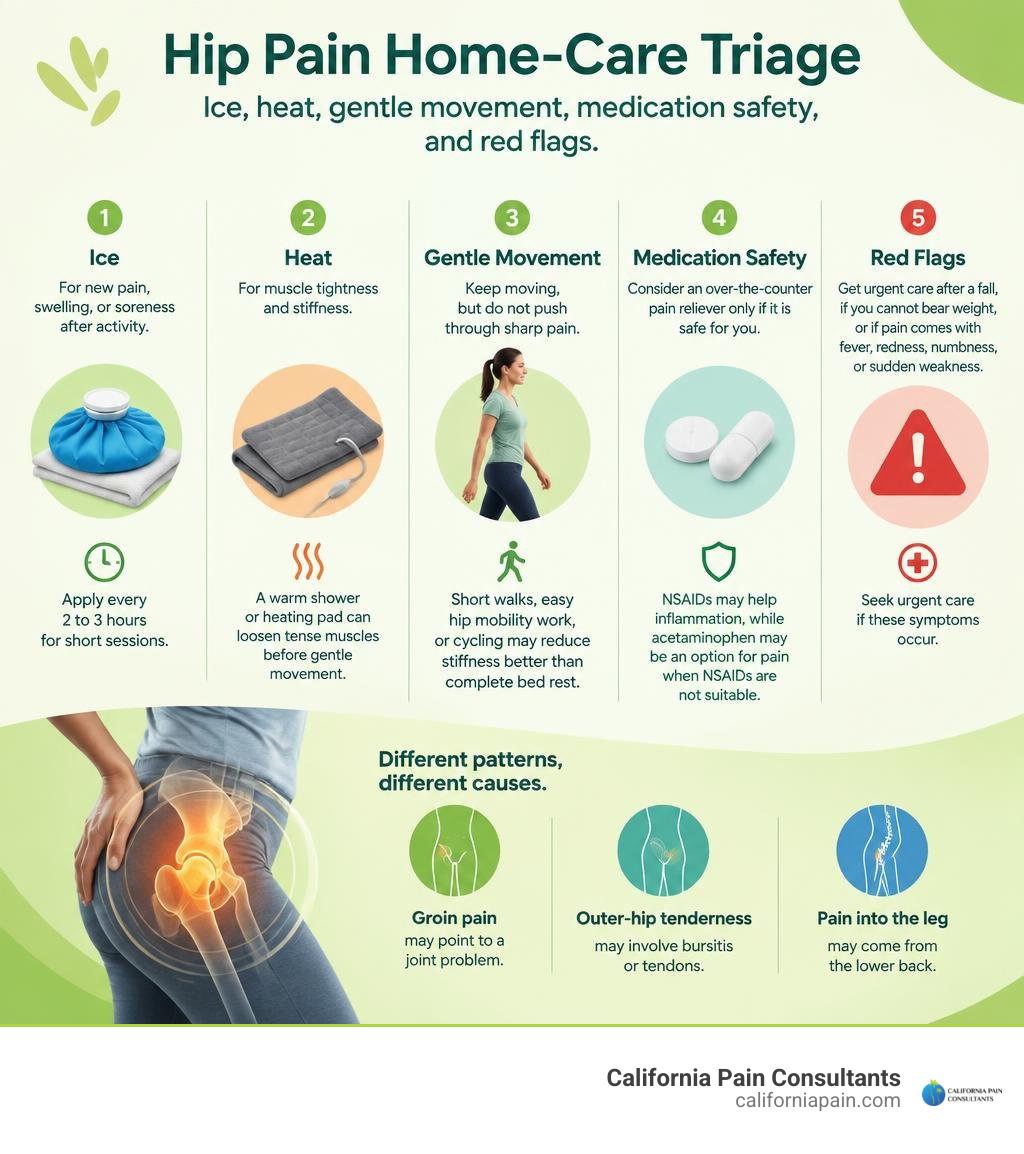
The best way to relieve hip pain is to match your first steps to the type of pain you have. For a new flare-up or injury, stop the activity that triggered it, use an ice pack wrapped in a towel for 15 to 20 minutes, and avoid putting extra weight on the painful side. For tightness or long-term stiffness without swelling, gentle movement, easy stretching, and heat may help more.
Start here:
- Use ice for new pain, swelling, or soreness after activity. Apply it every 2 to 3 hours for short sessions.
- Use heat for muscle tightness and stiffness. A warm shower or heating pad can loosen tense muscles before gentle movement.
- Keep moving, but do not push through sharp pain. Short walks on level ground, easy hip mobility work, or cycling may reduce stiffness better than complete bed rest.
- Consider an over-the-counter pain reliever only if it is safe for you. NSAIDs such as ibuprofen may help inflammation, while acetaminophen may be an option for pain when NSAIDs are not suitable.
- Get urgent care after a fall, if you cannot bear weight, or if pain comes with fever, redness, numbness, or sudden weakness.
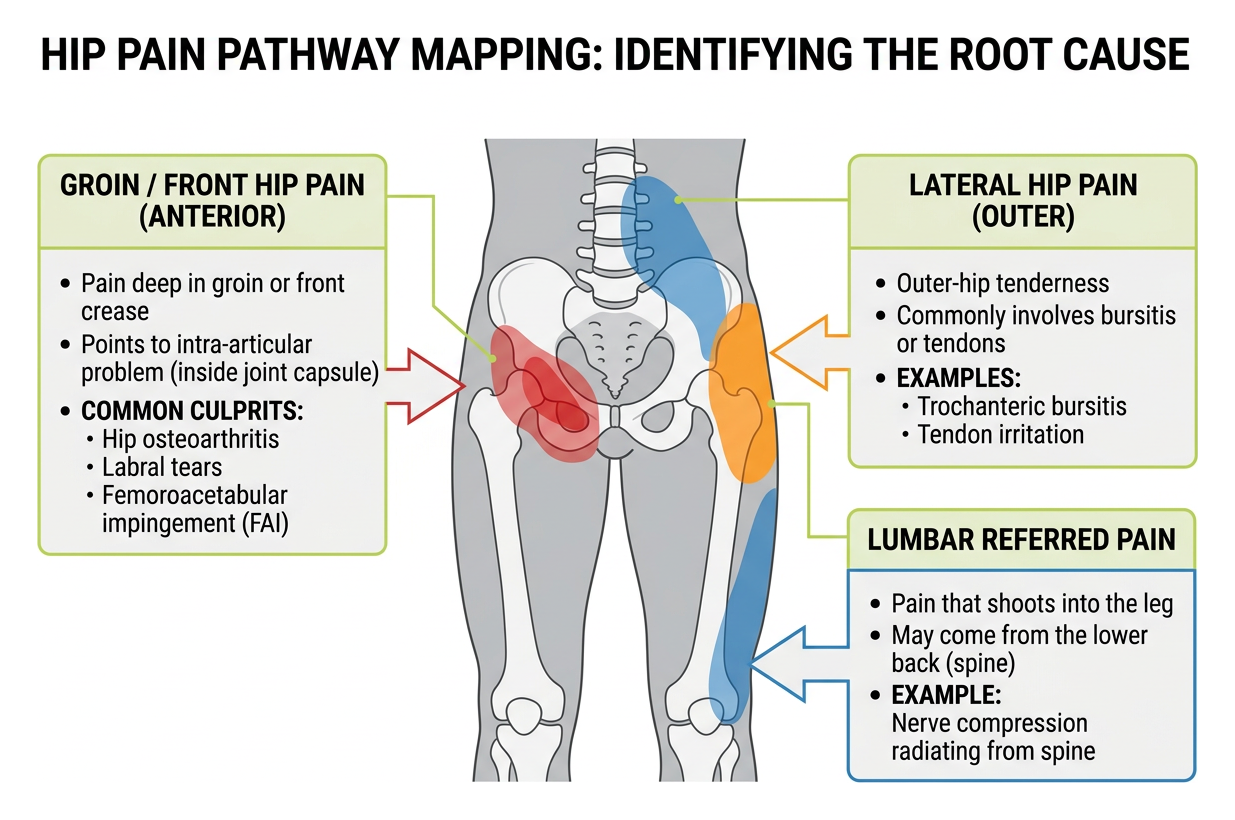
Hip pain is not always coming from the hip joint itself. Pain in the groin can point to a joint problem, outer-hip tenderness may involve bursitis or tendons, and pain that shoots into the leg may come from the lower back. The right plan starts with recognizing these patterns instead of relying on one-size-fits-all stretches or medication.
I am Dr. Zach Cohen, a double board-certified physician in anesthesiology and chronic pain medicine who helps patients find the best way to relieve hip pain through clear diagnosis, targeted rehabilitation, and non-surgical care when appropriate. Next, let us look at the clues that can help you tell what may be causing your hip pain.
Similar topics to best way to relieve hip pain:
Identifying the Root Cause: Muscle Strain, Bursitis, or Arthritis?
When dealing with hip discomfort, knowing the root cause dictates whether you should reach for an ice pack, stretch your glutes, or seek an evaluation. According to established medical insights on Hip Pain: Causes and Treatment, the ball-and-socket structure of the hip is among the largest weight-bearing joints in the body, surrounded by complex networks of bursae, tendons, and ligaments.
Pain originating inside the actual joint space often behaves differently from soft-tissue irritation or nerve compression radiating from the spine.
Anatomical Clues: Groin, Outer Hip, or Radiating Pain
Pay close attention to where your pain lives:
- Groin or Front Hip (Anterior): Pain felt deep in the groin or front crease of the hip typically points to an intra-articular problem—meaning inside the actual joint capsule. Common culprits include hip osteoarthritis, labral tears, and femoroacetabular impingement (FAI).
- Outer Hip (Lateral): Sharp or aching pain directly on the outside of your hip bone is rarely deep arthritis. Instead, it usually stems from greater trochanteric pain syndrome, which involves trochanteric bursitis or gluteal tendinopathy. This pain frequently worsens when lying on that side at night.
- Buttock and Lower Back (Posterior / Radiating): Discomfort centered in the buttocks that radiates down the back of your thigh is often referred pain from the lumbar spine (such as sciatica or disc herniation) or sacroiliac (SI) joint dysfunction rather than the hip itself.
Distinguishing the Best Way to Relieve Hip Pain by Diagnosis
Differentiating between a muscular strain, bursitis, and joint arthritis helps avoid movements that could aggravate the condition. As outlined by official clinical guidance on Hip pain in adults – NHS, joint stiffness that lasts more than 30 minutes upon waking is a classic hallmark of degenerative arthritis.
| Diagnostic Category | Primary Location | Pain Quality & Triggers | Morning Stiffness Duration | Direct Palpation Tenderness |
|---|---|---|---|---|
| Muscle Strain / Tendonitis | Pelvic attachments, groin, or glutes | Dull, aching, or sharp during active contraction; eases with warming up | Less than 10–15 minutes | Moderate tenderness over the muscle belly |
| Trochanteric Bursitis | Lateral outer hip over greater trochanter | Sharp, burning; severe when lying on side or pressing hip | Minimal (under 15 minutes) | Severe / Point-tender directly over the bony prominence |
| Hip Osteoarthritis (OA) | Deep groin, inner thigh, sometimes knee | Deep, achy, grinding; worse with prolonged weight-bearing | Prolonged (≥ 30 minutes) | Minimal surface tenderness; deep motion restriction |
Globally, hip osteoarthritis affects roughly 7.2% of the population, with nearly 2 million new cases diagnosed each year. In the United States, approximately 19.6% of adults aged 55 and older experience hip osteoarthritis, with women accounting for nearly 78% of diagnosed cases.
Immediate Home Care: What Is the Best Way to Relieve Hip Pain Quickly?
When a sudden flare-up strikes, practical home strategies can ease your symptoms and protect the joint from further stress.
Modified RICE Protocol and Joint Decompression
For acute injuries or sudden flares, apply a modified RICE strategy (Rest, Ice, Compression, Elevation):
- Relative Rest: Avoid aggravating activities, but do not stay completely bedridden.
- Ice: Apply a cold pack for 15 to 20 minutes every 2 to 3 hours to constrict blood vessels and numb local pain signals.
- Compression: Gentle compression shorts or wraps provide stability and help manage localized swelling.
- Elevation / Joint Decompression: Lie flat on your back on a supportive surface and practice the Constructive Rest Pose—bend your knees at a 90-degree angle with feet flat on the floor or rest your calves on an ottoman. This position takes tension off the psoas and hip flexor muscles.
Thermal Therapy: When to Apply Ice vs Heat
- When to Use Cold (First 24–48 Hours): Use cold packs for acute flare-ups, sudden sprains, or after strenuous activity that provokes sharp pain. Cold induces vasoconstriction, reducing inflammation and numbing sharp nerve endings.
- When to Use Heat (After 48 Hours or for Chronic Aches): Use moist heat packs, warm baths, or heating pads for chronic stiffness, tight muscles, or before gentle stretching. Heat causes vasodilation, boosting local blood flow, flushing cellular waste, and relaxing contracted muscle fibers.
Safe Over-the-Counter Medications and Topical Relief
- Oral NSAIDs: Medications like ibuprofen or naproxen help lower inflammatory prostaglandins. They are often effective for joint and soft-tissue inflammation when medically safe for you.
- Acetaminophen: Provides analgesic pain relief without anti-inflammatory action, making it an alternative for individuals with sensitive stomachs, kidney issues, or cardiovascular contraindications to NSAIDs.
- Topical Relief: Over-the-counter topical NSAID gels (such as diclofenac) or counter-irritant creams (menthol, capsaicin) deliver targeted local relief with minimal systemic absorption.
- Safety Rule: Do not use self-administered OTC pain medications continuously for more than 10 consecutive days without consulting a medical provider.
Active Recovery: Targeted Exercises and Stretches for Sore Hips
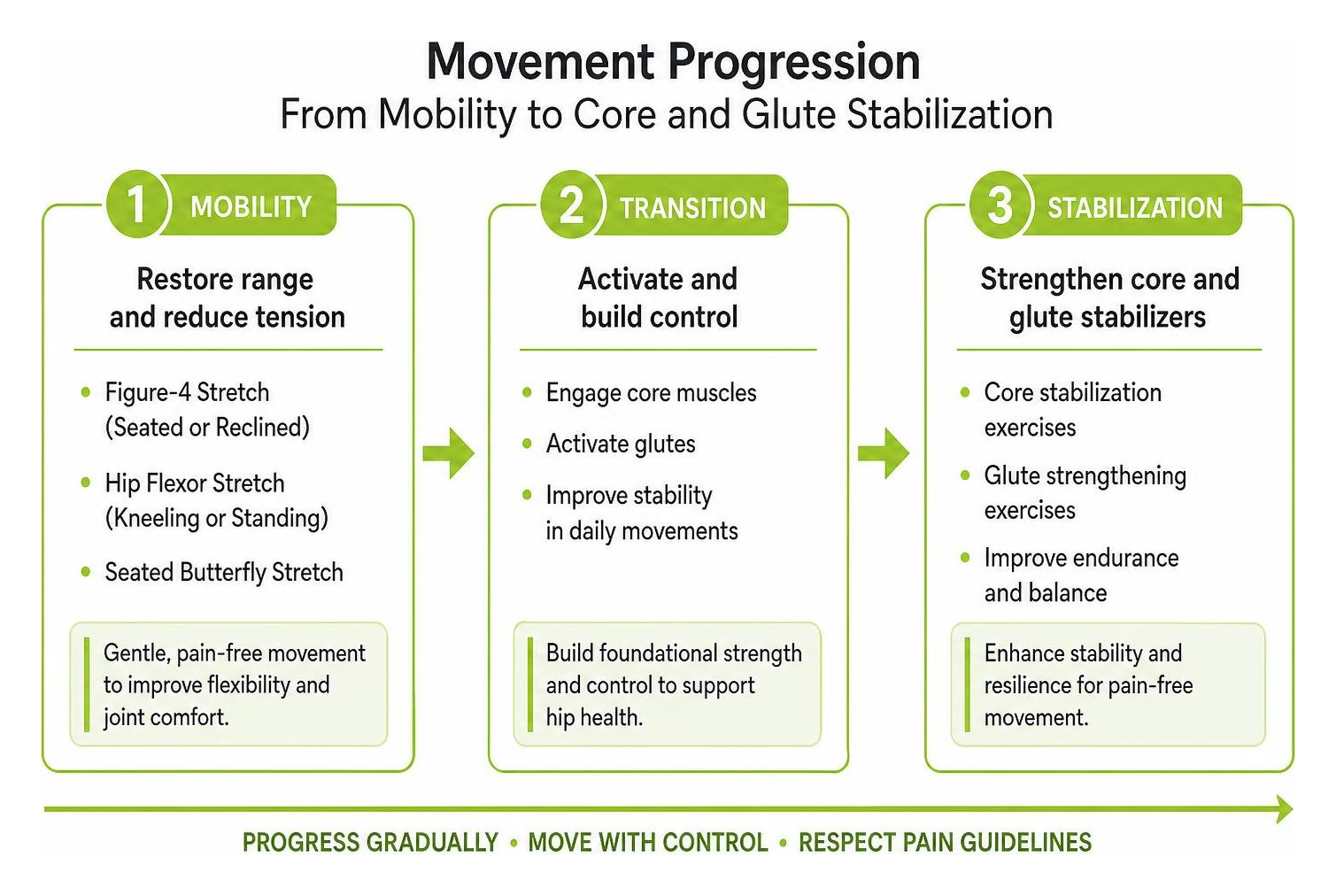
Clinical research confirms that gentle movement lubricates joints by circulating synovial fluid, preventing muscle atrophy and easing stiffness. A strategic framework outlined in How To Treat Hip Pain: A Step-by-Step Guide emphasizes balancing progressive mobility with active stabilization.
Use a simple 0–10 Pain Rating Scale: keep exercise discomfort between 0 and 3 (minimal), accept 4 to 5 temporarily only if it quickly settles, and stop immediately if pain exceeds 5.
Gentle Mobility Work and Restorative Poses
- Figure-4 Stretch (Seated or Reclined): Cross your affected ankle over the opposite knee. Gently press the knee open or pull the uninjured thigh toward your chest until you feel a comfortable stretch in the outer glute. Hold for 30 seconds. Repeat 2 to 3 times per side.
- Kneeling or Standing Hip Flexor Stretch: Step one foot forward into a gentle lunge, keeping your pelvis tucked under and torso upright until you feel a gentle opening in the front of your rear hip. Hold for 30 seconds.
- Seated Butterfly Stretch: Sit upright, place the soles of your feet together, and let your knees relax outward. Hold your ankles and gently hinge forward from the hips without rounding your spine. Hold for 30 seconds.
Progressive Strengthening: Glutes, Core, and Abductors
- Glute Bridges: Lie on your back with knees bent and feet hip-width apart. Squeeze your glutes and lift your hips until your thighs and torso form a straight line. Hold for 2 seconds at the top, then lower slowly. Perform 2 to 3 sets of 10 to 12 repetitions.
- Side-Lying Clamshells: Lie on your uninjured side with hips and knees bent at 45 degrees. Keeping your heels glued together, raise your top knee without rotating your pelvis backward. Perform 2 to 3 sets of 12 to 15 reps to strengthen the gluteus medius.
- Pelvic Tilts: Lie flat with knees bent. Flatten the small of your back against the floor by gently contracting your abdominals and tilting your pelvis upward. Hold for 5 seconds, release, and repeat 10 times.
Relative Rest: Is It Better to Rest or Keep Moving?
Prolonged sitting shortens the hip flexors, increases pressure on the lumbar spine, and causes surrounding stabilizer muscles to weaken.
If walking causes a flare-up, adjust your stride: take shorter steps, slow your walking speed, and choose flat, even surfaces. If walking remains uncomfortable, switch to low-impact aerobic cross-training such as stationary cycling or aquatic therapy, where water buoyancy can reduce joint stress by up to 90%.
Long-Term Lifestyle Adjustments to Protect Your Hip Joints
Protecting your hips over time involves managing the physical forces placed on them during daily activities.
Weight Management and Biomechanical Joint Load
Normal walking generates biomechanical forces equivalent to 3 to 5 times your total body weight across the hip joint. Because of the lever mechanics of the pelvis:
$$text{Joint Force Multiplier} approx 5times$$
Every 10 pounds of excess body weight places approximately 50 pounds of weight-bearing pressure across your hips with every single step. Losing just 10 to 11 pounds can cut hundreds of pounds of cumulative joint load throughout a day, preserving articular cartilage and slowing the progression of wear-and-tear changes.
Ergonomic Adjustments, Footwear, and Sleep Positioning
- Ergonomic Seating: Avoid low, soft couches that force your knees higher than your hips. Choose firm chairs that keep your hips positioned at or slightly above a 90-degree angle.
- Supportive Footwear: Wear supportive, shock-absorbing shoes with adequate arch support to cushion impact before forces reach your pelvis.
- Side-Sleeping Modifications: If you sleep on your side, place a firm, contoured pillow between your knees and ankles. This keeps your knees hip-width apart, preventing the top leg from pulling the hip into internal rotation and stressing the trochanteric bursa.
Advanced Non-Surgical Medical Treatments and Red Flags
When structured home care, targeted exercises, and lifestyle modifications do not provide sufficient relief, modern interventional pain medicine offers proven options to restore mobility without resorting to major surgery.
Reviewing our comprehensive guide to non-surgical hip pain relief can help you explore personalized diagnostic pathways and advanced conservative therapies.
Physical Therapy, Guided Injections, and Interventional Care
- Supervised Physical Therapy: A structured physical therapy program targets muscle imbalances, corrects gait mechanics, and unloads irritated hip structures.
- Image-Guided Corticosteroid Injections: Administered under precise ultrasound or fluoroscopic guidance, these targeted injections deliver potent anti-inflammatory medication directly into the hip capsule, bursa, or tendon sheath. This relieves pain and creates a window for productive rehabilitation.
- Regenerative Medicine (PRP Therapy): Platelet-rich plasma injections concentrate healing growth factors from your own blood to support tissue recovery in chronic tendinopathy and early joint degeneration.
When to Consult a Specialist for the Best Way to Relieve Hip Pain
Seek prompt medical care if you experience any of the following signs:
- Complete inability to bear weight on the affected leg
- Sudden, severe pain following a fall or traumatic impact
- Visible deformity or inability to rotate the leg
- Hip pain accompanied by fever, chills, redness, or localized heat
- New numbness, tingling, or progressive weakness traveling down your leg
- Persistent pain that wakes you from sleep or fails to improve after two weeks of home care
Frequently Asked Questions About Hip Pain Relief
What is the fastest way to relieve severe hip pain at home?
The fastest initial approach is to offload the joint immediately: lie down in the Constructive Rest Pose, apply a towel-wrapped cold pack for 15 to 20 minutes, and consider an over-the-counter pain reliever if medically appropriate for you.
Should I keep walking if my hip joint hurts?
Yes, as long as the pain is mild to moderate (under 5 on a 10-point scale) and does not cause a limp. Shorten your stride, slow your pace, and choose level ground. If walking triggers a sharp pinch or lasting flare-up, switch temporarily to stationary cycling or swimming.
How can I tell if my hip pain is coming from my back?
If the pain originates in your lower back or buttock and travels down the back or side of your thigh past your knee, or if it is accompanied by numbness, pins and needles, or shooting electrical sensations, the source is likely a compressed lumbar nerve root (such as sciatica) rather than the hip joint itself.
Conclusion
Finding lasting hip pain relief begins with identifying the root cause of your discomfort, applying targeted home-care strategies, and maintaining joint mobility through safe, low-impact exercise.
At California Pain Consultants, our double board-certified physicians specialize in comprehensive, non-surgical pain management tailored to your needs. If persistent hip pain is limiting your daily routine, our teams in San Diego, Kearny Mesa, Chula Vista, Rancho Bernardo, La Mesa, and Miramar are here to help you regain comfort, strength, and mobility.