
Joint injections are minimally invasive procedures that deliver medication, such as a corticosteroid or a lubricating gel, directly into or around a painful joint. They may help adults with arthritis, inflammation, or degeneration in the knee, shoulder, hip, sacroiliac joint, or hand when pain limits movement and daily activity. Board-certified pain specialists at California Pain Consultants in San Diego evaluate joint pain and perform image-guided joint injections as part of a broader plan.
Most people do not realize how much they rely on healthy joints until pain begins interfering with everyday life.
Standing up from a chair. Walking up stairs. Reaching overhead. Getting dressed. Holding a coffee cup.
The purpose of Joint Injections is not to promise a cure. It is to address a carefully identified pain source, support function, and help the patient participate more comfortably in an individualized care plan.
What Are Joint Injections?
Understanding the diagnosis and treatment target helps set realistic expectations before Joint Injections is recommended.
Joints are the areas where bones meet and move together.
But over time, injury, arthritis, inflammation, or degeneration may disrupt the joint environment and lead to pain.
Joint injections are minimally invasive procedures used to deliver medication directly into or around a painful joint.
The purpose is to reduce inflammation, improve movement, and decrease pain within the affected joint.
Types of Joint Injections
- Corticosteroid injections, which reduce inflammation and are often combined with a fast-acting local anesthetic
- Hyaluronic acid or gel injections, used for selected knee osteoarthritis
- Platelet-rich plasma (PRP), a regenerative approach considered for selected conditions
- Diagnostic injections, which numb a joint to confirm whether it is the source of pain
When Joint Injections May Be Considered
A procedure or medication plan is chosen only after the likely pain source, prior care, health history, and personal goals have been reviewed.
Knee Joint Injections
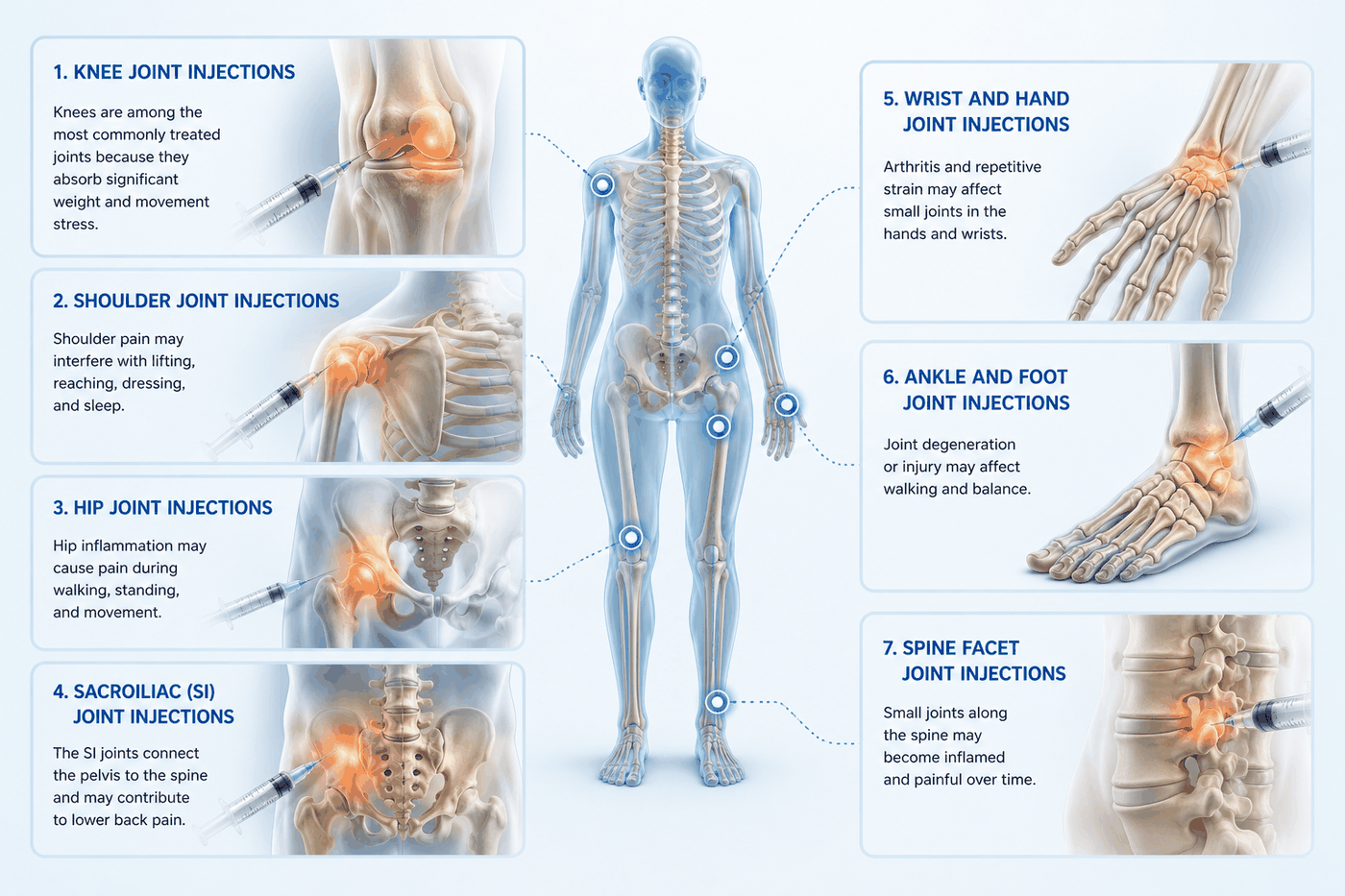
Knees are among the most commonly treated joints because they absorb significant weight and movement stress. Learn more about knee joint injections.
Shoulder Joint Injections
Shoulder pain may interfere with lifting, reaching, dressing, and sleep. The recommendation depends on the diagnosis, examination findings, prior care, overall health, and treatment goals.
Hip Joint Injections
Hip inflammation may cause pain during walking, standing, and movement.
Sacroiliac (SI) Joint Injections
The SI joints connect the pelvis to the spine and may contribute to lower back pain.
Wrist and Hand Joint Injections
Arthritis and repetitive strain may affect small joints in the hands and wrists.
Symptoms and Daily-Life Effects to Discuss
Tell your clinician where symptoms occur, what makes them better or worse, and how they affect function. That pattern can be as important as an imaging result.
- Aching
- Stiffness
- Swelling
- Sharp pain during movement
- Grinding sensations
- Reduced flexibility
- Symptoms often worsen after activity or prolonged periods of rest
- Some patients also notice decreased range of motion over time
How Candidacy Is Evaluated
Not everyone with a related diagnosis is a candidate for Joint Injections. Evaluation is used to confirm the treatment target and compare reasonable alternatives.
Medical History
Your clinician reviews pain severity, movement limitations, previous injuries, surgical history, and the activities affected by pain.
Physical Examination
The examination assesses joint movement, swelling, tenderness, stability, and strength.
Imaging and Care Planning
Imaging may show arthritis, cartilage loss, inflammation, tendon injuries, or joint degeneration, which helps guide the type and location of injection.
What to Expect During Joint Injections
Specific instructions vary. The care team explains preparation, anesthesia or medication decisions, what the patient may feel, and the follow-up plan before treatment.
Step 1: Preparation
The patient is positioned comfortably, and the skin is cleaned carefully.
Step 2: Imaging Guidance
Ultrasound or fluoroscopic imaging may be used to improve injection accuracy and help ensure proper medication placement.
Step 3: Medication Delivery
The medication is carefully injected into or around the joint.
Step 4: Recovery and Observation
Patients are monitored briefly before returning home.
Recovery, Timing, and Follow-Up
Response to Joint Injections varies with the diagnosis, treatment technique, and individual health factors. Follow the specific instructions provided by your care team.
After Treatment
Recovery is generally simple. Some patients experience mild soreness at the injection site temporarily, and patients are often advised to avoid strenuous activity briefly after treatment. Most individuals return to normal daily activity relatively quickly. OrthoInfo from the American Academy of Orthopaedic Surgeons notes that pain may get worse for 1 to 2 days before a steroid takes effect.
When Improvement May Begin
Relief timing varies depending on the type of injection used. Steroid injections may begin helping within days; Cleveland Clinic notes it can take up to a week for a cortisone shot to take effect. Gel injections often work more gradually; OrthoInfo reports that patients who benefit may take several weeks to notice improvement. The severity of joint damage and degree of inflammation also matter.
How Long Effects May Last
Relief duration varies from person to person. Some patients experience improvement lasting weeks or months, while others may require repeat treatment depending on the progression of the underlying condition. Cleveland Clinic reports that steroid injections usually last somewhere between a few weeks and a few months, and OrthoInfo notes that some patients report pain relief for several months after gel injections.
How Often Injections Can Be Repeated
Repeat steroid injections are limited because of cumulative risk. Cleveland Clinic advises that most people should not have more than three shots in a year and will probably need to wait at least three months between rounds, while OrthoInfo notes that providers often set a practical limit of 3 to 4 cortisone shots per year. Effective gel injections may be repeated after a period of time, usually 6 months.
Rehabilitation and Activity
Physical therapy often helps improve long-term outcomes after pain reduction by:
- Strengthening muscles around the joint
- Improving flexibility
- Correcting movement patterns
- Supporting long-term joint function
Potential Benefits of Joint Injections
The goal is meaningful improvement in comfort and function, not an unsupported promise that every symptom will disappear.
- Reduced inflammation
- Improved mobility
- Better walking or movement tolerance
- Reduced stiffness
- Improved participation in physical therapy
- Better sleep and quality of life
- Many patients report feeling more comfortable returning to everyday activities
- A treatment plan matched to a defined pain source
Risks, Safety, and When to Call
All treatments have risks. The risks of Joint Injections depend on the technique, medication or device, anatomy, and individual health history.
- Temporary soreness
- Infection
- Bleeding
- Allergic reactions
- Temporary increase in pain
- Temporarily higher blood sugar in people with diabetes
Cleveland Clinic advises people with diabetes to check blood sugar more often for about five days after a cortisone shot. OrthoInfo also notes that if you receive a cortisone shot in a joint, replacement surgery in that joint should be delayed for at least 3 months to lower infection risk.
Contact your care team for increasing redness, warmth, swelling, drainage, fever, severe or worsening pain, or numbness or weakness that does not improve as expected. Seek emergency care for trouble breathing, fainting, or signs of a severe allergic reaction.
How This Treatment Fits into Comprehensive Care
Interventional care is most useful when it supports a broader plan built around diagnosis, movement, function, emotional well-being, and informed decision-making.
Part of a Broader Plan
The goal is individualized care focused on long-term function and quality of life. A plan may include physical therapy, weight management, lifestyle modifications, exercise programs, and regenerative medicine approaches.
Movement and Rehabilitation
Physical therapy often helps improve long-term outcomes after pain reduction by strengthening muscles around the joint, improving flexibility, and correcting movement patterns.
Support for Daily Life
Many patients slowly begin structuring their lives around avoiding painful movement. Walking shorter distances. Avoiding stairs. Skipping exercise. Declining social activities. Over time, chronic pain may reduce confidence, independence, and overall well-being. Targeted treatment may help patients regain mobility and improve comfort again.
Are Joint Injections Right for You?
Chronic joint pain can slowly affect nearly every part of life. It changes movement, activity levels, independence, sleep, and emotional well-being. Over time, even simple daily tasks may become physically exhausting because of pain and stiffness.
California Pain Consultants provides individualized evaluation and discusses the expected benefits, limitations, alternatives, and risks before recommending care.
Joint Injections at California Pain Consultants
Your care team at California Pain Consultants evaluates joint pain for patients across San Diego County, with clinics in Kearny Mesa, Rancho Bernardo, La Mesa, and Chula Vista. Your visit includes a review of your symptoms, examination, and imaging so the injection type and location match your diagnosis. We accept most insurances. You can request your appointment online or call (858) 571-3630.
Book Your AppointmentTrusted Information and Related Care
General medical references: MedlinePlus: Pain · National Institute of Neurological Disorders and Stroke: Pain.
Related California Pain resources: Arthritis pain · Sacroiliac joint injections · Conditions and treatments.
This article is for general education and does not replace an individualized medical evaluation. Recommendations depend on the diagnosis, health history, current medications, examination, imaging or diagnostic testing, and personal goals.
Frequently Asked Questions About Joint Injections
Find clear, medically responsible answers about Joint Injections, who may be a candidate, what to expect, and when to contact your healthcare team.
What are joint injections, and how do they work?
Joint injections place medication directly into a painful joint for diagnostic or therapeutic purposes. Depending on the diagnosis, the injection may contain local anesthetic, corticosteroid, hyaluronic acid, or another selected product.
What conditions or symptoms may joint injections help address?
They may be considered for arthritis, bursitis near a joint, inflammatory flares, or pain when confirming the joint as the main source would guide treatment. The appropriate medication differs by joint, diagnosis, and health history.
Who may be a candidate for joint injections?
A candidate has a defined joint problem supported by examination and imaging when needed, with expected benefit that outweighs infection, bleeding, medication, and tissue risks. Unexplained severe swelling or suspected infection must be assessed first.
How should I prepare for joint injections?
Review blood thinners, diabetes, allergies, infection, pregnancy, and prior injection response with the clinician. Ask whether activity should be limited afterward and whether blood sugar needs closer monitoring if steroid is used.
Can I get a joint injection if I have diabetes?
Often yes, with extra precautions. Steroid injections can temporarily raise blood sugar, and Cleveland Clinic advises people with diabetes to check their blood sugar more often for about five days after a cortisone shot. Tell your care team about your diabetes and medications so they can plan the injection and follow-up safely.
What happens during joint injections?
After sterile preparation, a needle is guided into the joint, sometimes with ultrasound or fluoroscopy. Fluid may be removed for testing, and a carefully selected medication is then injected.
Do joint injections hurt?
Most patients feel a brief pinch and pressure rather than severe pain. The skin is cleaned and often numbed, and many steroid injections include a local anesthetic. Imaging guidance helps place the needle accurately. Some soreness at the site is common afterward, and OrthoInfo notes pain may get worse for 1 to 2 days before a steroid takes effect.
What should I do after a joint injection?
Rest the joint briefly and avoid strenuous activity as directed, then gradually return to normal activity. For gel injections, OrthoInfo advises avoiding excessive activity such as jogging or heavy lifting for the first 48 hours. Call your care team for increasing redness, warmth, swelling, drainage, or fever, which could signal infection. Use ice if advised.
What are the possible risks or side effects of joint injections?
Possible risks include bleeding, infection, skin or fat changes, temporary blood-sugar elevation, tendon or cartilage concerns with repeated steroid exposure, allergic reaction, and lack of benefit. Risk depends on the medication and joint treated.
How long does a cortisone joint injection last?
Relief varies. Cleveland Clinic reports that steroid injections usually last between a few weeks and a few months, and it can take up to a week to feel the effect. Results depend on the joint, the diagnosis, and how much inflammation is present. Pairing the injection with physical therapy may help you make the most of the relief. Local anesthetic may work quickly but briefly.
How many steroid joint injections can I have?
There is no single rule. Cleveland Clinic advises that most people should not have more than three shots in a year, with at least three months between rounds, and OrthoInfo notes providers often set a practical limit of 3 to 4 per year. Your clinician considers your joint, diagnosis, prior response, and overall health before recommending another.
What is the difference between a steroid injection and a gel injection?
A steroid injection reduces inflammation and may start helping within days. A gel injection, or hyaluronic acid, is used for selected knee osteoarthritis and works more gradually; OrthoInfo notes that patients who benefit may take several weeks to notice improvement and may have relief for several months. Individual response to gel injections varies.
How do joint injections fit into a broader treatment plan?
An injection can support diagnosis or create a window for rehabilitation, but it does not replace strengthening, movement, weight and health management, or treatment of the underlying joint disease. Repeated injections should be based on measurable benefit and safety.
When should I call my healthcare team or seek urgent care after joint injections?
Contact the care team for fever, rapidly increasing warmth, redness, swelling, drainage, or severe pain after an injection. Seek emergency care for breathing difficulty, facial swelling, fainting, or other signs of a severe allergic reaction.