
That Sharp Ache in the Middle of Your Back Might Be a Pulled Muscle
Dealing with this in San Diego? Same-day appointments are often available at our 4 clinics.
A pulled mid back muscle is one of the most common — and most frustrating — musculoskeletal injuries adults deal with. Before diving into the full guide, here is a quick answer if you just need the essentials:
What is a pulled mid back muscle? An injury to the muscles or ligaments of the thoracic spine (the middle section of your back), caused by overstretching or tearing muscle fibers.
Most common symptoms:
- Localized pain that worsens with movement
- Muscle spasms or stiffness
- Tenderness to the touch
- Pain on one side of the back
- Occasional crackling sensation when the area is pressed
Quick home relief steps:
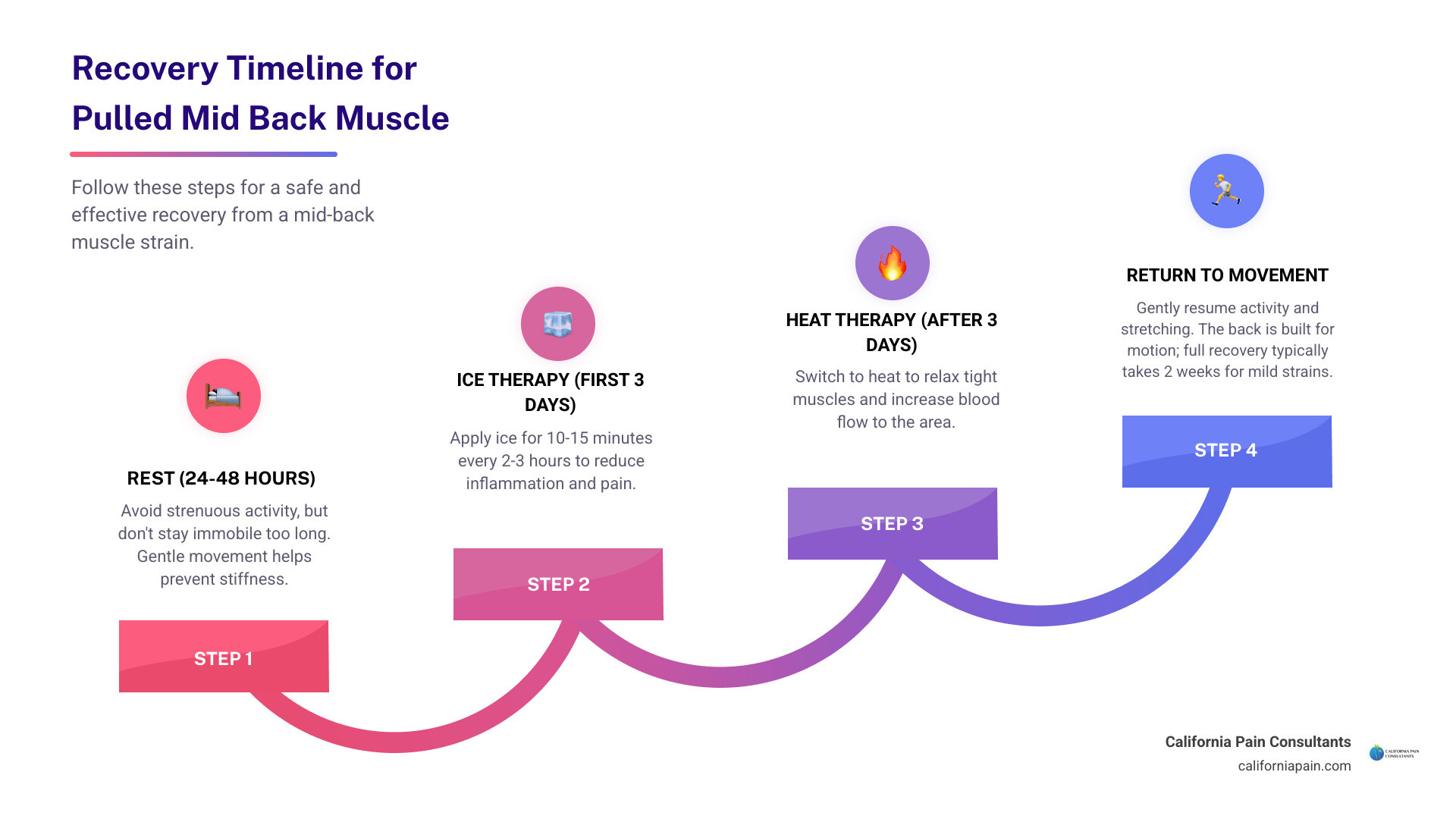
- Rest for 24 to 48 hours — but not longer
- Apply ice for 10 to 15 minutes every 2 to 3 hours in the first few days
- Switch to heat after 3 days to relax tight muscles
- Take over-the-counter NSAIDs like ibuprofen as directed
- Gently return to movement — the back is built for motion
How long does it take to heal?
| Strain Grade | Severity | Typical Recovery Time |
|---|---|---|
| Grade 1 | Mild | A few weeks |
| Grade 2 | Moderate partial tear | Several weeks to months |
| Grade 3 | Complete rupture | 4 to 6 months (may need surgery) |
Most pulled mid back muscles heal on their own within two weeks with proper home care.
Mid-back pain is far more common than most people realize. According to 2019 CDC data, 39% of U.S. adults reported back pain in the prior three months alone. Yet many people either push through the pain without treatment or worry it signals something more serious. Both approaches can make things worse.
Whether your pain came on suddenly after lifting a heavy box, built up slowly from hours at a desk, or hit you after a weekend of yard work — you are not alone, and there is a clear path to feeling better.
I’m Dr. Zach Cohen, a double board-certified physician in Anesthesiology and Chronic Pain, and I’ve helped countless patients recover from a pulled mid back muscle using a combination of interventional techniques, targeted rehabilitation, and non-surgical pain management strategies. In the sections below, I’ll walk you through exactly how to identify, treat, and prevent this injury — so you can get back to moving freely.
Know your pulled mid back muscle terms:
What is a Pulled Mid Back Muscle and What Causes It?
To understand how a pulled mid back muscle occurs, we have to look at the anatomy of your thoracic spine. Unlike your highly mobile neck (cervical spine) or your weight-bearing lower back (lumbar spine), your mid-back (thoracic spine) is relatively rigid. Consisting of 12 vertebrae (T1 to T12), it connects directly to your rib cage, serving as the primary structural scaffolding for your upper body.
While this rigidity protects your vital organs, it also means the muscles surrounding it are subjected to unique rotational forces and postural demands. The mid-back relies on several overlapping muscle groups to maintain stability and movement:
- Superficial Muscles: Large muscle groups like the trapezius (which extends from your neck down to your mid-back) and the rhomboids (which sit between your shoulder blades) are responsible for moving your shoulder blades and upper limbs.
- Deep Intrinsic Stabilizers: The erector spinae and smaller transversospinalis muscles (like the multifidus and rotatores) perform the quiet, tireless work of stabilizing your spine against gravity.
- Intercostal Muscles: These are three distinct layers of muscle sitting between your ribs. They stabilize your rib cage and expand or contract your chest wall as you breathe.
When you overstretch or tear any of these muscle fibers or their connecting tendons, you suffer a muscle strain. (If you stretch or tear a ligament, which connects bone to bone, it is technically a sprain). To dive deeper into how these muscle groups interact, take a look at our A Comprehensive Guide to Back Muscles.
Understanding the grading of your strain is crucial for managing your recovery. According to the medical standards outlined by the Cleveland Clinic, muscle strains are categorized into three distinct phases:
- Grade 1 (Mild): Damage to less than 5% of the muscle fibers. You will experience mild pain and tenderness, but your muscle strength remains largely intact.
- Grade 2 (Moderate): A more extensive partial tear of the muscle fibers. You will feel significant pain, swelling, and a noticeable loss of strength and mobility.
- Grade 3 (Severe): A complete rupture of the muscle or tendon. This is often accompanied by a distinct “popping” or tearing sensation, severe pain, immediate swelling, and a complete loss of muscle function.
To learn more about how these grades impact clinical treatment, you can read the Cleveland Clinic’s breakdown of Muscle Strains: Causes, Symptoms, Treatment & Recovery.
Common Causes and Risk Factors
Because the thoracic spine is built for stability, pulling a muscle here rarely happens completely out of the blue. It is usually the result of specific physical triggers or long-term structural fatigue. Some of the most common culprits we see at our clinics include:
- Repetitive Twisting and Rotational Sports: The thoracic spine provides the majority of your back’s rotational (twisting) motion. Sports that require explosive, repetitive twisting — such as golf, tennis, gymnastics, rowing, or swimming — place immense mechanical stress on these muscles. One awkward swing of a golf club or tennis racket can easily overstretch a vulnerable thoracic muscle.
- Acute Heavy Lifting: Lifting a heavy object, shoveling snow, or moving furniture using improper mechanics (like bending at the waist and twisting your torso) is a classic trigger for acute strains.
- Chronic Poor Posture and Desk Work: If you work a desk job, you likely spend hours leaning forward into a laptop screen. This sustained flexed posture overstretches and weakens your mid-back muscles while tightening your chest and shoulders. Over time, these unconditioned muscles lose their endurance, leaving them highly susceptible to micro-tears from everyday movements.
- The “Weekend Warrior” Phenomenon: Compressing a full week of physical inactivity into a single, high-intensity weekend workout is a major risk factor. Unconditioned muscles that aren’t warmed up are far more likely to tear when suddenly subjected to heavy physical demands.
- Severe Coughing or Respiratory Illnesses: It might surprise you to learn that a bad chest cold or a bout of bronchitis can strain your back. A persistent, violent cough exerts massive, repetitive force on your intercostal muscles, easily causing a painful strain.
- Backpack Overload: Carrying a heavy backpack, especially when slung over only one shoulder, forces the muscles on one side of your mid-back to work overtime to keep you upright. As a general rule, a backpack should never weigh more than 15% to 20% of the wearer’s body weight.
For more details on how these daily habits overload your spine, explore our guide to Back Muscles.
Signs, Symptoms, and Differential Diagnosis
When you pull a muscle in your mid-back, the symptoms can range from a dull, nagging ache to sharp, stabbing spasms that take your breath away. Because your mid-back muscles attach to your ribs, movements as simple as taking a deep breath, sneezing, or laughing can trigger sudden pain.
Common symptoms of a pulled mid back muscle include:
- Localized Pain and Tenderness: The pain is usually concentrated in one specific area (often on just one side of your spine) and feels tender when pressed.
- Muscle Spasms and Stiffness: The surrounding muscles may contract violently to protect the injured area, leading to painful spasms and a rigid, stiff sensation that makes turning your upper body difficult.
- Pain Worsening with Movement: The pain behaves mechanically, meaning it increases when you twist, bend, or reach overhead, and generally improves when you rest.
- A “Crackling” Sound or Sensation: In some cases, you might feel or hear a subtle crackling or crepitus-like sensation when the injured muscle tissue is touched or moved. This is often caused by localized inflammation and fluid buildup in the muscle sheath.
How to Tell if You Have a Pulled Mid Back Muscle
It is incredibly easy to confuse a mid-back muscle strain with other spinal conditions. For instance, is your pain coming from a torn muscle fiber, or is it a joint issue?
If your pain is mechanical — meaning it is highly localized, worsens when you actively use the muscle, and eases when you lie down in a comfortable position — you are likely dealing with a classic muscle strain. On the other hand, if your pain is sharp, shoots around your rib cage, or is accompanied by a deep, hollow ache even when you are completely still, it may point to a rib joint (costovertebral) strain, thoracic spine stiffness, or facet joint irritation.
If you are trying to figure out if your back pain is purely muscular, you can read our clinical breakdown of a Pulled Muscle in Back.
Is It a Muscle Strain or Something More Serious?
Because your mid-back sits directly behind your heart, lungs, and rib cage, chest and upper back pain can sometimes be a sign of a medical emergency. It is vital to know how to differentiate a benign muscle pull from a life-threatening condition.
To help you quickly evaluate your symptoms, we have put together this comparison table:
| Symptom / Feature | Pulled Mid-Back Muscle | Cardiovascular / Pulmonary Emergency | Rib Fracture |
|---|---|---|---|
| Type of Pain | Sharp, localized, or a dull ache; behaves mechanically. | Dull, heavy, squeezing pressure; constant and non-mechanical. | Severe, sharp, stabbing pinpoint pain. |
| Triggers | Worsens with physical movement, twisting, or touching the area. | Occurs at rest; unaffected by physical movement of the spine. | Worsens severely with deep breathing, coughing, or pressing the rib. |
| Associated Symptoms | Muscle stiffness, localized swelling, mild spasms. | Shortness of breath, cold sweats, dizziness, nausea, chest tightness. | Breathlessness, visible bruising, or a physical protrusion. |
| Pain Radiation | Stays localized or spreads slightly across the shoulder blade. | Radiates to the left arm, shoulder, neck, jaw, or stomach. | Stays localized strictly along the path of the affected rib. |
If your chest or upper back pain is accompanied by shortness of breath, a racing pulse, cold sweats, or dizziness, do not wait. Seek immediate emergency medical attention, as these are classic red flags for a heart attack, pulmonary embolism, or pneumonia. Additionally, any loss of bowel or bladder control is a critical medical emergency that indicates severe spinal cord compression (such as cauda equina syndrome).
For a detailed look at how musculoskeletal chest and back pain can mimic cardiac events, refer to Medical News Today’s article on a Pulled muscle in chest: Causes, symptoms, and recovery.
How to Treat a Mid-Back Muscle Strain at Home
For mild to moderate strains (Grade 1 and Grade 2), conservative home care is incredibly effective. Our primary clinical goal during the first few days of recovery is to reduce acute inflammation, control muscle spasms, and protect the injured tissue from further damage.
We recommend utilizing the classic RICE protocol, tailored specifically for your mid-back:
- Rest: Limit strenuous physical activity, heavy lifting, and repetitive twisting for the first 24 to 48 hours. However, avoid prolonged bed rest! Resting in bed for more than two days can lead to muscle stiffness, weakness, and actually prolong your recovery window.
- Ice: Apply cold therapy to the painful area to numb the pain and clamp down on localized swelling.
- Compression: While compressing the mid-back can be tricky, wearing a supportive elastic wrap or high-quality athletic tape (like KT tape) over the thoracolumbar fascia can provide gentle stability.
- Elevation: If your strain involves your intercostal muscles and makes breathing uncomfortable at night, try sleeping in a slightly elevated position, such as in a recliner or propped up with pillows.
To manage the pain and swelling at home, over-the-counter nonsteroidal anti-inflammatory drugs (NSAIDs) like ibuprofen or naproxen can be highly beneficial when used according to the label instructions. If you want to learn more about setting up a safe, structured home recovery plan, check out our guide on How to Treat Muscle Strain.
To help your muscles heal comfortably, you should also pay attention to how you sleep and massage the area:
- Supporting Spinal Alignment While Sleeping: If you sleep on your side, place a pillow between your knees to keep your pelvis and spine aligned. If you sleep on your back, place a pillow under your knees and use a rolled-up towel under your neck to support your cervical curve.
- Self-Massage with Tennis Balls: You can easily perform a gentle myofascial release at home. Lie down on a yoga mat with two tennis balls placed on either side of your spine (never directly on the spinal bones) in your mid-back. Bend your knees and gently roll your body up and down, allowing the tennis balls to massage the sore muscles.

Alternating Ice and Heat for Spasm Relief
One of the most common questions we get is: “Should I use ice or heat?” The answer depends entirely on where you are in your recovery timeline.
During the acute phase (the first 48 to 72 hours), stick to ice. Apply an ice pack wrapped in a thin towel for 10 to 15 minutes every 2 to 3 hours. This constricts blood vessels, reduces swelling, and numbs sharp pain.
After the first 3 days, once the acute swelling has subsided, switch to heat therapy. Apply a heating pad on a low or medium setting for 15 to 20 minutes, or take a warm shower. Heat dilates your blood vessels, bringing fresh, oxygen-rich blood to the damaged tissues to accelerate healing while relaxing tight, spasming muscles. For persistent spasms, you can also try contrast therapy (alternating 10 minutes of cold with 10 minutes of heat).
For further reading on managing acute rib and mid-back muscle spasms, check out Medical News Today’s guide on Intercostal muscle strain: Signs, treatments, and remedies.
Active Recovery: Stretches and Exercises for Pain Relief
When it comes to back pain, we always say: “Motion is lotion.” While resting for a day or two is fine, active recovery is the real key to restoring your mobility and preventing chronic stiffness.
To recover fully, your rehabilitation needs to focus on three distinct areas:
- Thoracic Mobility: Restoring your spine’s natural ability to bend and rotate.
- Scapular Stability: Strengthening the muscles around your shoulder blades (like the lower trapezius and rhomboids) so they can properly support your upper body.
- Core Strength: Building a strong abdominal and lower back foundation to reduce the mechanical load on your mid-back.
Simple Stretches to Relieve a Pulled Mid Back Muscle Fast
Before you begin, remember this golden rule of stretching: never push into sharp pain. You should only stretch to the point of a gentle, comfortable pull. If a movement hurts, stop immediately.
Here are five highly effective exercises to incorporate into your recovery:
- The Cat-Cow Stretch: Get on your hands and knees. As you inhale, gently arch your back, letting your belly dip toward the floor while looking up (Cow). As you exhale, round your spine toward the ceiling, tucking your chin to your chest (Cat). Repeat this slowly for 10 to 12 breaths to gently mobilize your thoracic spine.
- Child’s Pose: Kneel on the floor, sit your hips back onto your heels, and reach your arms out long in front of you on the floor. Lower your forehead to the mat. Hold this position for 30 seconds while taking deep, slow breaths to stretch your entire back.
- Seated Thoracic Rotation: Sit up straight in a chair with your feet flat on the floor. Cross your arms over your chest. Slowly rotate your torso to the right as far as comfortable, hold for 5 seconds, and then rotate to the left. Repeat 5 to 10 times on each side to restore rotational mobility.
- Foam Roller Thoracic Extension: Lie on your back with a foam roller placed horizontally across your mid-back (below your shoulder blades). Support your head with your hands, keep your hips on the floor, and gently lean backward over the roller. Hold for a few seconds, then roll slightly up or down to target a different spot.
- Prone Y/T/W Raises: Lie face down on the floor. To perform “Y” raises, extend your arms overhead at a 45-degree angle with your thumbs pointing up, and lift your chest and arms slightly off the floor. For “T” raises, bring your arms straight out to the sides. For “W” raises, bend your elbows to form a “W” shape. Perform 10 repetitions of each to build postural endurance in your scapular stabilizers.
Frequently Asked Questions about Mid-Back Strains
How long does it typically take for a mid-back muscle strain to heal?
Your recovery timeline depends almost entirely on the severity (grade) of your muscle strain and how quickly you begin proper self-care:
- Grade 1 (Mild): These strains typically heal within two weeks, with symptoms gradually improving every day.
- Grade 2 (Moderate): Because there is more tissue damage, a moderate strain can take 3 to 7 weeks to heal completely.
- Grade 3 (Severe): A complete muscle rupture is a complex injury. If surgery is required to reattach the torn fibers, full recovery can take 4 to 6 months of dedicated rehabilitation.
When should you see a doctor or seek emergency care for mid-back pain?
While most mid-back strains heal beautifully at home, you should schedule an appointment with a healthcare provider if:
- Your pain does not improve or continues to get worse after 2 to 4 weeks of home treatment.
- The pain is severe enough to wake you up at night or interferes with your ability to perform daily tasks.
- You experience any tingling, numbness, or weakness radiating down your arms, legs, or around your rib cage.
Seek immediate emergency medical care if your back pain is accompanied by any of the following red flags:
- A sudden loss of bowel or bladder function.
- Difficulty breathing, a persistent cough, or severe pain with deep breaths.
- Dizziness, fainting, cold sweats, nausea, or a racing pulse.
- A physical “gap” or visible dent in your back muscles following a sudden trauma.
How can you prevent a pulled mid-back muscle in the future?
Prevention is always the best medicine. You can dramatically lower your risk of re-injuring your mid-back by making a few simple adjustments to your daily routine:
- Optimize Your Workspace Ergonomics: Keep your computer monitor at eye level to prevent “tech neck” and rounded shoulders. Use a chair with proper lumbar and thoracic support, and take a 5-minute movement break for every hour of sitting.
- Warm Up Before Workouts: Never jump straight into intense physical activity or sports. Spend 5 to 10 minutes performing dynamic stretches (like arm circles, torso twists, and light cardio) to prime your muscles.
- Use Proper Lifting Mechanics: When lifting heavy objects, always bend your knees, keep your back straight, and hold the load close to your body. Avoid twisting your torso while lifting.
- Build Your Core and Postural Endurance: Incorporate regular strength training that targets your core, glutes, and upper back stabilizers (like rows, planks, and Y/T/W raises) to give your spine a strong foundation.
Conclusion
A pulled mid back muscle can throw a serious wrench in your daily life, making simple tasks like sitting at your desk, driving, or even breathing feel incredibly uncomfortable. Fortunately, with a smart combination of short-term rest, targeted ice and heat therapy, and gentle mobility stretches, most mid-back strains will resolve completely within a couple of weeks.
However, if your pain is persistent, keeps returning, or isn’t responding to basic home care, you don’t have to simply live with the discomfort.
At California Pain Consultants, we specialize in comprehensive, non-surgical pain management. Serving patients across San Diego, Kearny Mesa, Chula Vista, Rancho Bernardo, La Mesa, and Miramar, our board-certified doctors offer personalized, multifaceted treatment programs designed to target the root cause of your pain. From specialized physical therapy and medical massage to advanced interventional options like trigger point injections, we are dedicated to providing compassionate care and restoring your mobility.
If you are struggling with persistent mid-back pain, we are here to help. Contact us today to schedule your comprehensive evaluation.
- Learn more about our Middle Back Pain Relief programs.
- Ready to find relief? Get Upper Back Pain Relief Today.