
Start With 10 Minutes of Gentle Lower Back Mobility
Dealing with this in San Diego? Same-day appointments are often available at our 4 clinics.
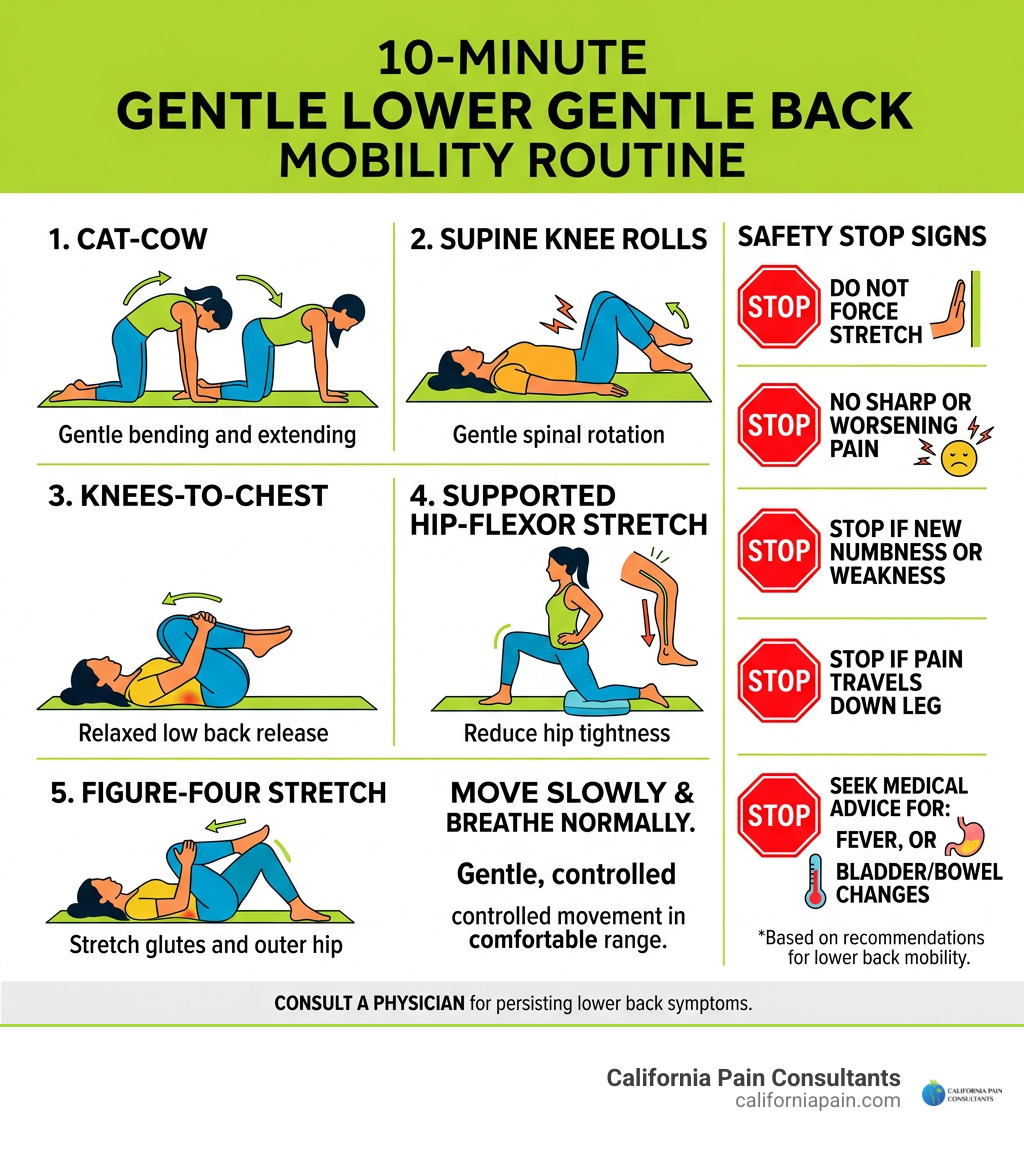
For most everyday lower back stiffness, gentle, controlled movement is a safe place to start. Try these lower back stretches for mobility in a comfortable range, move slowly, and breathe normally:
- Cat-cow for easy bending and extending.
- Supine knee rolls for gentle rotation.
- Knees-to-chest for a relaxed low back release.
- A supported hip-flexor stretch to reduce hip tightness.
- A figure-four stretch for the glutes and outer hip.
This short routine targets more than the lumbar spine. Tight hips, glutes, and hamstrings can make the lower back work harder during walking, standing, and bending. Do not force a stretch or push through sharp, spreading, or worsening pain. Stop and seek medical advice if you have new numbness, weakness, pain traveling down a leg, fever, or changes in bladder or bowel control.
I am Dr. Zach Cohen, a double board-certified anesthesiologist and chronic pain physician who helps people manage lower back pain through personalized, non-surgical care. In practice, I often recommend lower back stretches for mobility as one part of a broader plan that may also include core stability, activity changes, and a clear diagnosis when symptoms persist.
Simple lower back stretches for mobility glossary:
- lower back stretches for muscle spasms
- stretches for the lower back
- stretches to help lower back strain
Mobility vs. Flexibility: Understanding Spinal Movement
Many people use the terms “mobility” and “flexibility” interchangeably, but in spine care and rehabilitation, they describe two distinct aspects of human movement.
Flexibility refers to the passive ability of a muscle or connective tissue to lengthen. Think of sitting on the floor and pulling your foot toward you to stretch your hamstring. In contrast, mobility is the dynamic, active ability of a joint to move under control through its intended range of motion. Mobility incorporates muscle length, joint capsule compliance, nervous system signaling, and motor control.
When your lower back feels locked up after hours at a desk, your spine does not simply need aggressive, passive pulling. It needs active neuromuscular input to restore healthy joint lubrication and reduce protective muscle tension. Incorporating structured dynamic stretching exercises encourages the five lumbar vertebrae (L1–L5) and the sacrum to articulate smoothly without placing excessive mechanical strain on the intervertebral discs.
About 80 percent of adults experience low back pain at some point in their lifetimes, and more than 25% of American adults are experiencing lower back pain right now. Sedentary habits often cause the brain to initiate “muscle guarding”—a protective tightening of the lumbar erectors and surrounding musculature. Gentle mobility routines tell the nervous system that movement is safe, breaking the cycle of stiffness and discomfort.
5 Essential Lower Back Stretches for Mobility
A well-rounded mobility routine focuses on the lumbar spine as well as the pelvis and hips. Because the hips and lower back are anatomically linked through shared muscular attachments and fascia, restricted hip joints force the lumbar spine to compensate by bending or twisting beyond its comfort zone.
According to the Mayo Clinic back exercises guide, gentle daily physical activity helps maintain spinal flexibility and prevents recurring bouts of disability. Below are five foundational movements designed to decompress the spine, restore rotational ease, and release surrounding tension. If you are dealing with chronic discomfort, combining these movements with targeted exercises for lower back pain will give you the best foundation for long-term health.
1. Cat-Cow Spinal Articulation
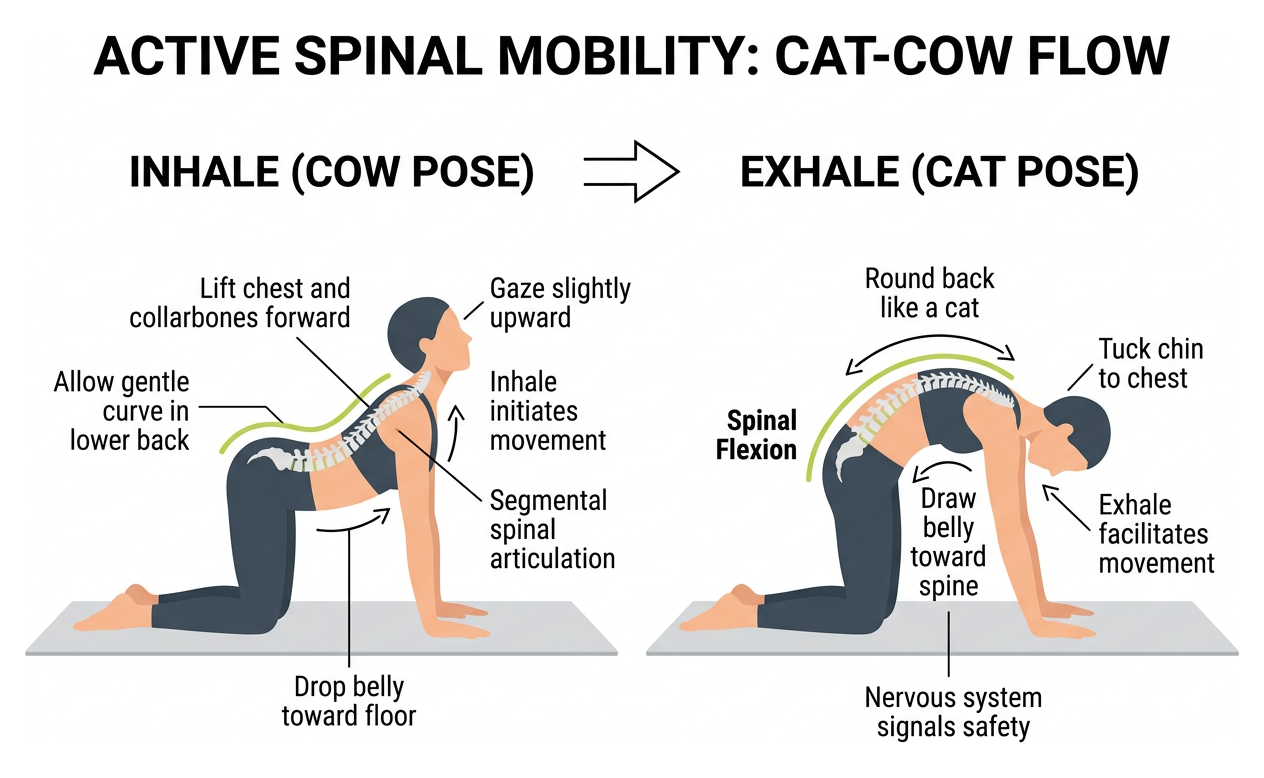
The Cat-Cow flow is a gold standard in physical therapy for segmental spinal mobility. Rather than moving your entire spine as a rigid block, this exercise encourages each individual vertebra to articulate through gentle flexion and extension.
How to Perform:
- Begin on your hands and knees in a tabletop position on a comfortable yoga mat. Ensure your wrists are directly under your shoulders and your knees are stacked beneath your hips.
- Inhale (Cow Pose): Slowly drop your belly toward the floor, lift your chest and collarbones forward, and allow a gentle curve in your lower back. Gaze slightly upward without cranking your neck.
- Exhale (Cat Pose): Press through your palms, round your spine toward the ceiling, tuck your tailbone, and gently bring your chin toward your chest.
- Move smoothly between these two shapes, matching each transition to the rhythm of your breath.
- Complete 8 to 10 slow cycles over 60 to 90 seconds.
Doctor’s Tip:
Keep the movement distributed evenly through your thoracic spine (mid-back) and lumbar spine. Avoid forcing end-range arching in the lower back if you experience pinching in the facet joints.
2. Supine Lower Trunk Rotations (Windshield Wipers)
Lower trunk rotations (often called windshield wipers) gently mobilize the lumbar facet joints and the sacroiliac (SI) joints while lengthening the quadratus lumborum (QL) and external rotators.
How to Perform:
- Lie flat on your back with your knees bent, feet flat on the floor, and arms spread outward in a “T” position or resting like airplane wings.
- Keep your knees and inner ankles glued together throughout the movement.
- Inhale deeply, and as you exhale, slowly let both knees lower to the right side toward the floor. Only lower them as far as is comfortable without your left shoulder lifting off the mat.
- Inhale to return your knees to the center position.
- Exhale and lower both knees smoothly to the left side, keeping your right shoulder firmly anchored.
- Continue alternating for 10 repetitions per side in a slow, controlled tempo.
Doctor’s Tip:
Stop at your “first barrier” of resistance. Mobility is not a contest to see how quickly your knees touch the floor. By keeping your feet together, you maintain a controlled rotational axis that prevents shear stress on the lower lumbar discs.
3. Knees-to-Chest Lower Back Release
The Knees-to-Chest stretch provides passive lumbar flexion and gentle decompression. It opens the neural foramina (the small openings where spinal nerves exit) and gently lengthens the paraspinal musculature.
How to Perform:
- Lie flat on your back with your head supported by a thin pillow or mat.
- Bend your knees, then lift your feet and draw your knees up toward your ribcage.
- Wrap your hands around your shins or behind your thighs (under the knee crease if you have sensitive knees).
- Gently pull your knees closer to your chest while keeping your tailbone and lower sacrum resting naturally against the floor.
- Hold this position for 30 to 45 seconds while taking deep, diaphragmatic breaths into your abdomen.
- Release your feet slowly to the floor for a 10-second rest, then repeat 2 to 3 times.
For a deeper exploration of passive decompression methods, explore our targeted lower back stretches guide to learn progressive variations.
4. Supported Low Lunge Hip Flexor Stretch
Prolonged sitting keeps the psoas and iliacus muscles (the deep hip flexors) in a shortened position. Because the psoas attaches directly to the lumbar vertebrae (T12–L5), tight hip flexors pull your pelvis into an excessive anterior pelvic tilt, creating constant compression across the lower back.
How to Perform:
- From a kneeling position, step your right foot forward so your right knee is bent at a 90-degree angle directly over your ankle.
- Keep your left knee resting on the floor (place a folded towel underneath for extra cushion).
- Gently tuck your tailbone under (posterior pelvic tilt) to engage your lower abdominals and squeeze your left glute.
- Shift your weight slightly forward from your hips until you feel a comfortable stretch across the front of your left hip and thigh.
- Avoid arching your lower back to get deeper; the movement should come entirely from hip extension.
- Hold for 30 to 45 seconds, breathing deeply, then switch to the left leg. Repeat twice per side.
5. Supine Figure-Four Stretch
The figure-four stretch targets the piriformis and deep gluteal rotators. When these muscles become tight, they can irritate the nearby sciatic nerve and restrict pelvic rotation, forcing your lumbar spine to twist unnaturally during daily tasks.
How to Perform:
- Lie on your back with both knees bent and your feet flat on the floor.
- Cross your right ankle over your left knee, creating a “4” shape with your legs.
- Reach your hands through and grasp the back of your left thigh.
- Gently draw your left thigh toward your chest until you feel a moderate stretch in the outer right hip and buttock.
- Keep your right foot flexed (toes pulled toward the shin) to protect your right knee joint.
- Hold for 30 to 60 seconds while relaxing your head, neck, and shoulders flat on the floor.
- Switch sides and repeat for 2 sets on each leg.
How to Integrate a 10-Minute Mobility Routine Daily
Consistency matters more than workout duration. A daily 10-minute mobility session creates lasting adaptations in tissue elasticity and joint health that a single 60-minute weekend workout cannot match. Low back pain is the most common cause of job-related disability and a leading contributor to missed work days, but setting aside a brief window each day keeps stiffness at bay.
If you sit for extended periods during your workday, consider pairing this sequence with our desk job relief stretches for office workers to interrupt postural strain before it accumulates.
How Often Should You Do Lower Back Stretches for Mobility?
For general mobility maintenance, performing this routine 3 to 5 days per week works well. If you are recovering from mild muscular tightness or an acute flare-up triggered by travel or desk work, performing the routine in short, 5- to 10-minute blocks once or twice daily can help restore movement.
Listen to your body’s feedback: if a morning session leaves your back feeling lighter and more supple, maintain that cadence. For additional routine planning, check out our daily back stretches guide for sustainable scheduling frameworks.
Beginner Modifications for Lower Back Stretches for Mobility
If getting up and down from the floor is difficult, you can adapt every stretch in this routine to match your current comfort level:
- Bed-Friendly Adaptations: Perform your knee rolls, knees-to-chest, and figure-four stretches on a firm mattress in the morning before getting out of bed.
- Strap Assistance: If you cannot easily reach your thighs for the knees-to-chest or figure-four stretch, loop a yoga strap, leather belt, or bath towel behind your leg to guide the limb without straining your neck.
- Seated Options: You can perform the figure-four stretch seated upright in a sturdy chair by crossing one ankle over the opposite knee and hinging forward slightly from the hips with a straight spine.
For older adults or individuals managing joint sensitivity, our guide on safe lower back stretches for older adults provides clear, low-impact variations.
The Supporting Role of Core Stability and Hip Mobility
While mobility creates necessary range of motion, stability ensures your body can safely support that range. If you mobilize a joint without strengthening the muscles that control it, your body will revert to muscle spasms to protect itself.
True core stability does not come from high-repetition sit-ups or crunches. Research into spinal biomechanics shows that traditional sit-ups place extreme compressive loads across the lumbar discs, often exceeding safety limits. Instead, spine-sparing stabilization exercises such as bird-dogs, side planks, and abdominal bracing build endurance in the deep transverse abdominis and multifidus muscles.
Pairing hip mobility drills with neutral-spine core training builds a natural “corset” around the lumbar spine, taking excessive pressure off the vertebrae during lifting and bending.
Safety Precautions and When to Seek Medical Evaluation
While gentle movement benefits mechanical lower back stiffness, stretching is not appropriate for every spinal condition. Understanding how to stretch your lower back safely requires listening to your body and recognizing warning signs that indicate a nerve or structural issue rather than simple muscular tightness.
About 20 percent of people affected by acute low back pain develop chronic symptoms within one year, and low back pain is the second most common reason for hospitalization in the United States. If your pain does not improve after two weeks of consistent, gentle self-care, or if you experience radiating pain or neurological changes, schedule an evaluation with a medical specialist.
Frequently Asked Questions About Lower Back Mobility
Can stretching alone cure chronic lower back pain?
Stretching alone rarely resolves long-standing back pain if underlying structural issues exist. Conditions such as lumbar spinal stenosis, facet arthropathy, degenerative disc disease, or spondylolisthesis require a multifaceted rehabilitation strategy that blends mobility work, core stabilization, postural retraining, and specialized medical care.
Is mild soreness normal when performing mobility exercises?
A mild, warm stretching sensation in the muscle belly is completely normal, especially if your tissues are accustomed to sitting. However, sharp, pinpoint joint pain or pain that worsens over subsequent hours indicates that the movement was either forced beyond your safe range or that an underlying inflammation requires professional evaluation.
Should I do lower back mobility stretches in the morning or evening?
Both times offer distinct advantages:
- Morning: Helps rehydrate the intervertebral discs and clear fluid that accumulates during sleep, easing morning stiffness.
- Evening: Helps decompress the spine after a long day of gravitational loading and relaxes tight postural muscles before sleep.
Choose whichever window allows you to stay consistent without rushing.
Conclusion
A healthy spine requires a balance of mobility, stability, and consistent daily movement. By dedicating just 10 minutes a day to these five gentle stretches, you can reduce muscle guarding, support healthy spinal discs, and restore everyday freedom of movement.
When at-home mobility exercises are not enough to manage persistent or worsening discomfort, our team is here to help. California Pain Consultants is a specialized healthcare practice providing comprehensive, non-surgical pain management across Southern California. Our board-certified physicians serve patients throughout San Diego, Kearny Mesa, Chula Vista, Rancho Bernardo, La Mesa, and Miramar, California. We develop personalized, multimodal treatment plans focused on identifying the root cause of your pain and restoring your quality of life.
If lower back stiffness or nerve pain is holding you back, explore our comprehensive non-surgical pain management services or contact our team to schedule your consultation today.