
Vertebroplasty and kyphoplasty are minimally invasive, image-guided procedures that inject medical bone cement into a painful, collapsed spinal bone to stabilize a vertebral compression fracture. They may help people, most often older adults with osteoporosis or patients whose spine has been weakened by cancer, whose fracture pain stays severe despite rest, bracing, and medication. Board-certified pain specialists at California Pain Consultants in San Diego evaluate candidates and perform these procedures as part of an individualized spine care plan.
Sometimes the pain begins after a fall. Other times, it develops after lifting something light, bending forward, or even coughing. Many people are surprised to learn that weakened spinal bones can fracture during normal daily activities, especially in individuals with osteoporosis or other bone-related conditions.
And unlike common muscle strain, compression fracture pain often feels severe and constant.
The purpose of Vertebroplasty and Kyphoplasty is not to promise a cure. It is to address a carefully identified pain source, support function, and help the patient participate more comfortably in an individualized care plan.
What Is Vertebroplasty and Kyphoplasty?
Understanding the diagnosis and treatment target helps set realistic expectations before Vertebroplasty and Kyphoplasty is recommended.
The spine is built from stacked bones called vertebrae; the American Academy of Orthopaedic Surgeons notes there are 24 of them. These vertebrae support body weight, protect the spinal cord, and allow movement.
When a vertebra weakens and partially collapses, it is called a compression fracture. The AAOS reports that vertebral compression fractures happen about 1.5 million times every year in the United States. You can read more about the condition itself on our vertebral fracture page.
Vertebroplasty
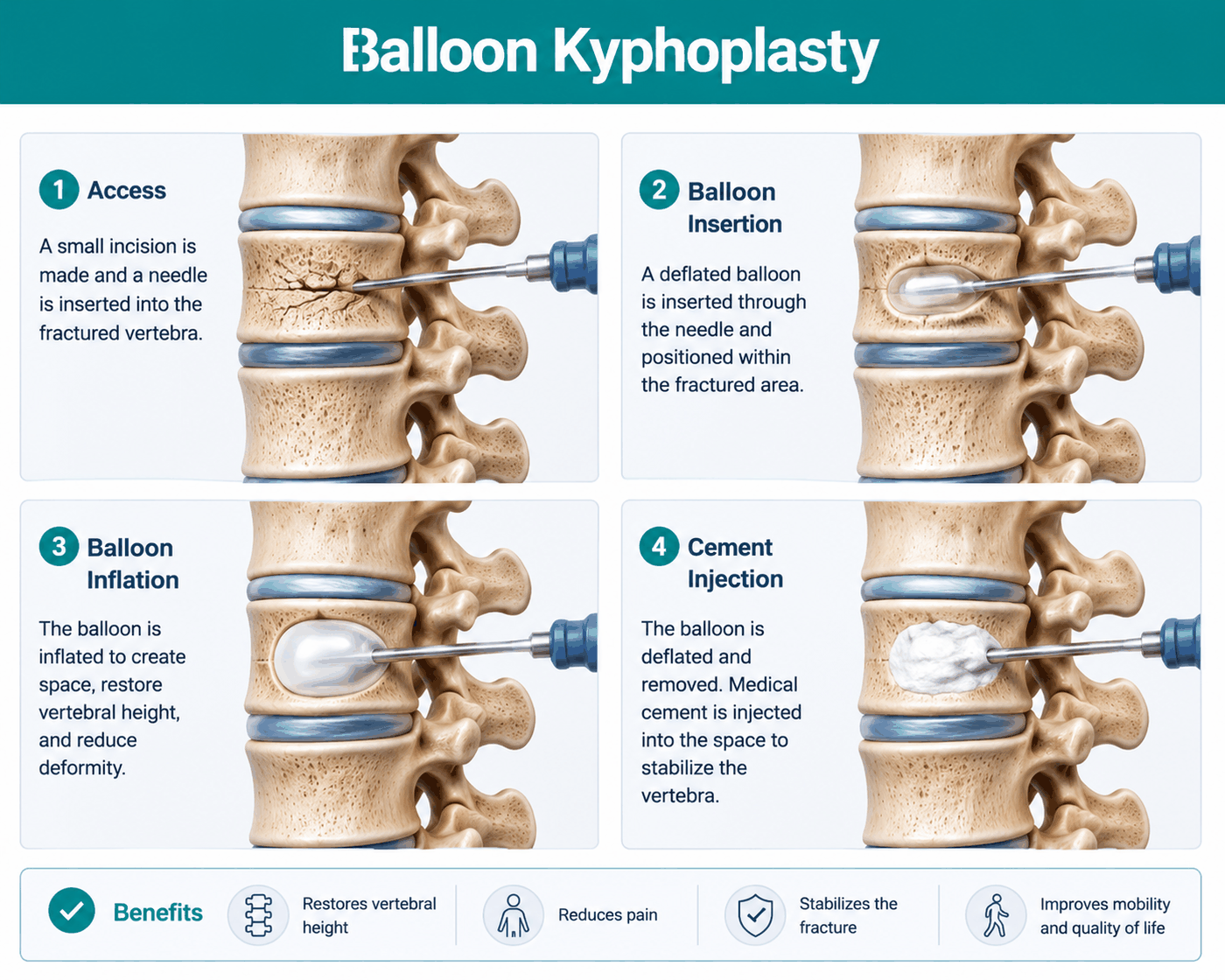
Vertebroplasty is a minimally invasive procedure used to stabilize fractured vertebrae. During the procedure, specialized medical cement is injected directly into the fractured spinal bone. The cement hardens inside the vertebra and helps stabilize the fracture. This may reduce movement within the damaged bone and help relieve pain.
Kyphoplasty
Kyphoplasty follows the same principle with one added step: a small balloon is first inserted into the fractured vertebra and inflated to create a space, and the cement is then placed into that space. MedlinePlus notes that cement leakage is more common with vertebroplasty than with kyphoplasty, which is one of the factors your physician weighs when choosing between them.
When Vertebroplasty and Kyphoplasty May Be Considered
A procedure or medication plan is chosen only after the likely pain source, prior care, health history, and personal goals have been reviewed. MedlinePlus describes vertebroplasty as an option for severe, disabling pain lasting 2 months or more after a compression fracture that has not improved with bed rest, pain medicines, and physical therapy.
Osteoporotic Compression Fractures
This is one of the most common reasons for treatment. Weakened bones from osteoporosis may collapse even during normal daily activities.
Cancer-Related Vertebral Fractures
Cancer affecting the spine may weaken vertebrae and lead to painful fractures.
Traumatic Compression Fractures
Falls or accidents may cause vertebral collapse injuries.
Painful Vertebral Instability
Persistent spinal fracture pain may interfere with movement and quality of life.
Symptoms and Daily-Life Effects to Discuss
Tell your clinician where symptoms occur, what makes them better or worse, and how they affect function. That pattern can be as important as an imaging result.
- Sharp back pain
- Sudden severe pain after minor activity
- Pain worsening while standing
- Muscle spasms
- Difficulty walking
- Pain during movement or position changes
How Candidacy Is Evaluated
Not everyone with a related diagnosis is a candidate for Vertebroplasty and Kyphoplasty. Evaluation is used to confirm the treatment target and compare reasonable alternatives. Many fractures heal well without a procedure; the AAOS notes that most people with a spinal compression fracture feel better within 3 months without surgery.
Medical History
Your clinician will review pain severity, any fall or injury history, osteoporosis history, cancer history, and current mobility limitations.
Physical Examination
The exam looks at spine tenderness, walking ability, postural changes, and functional limitations.
Imaging and Care Planning
Imaging is extremely important in compression fracture evaluation. It shows the fracture location, fracture severity, the degree of bone collapse, and any spinal alignment changes. MRI may also help determine whether fractures are actively painful or healing, which matters because cement is most useful for a fracture that is still causing pain.
What to Expect During Vertebroplasty and Kyphoplasty
Specific instructions vary. The care team explains preparation, anesthesia or medication decisions, what the patient may feel, and the follow-up plan before treatment. MedlinePlus notes you may be asked to stop medicines such as aspirin, ibuprofen, or naproxen beforehand and not to eat or drink for several hours before the procedure.
Step 1: Preparation
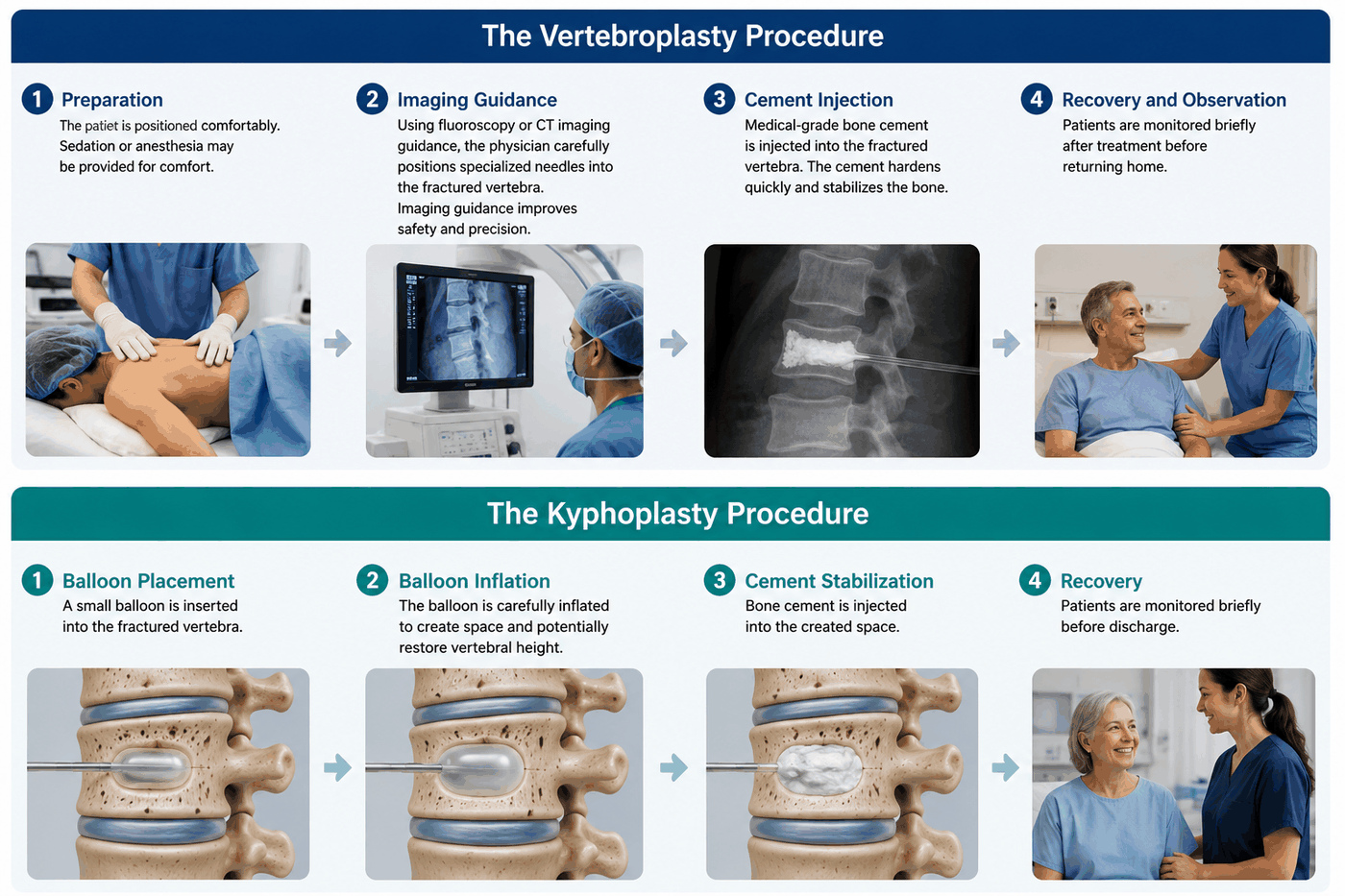
The patient is positioned comfortably, and sedation or anesthesia may be provided for comfort.
Step 2: Imaging Guidance
Using fluoroscopy or CT imaging guidance, the physician carefully positions specialized needles into the fractured vertebra. Imaging guidance improves safety and precision.
Step 3: Balloon Placement (Kyphoplasty)
For kyphoplasty, a small balloon is inserted into the fractured vertebra and inflated to create a space before cement is placed.
Step 4: Cement Injection
Medical-grade bone cement is injected into the fractured vertebra. The cement hardens quickly and stabilizes the bone.
Step 5: Recovery and Observation
Patients are monitored briefly after treatment before returning home.
Recovery, Timing, and Follow-Up
Response to Vertebroplasty and Kyphoplasty varies with the diagnosis, treatment technique, and individual health factors. Follow the specific instructions provided by your care team.
After Treatment
Recovery is often relatively quick compared to traditional spine surgery, and many patients return home the same day. Some temporary soreness near the treatment area may occur initially. How quickly you recover depends on fracture severity, overall health, and bone quality.
MedlinePlus outlines a typical home recovery after vertebroplasty:
- You will probably go home the same day
- Staying in bed for the first 24 hours is usually best, except to use the bathroom
- After 24 hours, you slowly return to regular activities
- Heavy lifting and strenuous activity are avoided for at least 6 weeks
When Improvement May Begin
Some patients experience relief relatively quickly after stabilization, while others notice gradual improvement over several days. Timing depends on fracture severity, how long symptoms have been present, and the overall condition of the spine.
Rehabilitation and Activity
Exercise programs are often carefully individualized based on fracture severity and overall health, focusing on strength, balance, posture, mobility, and confidence during movement.
Potential Benefits of Vertebroplasty and Kyphoplasty
The goal is meaningful improvement in comfort and function, not an unsupported promise that every symptom will disappear.
- Reduced severe back pain
- Improved spinal stability
- Better walking ability
- Improved posture
- Faster return to activity
- Reduced dependence on pain medication
- Many patients report significant improvement in comfort and mobility after successful treatment
- A treatment plan matched to a defined pain source
The evidence is not uniform, and it is fair to know that before deciding. The AAOS notes that two large studies found vertebroplasty helps only in the short term, which is one reason careful patient selection and a broader bone-health plan matter.
Risks, Safety, and When to Call
All treatments have risks. The risks of Vertebroplasty and Kyphoplasty depend on the technique, medication or device, anatomy, and individual health history. MedlinePlus describes vertebroplasty as generally safe, and lists blood clots and nerve injury among possible complications in addition to those below.
- Infection
- Bleeding
- Cement leakage
- Persistent pain
- Adjacent vertebral fractures
Contact your care team for increasing redness, warmth, swelling, drainage, fever, severe or worsening spinal pain, or numbness or weakness that does not improve as expected. Seek urgent medical care for new or progressive weakness, loss of bowel or bladder control, trouble breathing, or rapidly worsening neurologic symptoms.
How This Treatment Fits into Comprehensive Care
Interventional care is most useful when it supports a broader plan built around diagnosis, movement, function, emotional well-being, and informed decision-making.
Part of a Broader Plan
The goal is improving long-term mobility, spinal stability, and quality of life. That plan often includes osteoporosis treatment, physical therapy, balance training, rehabilitation, and ongoing pain management. Protecting the rest of the spine matters: the AAOS reports that more than 30% of people with a spinal fracture will have another fracture within 1 year.
Movement and Rehabilitation
Exercise programs are often carefully individualized based on fracture severity and overall health, with attention to strength, balance, posture, mobility, and confidence during movement.
Support for Daily Life
Many patients slowly begin organizing life around avoiding painful movement. Over time, chronic spinal pain may affect independence, emotional well-being, and quality of life, making it harder to stand upright, walk, sleep comfortably, or climb stairs.
Is Vertebroplasty and Kyphoplasty Right for You?
Spinal compression fractures can slowly affect every part of life. They interfere with movement, posture, sleep, confidence, independence, and emotional well-being. Over time, even simple activities may become exhausting because of constant spinal pain and instability.
California Pain Consultants provides individualized evaluation and discusses the expected benefits, limitations, alternatives, and risks before recommending care.
Treatment at California Pain Consultants
Your care team sees patients at four San Diego County clinics: Kearny Mesa, Rancho Bernardo, La Mesa, and Chula Vista. Vertebroplasty and kyphoplasty are performed at the Comprehensive Pain ASC in Rancho Bernardo and the EPC Surgery Center in La Mesa, so you can have your evaluation close to home and your procedure in a dedicated outpatient setting. When pain persists after a fracture has healed, other options such as basivertebral nerve ablation or radiofrequency ablation may be discussed where appropriate.
We accept most insurances. Call (858) 571-3630 or request your appointment to book your appointment.
Book Your AppointmentTrusted Information and Related Care
General medical references: MedlinePlus: Pain · National Institute of Neurological Disorders and Stroke: Pain.
Related California Pain resources: Vertebral fracture · Compression fractures · Conditions and treatments.
This article is for general education and does not replace an individualized medical evaluation. Recommendations depend on the diagnosis, health history, current medications, examination, imaging or diagnostic testing, and personal goals.
Frequently Asked Questions About Vertebroplasty and Kyphoplasty
Find clear, medically responsible answers about Vertebroplasty and Kyphoplasty, who may be a candidate, what to expect, and when to contact your healthcare team.
What are vertebroplasty and kyphoplasty, and how do they work?
Vertebroplasty and kyphoplasty are image-guided procedures that stabilize selected painful vertebral compression fractures with bone cement. Kyphoplasty first uses a balloon or other device to create a cavity and may help restore some vertebral height in certain cases.
What is the difference between vertebroplasty and kyphoplasty?
Both procedures inject bone cement into a fractured vertebra to stabilize it. In kyphoplasty, a small balloon is first inflated inside the bone to create a space, and cement is placed into that space. Vertebroplasty injects cement directly. MedlinePlus notes cement leakage is more common with vertebroplasty. Your physician will recommend the approach that fits your fracture.
What conditions or symptoms may vertebroplasty and kyphoplasty help address?
They may be considered for severe focal pain from a recent or unhealed osteoporotic, traumatic, or cancer-related compression fracture that has not improved enough with appropriate conservative care. Not every fracture or chronic back-pain pattern benefits.
Who is a good candidate for vertebroplasty or kyphoplasty?
Good candidates usually have a painful compression fracture confirmed on imaging, often with MRI showing the fracture is still active, and pain that remains severe despite rest, bracing, and medication. MedlinePlus describes severe, disabling pain lasting 2 months or more as a common reason to consider the procedure. Bleeding problems, infection, or certain fracture patterns may rule it out.
How should I prepare for vertebroplasty and kyphoplasty?
The team will review MRI or CT findings, bone health, blood thinners, allergies, infection, and anesthesia instructions. Follow fasting and transportation guidance and discuss osteoporosis or cancer treatment plans.
What happens during vertebroplasty and kyphoplasty?
Under fluoroscopic guidance, the physician advances a needle into the fractured vertebra. Vertebroplasty injects cement directly, while kyphoplasty creates space before controlled cement placement.
Is kyphoplasty painful?
The procedure is done with sedation or anesthesia and local numbing, so most people are comfortable during it. Some temporary soreness near the needle site is common afterward and usually eases over a few days. If pain gets significantly worse, or you develop new numbness or weakness, contact your care team right away.
How long does it take to recover from kyphoplasty or vertebroplasty?
Most patients go home the same day. MedlinePlus advises resting in bed for the first 24 hours, then slowly returning to regular activities, while avoiding heavy lifting and strenuous activity for at least 6 weeks. Some people notice relief quickly, while others improve gradually over several days. Your care team will give you specific instructions.
What are the possible risks or side effects of vertebroplasty and kyphoplasty?
Possible risks include bleeding, infection, cement leakage, nerve or spinal-cord injury, pulmonary embolism, adjacent-level fracture, allergic reaction, and lack of benefit. Rare serious complications can occur.
How long do the results last?
The cement hardens quickly and stays in place permanently, so the treated bone remains stabilized. Pain relief varies, and the AAOS notes that large studies found vertebroplasty helps mainly in the short term. Because more than 30% of people with a spinal fracture have another within a year, treating osteoporosis is key to protecting your results over time.
Can these procedures prevent future fractures?
No. Vertebroplasty and kyphoplasty treat a fracture that has already happened; they do not strengthen the rest of the spine. Some patients go on to develop fractures in nearby vertebrae. Bone density testing, osteoporosis treatment, fall prevention, and strength and balance training are the main ways to lower the chance of another fracture.
How do vertebroplasty and kyphoplasty fit into a broader treatment plan?
Stabilizing one fracture does not treat the underlying bone weakness. Osteoporosis evaluation, calcium and vitamin D when appropriate, fall prevention, medication, rehabilitation, and cancer care may be essential to reduce future fractures.
When should I call my healthcare team or seek urgent care after vertebroplasty and kyphoplasty?
Call promptly for fever, drainage, increasing redness, severe or worsening back pain, or new numbness. Seek emergency care for sudden shortness of breath, chest pain, coughing blood, progressive weakness, new bowel or bladder changes, or saddle numbness.