
What Are Trigger Point Injections? A Quick-Start Guide for Chronic Pain Sufferers
Dealing with this in San Diego? Same-day appointments are often available at our 4 clinics.
Trigger point injections are a minimally invasive procedure used to relieve muscle pain caused by tight, knotted areas in the muscle called myofascial trigger points.
Here’s what you need to know at a glance:
| Question | Quick Answer |
|---|---|
| What are they? | Injections into painful muscle knots to break the pain cycle |
| Who are they for? | People with chronic muscle pain, tension headaches, or myofascial pain syndrome |
| What’s injected? | Local anesthetic (like lidocaine), saline, or a corticosteroid |
| How long does relief last? | Typically 2 to 4 months; potentially longer when combined with physical therapy |
| Is it painful? | Mild discomfort; no sedation required |
| Success rate? | Over 95% when used for the right indications |
If you’ve been living with stubborn muscle pain that won’t respond to over-the-counter medications or rest, you’re not alone — and you’re not imagining it.
Myofascial trigger points are real, measurable, and treatable. These focal “knots” in skeletal muscle were first described by Dr. Janet Travell in 1942 and have since become one of the most studied sources of chronic musculoskeletal pain. Research shows that latent trigger points exist in the shoulder girdle of 45% to 55% of healthy young adults — meaning this problem is far more common than most people realize.
When a trigger point becomes active, it doesn’t just hurt where the knot is. It can send pain radiating to completely different parts of your body — a phenomenon called referred pain. That’s why a tight muscle in your upper back might be the hidden cause of your chronic headaches, or why neck tension can masquerade as shoulder pain.
The good news: a targeted trigger point injection can disrupt that pain cycle quickly, often within minutes, and open the door to lasting relief through physical therapy and rehabilitation.
I’m Dr. Zach Cohen, double board-certified in Anesthesiology and Chronic Pain, with specialized fellowship training in pain medicine from UC San Diego — and trigger point injections are one of the most effective tools in my practice for helping patients break free from chronic muscle pain. In this guide, I’ll walk you through everything you need to know: how these injections work, who they’re right for, what the procedure involves, and how to get the most out of your results.
Understanding Myofascial Pain and Trigger Points
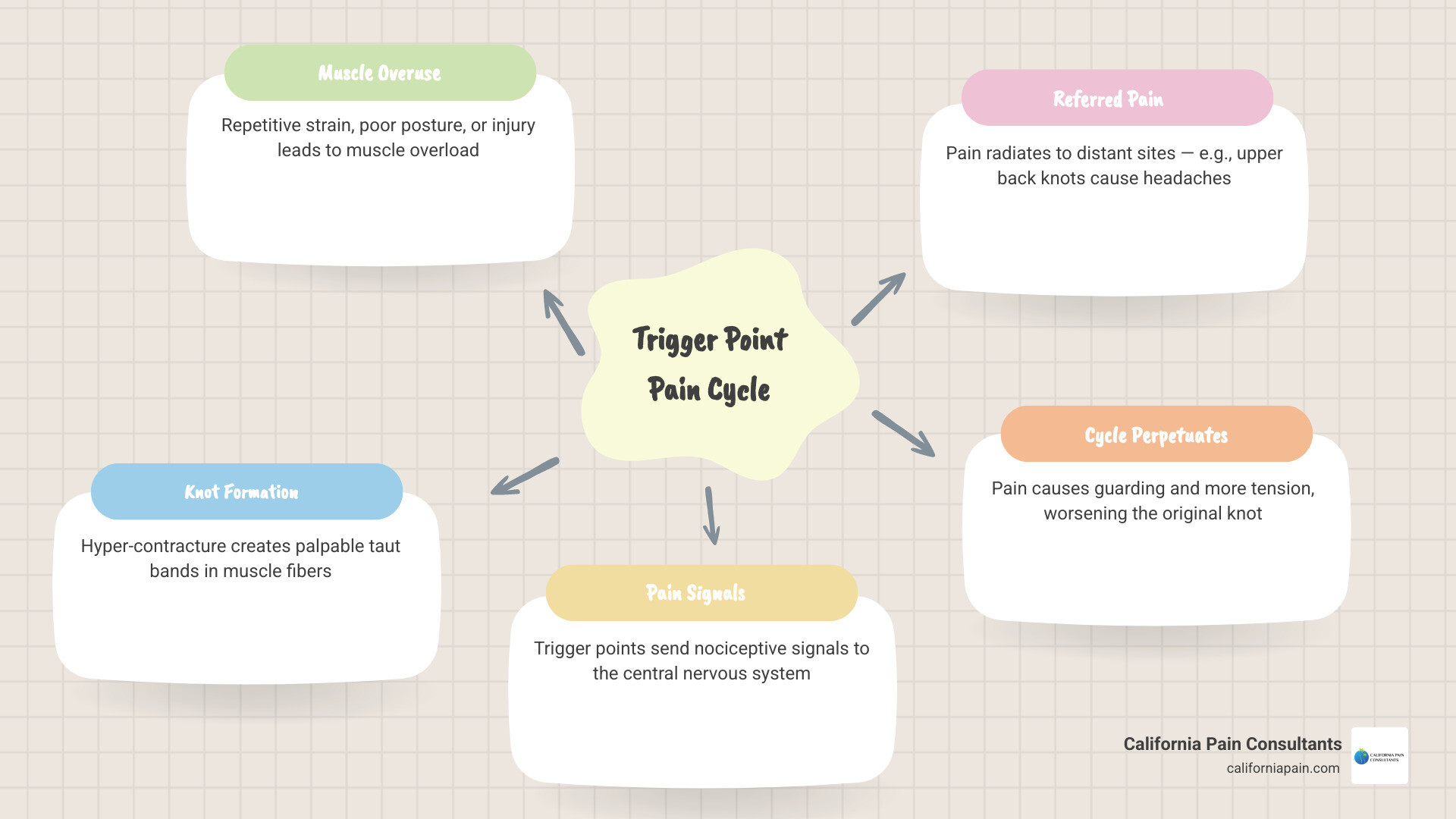
To understand how trigger point injections provide such profound relief, we first need to look at what is actually happening inside your muscle tissue. When we talk about myofascial pain, we are referring to pain that originates from the muscles and the fascia (the thin, protective wrapping around them).
When muscles are subjected to repetitive strain, poor posture, or acute injury, the muscle fibers can get stuck in a state of localized, continuous contraction. These tight bands of fibers are what you feel when you rub a “knot” in your neck or back.
We classify these painful knots into two main categories:
- Active Trigger Points: These are the troublemakers. They cause pain when you are resting, and when you press on them, they reproduce a familiar, radiating pain pattern elsewhere in the body.
- Latent Trigger Points: These knots are clinically quiet during daily activities but are highly tender when pressed. While they do not cause spontaneous pain, they can restrict your range of motion and weaken the muscle. Interestingly, latent trigger points are incredibly common, found in the shoulder girdles of 45% to 55% of healthy, asymptomatic young adults.
What is a Trigger Point vs. a Tender Point?
It is very common for patients to confuse trigger points with tender points, but they are clinically distinct.
A tender point causes localized pain directly under the area of pressure. If you press on it, it hurts right there, but the pain does not travel anywhere else. Tender points are widely distributed and are a hallmark feature of conditions like fibromyalgia.
A trigger point, on the other hand, is a localized nodule within a taut band of skeletal muscle that produces both local pain and a characteristic, predictable referred pain pattern. When we press on an active trigger point, it often triggers a “local twitch response”—an involuntary muscle contraction—and sends a wave of pain to a distant zone. For instance, pressing a trigger point in your trapezius muscle might send pain straight up to your temple, mimicking a tension headache. Understanding these differences is crucial for finding targeted muscle pain relief.
Pathophysiology of Muscle Knots and Referred Pain
So, what is actually happening under the microscope? The leading scientific explanation for trigger points involves the motor end-plate—the site where nerve pathways communicate with muscle fibers.
When a muscle is overworked or injured, abnormal electrical activity occurs at this junction. This causes the sarcoplasmic reticulum (the muscle cell’s calcium storage unit) to continuously leak calcium. Because calcium is the chemical “on-switch” for muscle contraction, this continuous release keeps the local muscle fibers locked in a hyper-contracted state.
This localized spasm compresses nearby microscopic blood vessels, cutting off oxygen and nutrient delivery (ischemia). The muscle tissue starves for energy, inflammatory mediators pool in the tissue, and pain receptors are continuously stimulated. This ongoing sensory barrage can eventually sensitize your central nervous system, making your brain highly sensitive to pain inputs. You can read more about the detailed molecular mechanisms in this scientific research on trigger point pathophysiology.
Clinical Indications and Contraindications for Trigger Point Injections
At California Pain Consultants, we use trigger point injections as a highly targeted therapy. They are not a random “shot in the dark” but are instead indicated for specific, diagnosed muscle abnormalities.
Who is a Candidate for Trigger Point Injections?
You may be an excellent candidate for this procedure if you suffer from:
- Chronic Tension Headaches: Often caused by active trigger points in the upper trapezius, splenius capitis, or temporalis muscles.
- Myofascial Pain Syndrome: Widespread, persistent muscle pain that does not improve with rest or anti-inflammatory medications.
- Neck and Shoulder Pain: Frequently localized in the levator scapulae or upper trapezius. For a deeper look, check out our neck pain injections complete guide.
- Lower Back Pain: Often involving the quadratus lumborum or gluteus medius. You can explore more options in our back pain injections guide.
- Piriformis Syndrome: A common cause of buttock and leg pain. The piriformis muscle is considered the primary pain generator in approximately 8% of patients presenting with buttock pain. Because the sciatic nerve passes directly in front of the piriformis muscle in 78% to 84% of the population (and actually runs through or behind it in the remaining 12% to 21%), a tight piriformis can easily pinch the nerve, causing sciatica-like symptoms.
If you have hit a plateau in physical therapy because a stubborn muscle knot is simply too painful to stretch, an injection can act as the “key” to unlock that muscle, allowing you to progress in your rehabilitation.
Absolute and Relative Contraindications
While this procedure is exceptionally safe, there are situations where we must avoid or delay it.
Absolute Contraindications (Reasons we cannot perform the procedure):
- An active, local infection at the injection site (to prevent spreading bacteria into deep tissues).
- A known allergy to local anesthetics (like lidocaine or bupivacaine).
- Patient refusal or inability to give informed consent.
Relative Contraindications (Reasons we must exercise extreme caution):
- Bleeding disorders or anticoagulant therapy: If you take blood thinners, we must carefully evaluate the risk of hematoma (bleeding under the skin).
- Pregnancy: We limit the use of certain medications, such as corticosteroids, in pregnant patients.
- Poorly controlled diabetes: If a corticosteroid is added to the injection, it can temporarily elevate blood glucose levels.
We always review your complete medical history and perform a physical exam to ensure safety, as outlined in the scientific research on trigger point indications.
The Trigger Point Injection Procedure: Equipment, Medications, and Techniques
The clinical goal of a trigger point injection is simple: mechanically disrupt the hyper-contracted muscle fibers and wash out the pool of inflammatory chemicals.
Dry Needling vs. Wet Needling with Local Anesthetics
There are two primary ways to perform this procedure:
- Dry Needling: The clinician inserts a thin, non-medicated needle directly into the trigger point and moves it around to mechanically disrupt the knot.
- Wet Needling (Trigger Point Injections): The clinician inserts the needle and injects a small amount of liquid—typically a local anesthetic like 1% lidocaine or 0.25% bupivacaine.
Clinical studies show that both techniques are highly effective because the mechanical “needle effect” itself is what resets the hyper-contracted muscle fibers. In fact, research indicates that normal saline is clinically non-inferior to anesthetic-steroid mixtures. However, wet needling with a local anesthetic is strongly preferred by patients because it significantly reduces post-procedure soreness. Dry needling often leaves patients feeling bruised and sore for several days, whereas local anesthetics numb the area immediately. To learn more about how we utilize these solutions, explore our guide on trigger point injection therapy.
Step-by-Step Technique for Performing Trigger Point Injections
When you visit one of our clinics in the San Diego area, the procedure is straightforward and typically takes less than 15 minutes:
- Identification: We palpate the muscle to locate the exact coordinate of the taut band and the hyperirritable nodule. We often mark the site with a skin marker.
- Sanitization: The skin is thoroughly cleansed with an antiseptic solution (such as alcohol or chlorhexidine) and allowed to dry.
- Stabilization: Using a “pincer grip” or a flat two-finger stabilization technique, we isolate the muscle knot between our fingers. This prevents the muscle band from rolling away from the needle.
- Insertion: We insert a fine, 25- to 30-gauge needle (typically 1.5 inches long) at a 30-degree angle to the skin.
- Aspiration & Injection: We always gently pull back on the syringe plunger (aspirate) before injecting to ensure the needle tip is not inside a blood vessel. Once safety is confirmed, we slowly inject 0.2 to 1 mL of the anesthetic.
- Fanning Technique: Without fully withdrawing the needle from the skin, we redirect it in a fanning pattern 3 to 5 times into adjacent parts of the knot to ensure complete mechanical disruption.
- Pressure: After withdrawing the needle, we hold firm, direct pressure on the site for 1 to 2 minutes to minimize bleeding and distribute the anesthetic evenly.
For more technical details on this clinical protocol, you can refer to the scientific research on injection techniques.
The Role of Ultrasound and Image Guidance
For most superficial muscles—like the trapezius in your upper back—board-certified physicians can safely perform injections using physical palpation alone. However, image guidance is an invaluable tool for deeper or high-risk muscles.
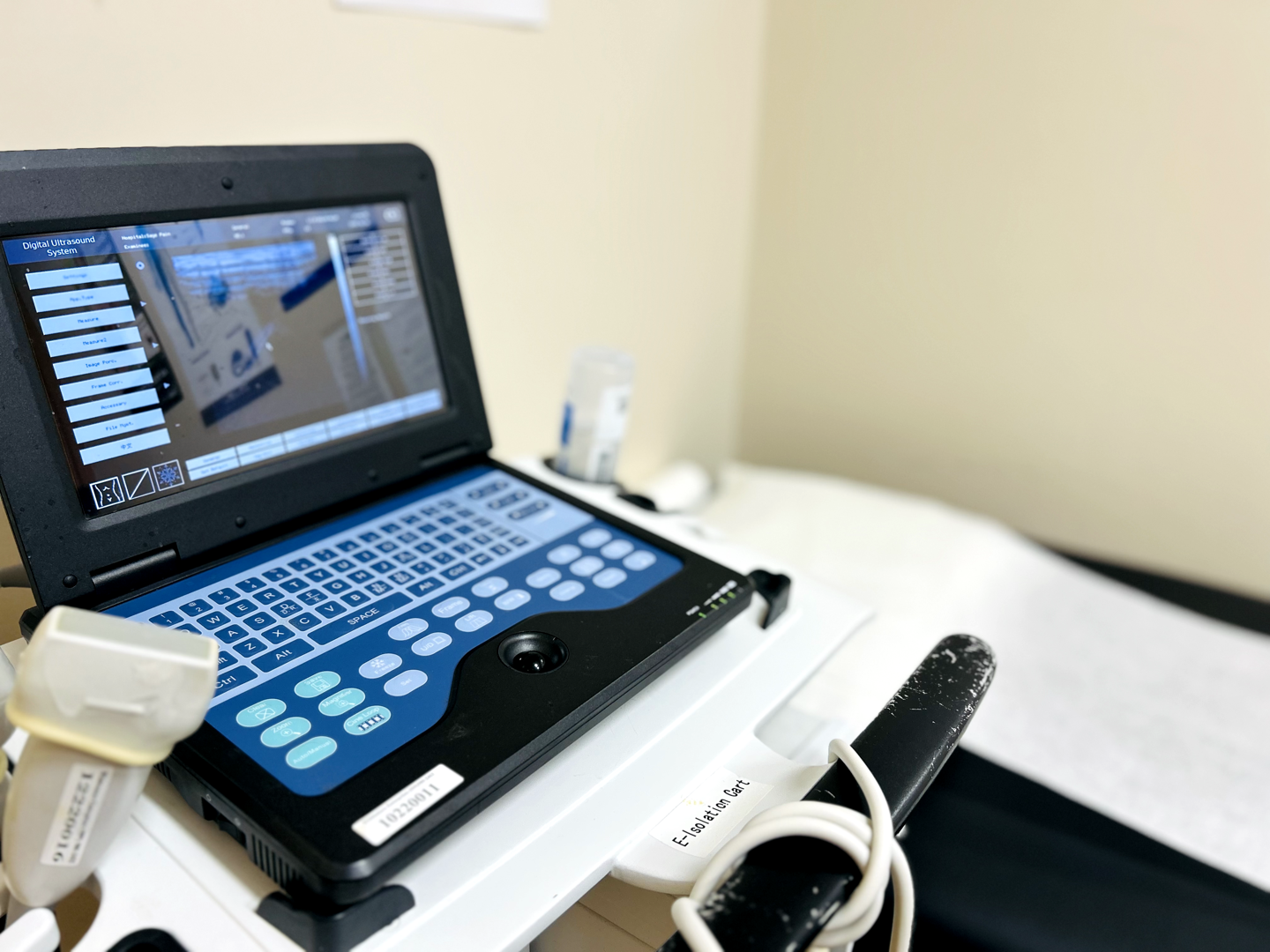
We utilize high-resolution ultrasound to provide real-time visualization of the needle tip, muscle layers, and surrounding anatomical structures. This is particularly crucial when injecting muscles near the ribcage (to avoid the lungs) or when targeting deep pelvic muscles like the piriformis. Ultrasound allows us to use Doppler imaging to identify and avoid blood vessels, and to ensure we do not accidentally poke the adjacent sciatic nerve. This high level of precision is a key component of our advanced interventional pain management programs.
Efficacy, Risks, and Complications of Trigger Point Injections
When performed by experienced pain management specialists, trigger point injections are highly successful and carry very low risk.
Clinical Evidence and Success Rates
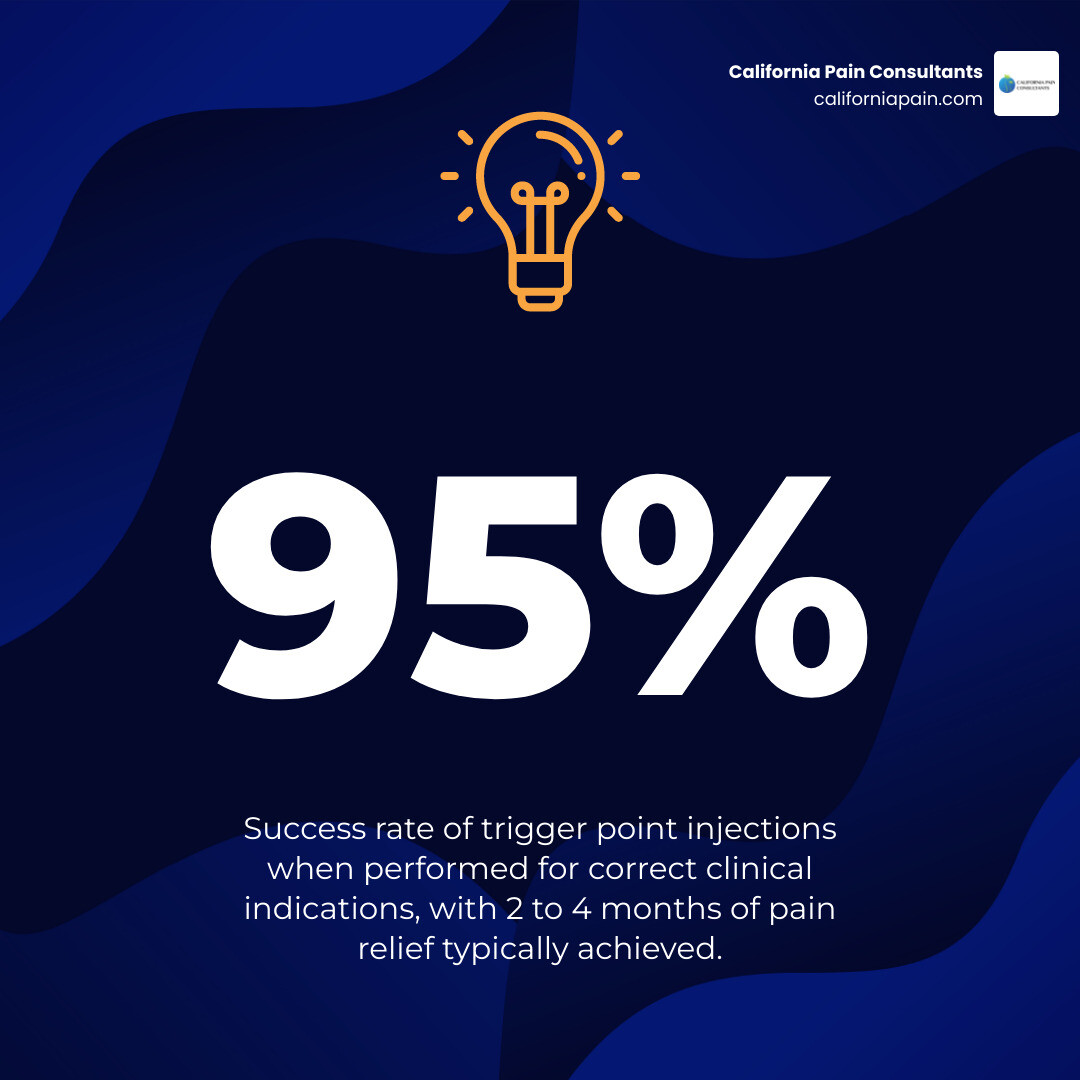
When performed for the correct clinical indications, trigger point injections have a success rate estimated at over 95%.
Patients typically experience an immediate reduction in pain due to the local anesthetic, followed by 2 to 4 months of improved muscle mobility. To illustrate the importance of proper candidate selection, a landmark crossover clinical trial evaluated patients with discogenic low back pain (pain coming from spinal discs, not muscles). In that study, 100% of the patients who received saline trigger point injections as a control reported less than 50% pain relief and subsequently crossed over to receive active regenerative therapies. This highlights that while TPI is incredibly successful for muscle spasms, spinal joint and disc issues require different specialized treatments, such as regenerative injection therapy. You can read more about this clinical trial in the scientific research on injection efficacy.
| Therapy Type | Primary Mechanism | Post-Procedure Soreness | Average Duration of Relief | Best Used For |
|---|---|---|---|---|
| Dry Needling | Mechanical disruption | Moderate to High (3-4 days) | Weeks to Months | Localized muscle knots |
| Wet Needling (TPI) | Mechanical + Anesthetic wash | Low to Mild (1-2 days) | 2 to 4 Months | Active myofascial pain, headaches |
| Orthobiologics (PRP/BMC) | Cellular regeneration | Moderate (temporary inflammatory response) | Long-term / Permanent | Discogenic pain, joint degeneration |
Potential Risks and Complications
While complications are rare, we believe in complete transparency. Potential risks include:
- Pneumothorax (Collapsed Lung): This is an extremely rare but serious risk when injecting muscles directly over the ribcage (like the pectoralis or intercostals). To put this in perspective, a historical case series of 38 patients developed pneumothorax after deep needle insertions along the thoracic spine, resulting in one death. To completely mitigate this risk, we use a pincer grip to pull the muscle tissue up and away from the chest wall, and we always insert the needle at a tangential (flat) angle rather than pointing it vertically down toward the lungs.
- Myotoxicity (Muscle Damage): Local anesthetics can cause a very mild, temporary, and completely reversible form of muscle cell injury called myonecrosis. Bupivacaine carries a slightly higher risk of this than lidocaine, while procaine carries the least. The muscle tissue heals completely on its own within a few weeks.
- Infection and Hematoma: Minimized through strict sterile techniques and holding firm pressure immediately after the needle is removed.
Integrating Injections into a Multimodal Recovery Plan
At California Pain Consultants, we do not view trigger point injections as a standalone, permanent cure for chronic pain. Instead, we view them as a powerful “reset button.”
If you have a chronic posture issue or joint misalignment, your muscles will eventually tighten back up into knots if the underlying cause is not addressed. The injection temporarily eliminates the pain and relaxes the muscle, creating a crucial “window of opportunity” (usually lasting 2 to 4 months) where you can comfortably perform physical therapy, strengthen weak muscle groups, and correct your ergonomics. This synergistic approach is why pain injection therapy is such a highly effective tool in modern medicine.
Post-Procedure Instructions and Recovery Timeline
To maximize your results and stay safe after your injection, we recommend following these post-care guidelines:
- Immediate Stretching: Immediately after your injection, perform gentle, active stretching of the treated muscle group through its full range of motion three times.
- Avoid Heavy Lifting: Avoid heavy lifting, intense workouts, or strenuous activity for the first 24 hours. Because the local anesthetic numbs the muscle, you will not be able to feel if you are over-straining or re-injuring the tissue.
- Expect Mild Soreness: It is normal to feel some mild soreness at the injection site for 3 to 4 days as the mechanical disruption heals. You can apply ice or heat to the area for comfort.
- Stay Active: Keep moving! Light, low-impact activities like walking and gentle stretching help keep the muscle fibers long and prevent them from locking back up.
Long-Term Outlook and Repeat Injection Frequency
For acute muscle injuries or temporary spasms, a single injection paired with a few weeks of physical therapy can resolve the issue permanently.
For chronic conditions, trigger point injections can be safely repeated if the pain returns. However, we typically limit injections to the same muscle group to no more than once every few months. If a patient does not experience significant, lasting improvement after 2 to 3 injection sessions, we pause and perform a deeper diagnostic evaluation to see if an underlying spinal issue, joint problem, or nerve compression is continuously triggering the muscle spasms. Our ultimate goal is always to guide you toward a comprehensive, long-term chronic pain treatment plan that restores your quality of life.
Frequently Asked Questions about Trigger Point Injections
How painful are trigger point injections and will I need sedation?
The procedure is very well tolerated and performed on an outpatient basis without the need for sedation. The needle we use is incredibly thin—similar to the needles used for insulin injections. You will feel a quick pinch as the needle enters the skin.
When the needle tip contacts the active trigger point, you may experience a brief, intense ache or a “local twitch response” as the muscle spasm releases. To make the process as comfortable as possible, we can add a tiny amount of sodium bicarbonate (5%) to the anesthetic solution, which acts as a buffer to neutralize the acidic pH of the medication and eliminate the “stinging” sensation.
How long does the pain relief from a trigger point injection last?
The local anesthetic provides immediate numbing that lasts for a few hours. Once that wears off, the mechanical disruption of the knot provides long-term relief that typically lasts between 2 to 4 months. If you actively participate in physical therapy and correct the underlying postural or biomechanical issues during this pain-free window, the relief can become permanent!
Can I drive myself home and return to normal activities immediately?
Yes, because no sedation is required, you can safely drive yourself home or back to work immediately after the procedure. We simply ask that you avoid heavy lifting or high-intensity exercise for the first 24 hours to protect the numbed muscle from accidental strain.
Conclusion
Living with chronic muscle knots and radiating referred pain can make even the simplest daily tasks feel like an uphill battle. But you do not have to simply “live with it.”
At California Pain Consultants, our board-certified pain specialists are dedicated to providing compassionate, non-surgical pain relief tailored to your unique body and lifestyle. Whether you are dealing with persistent tension headaches, lower back spasms, or complex conditions like piriformis syndrome, we are here to help you find answers and reclaim your active lifestyle.
If you are ready to take the next step toward restoring your mobility and breaking the cycle of chronic pain, we invite you to schedule a comprehensive consultation at one of our convenient Southern California locations.
We proudly serve patients throughout the region, with state-of-the-art clinics in:
- San Diego
- Kearny Mesa
- Chula Vista
- Rancho Bernardo
- La Mesa
- Miramar
To learn more about our comprehensive treatment options, explore our guide to non-surgical pain relief or browse our full menu of conditions and treatments. Let us help you get back to doing what you love, pain-free!