Gentle Stretching Can Help You Reclaim Back Mobility
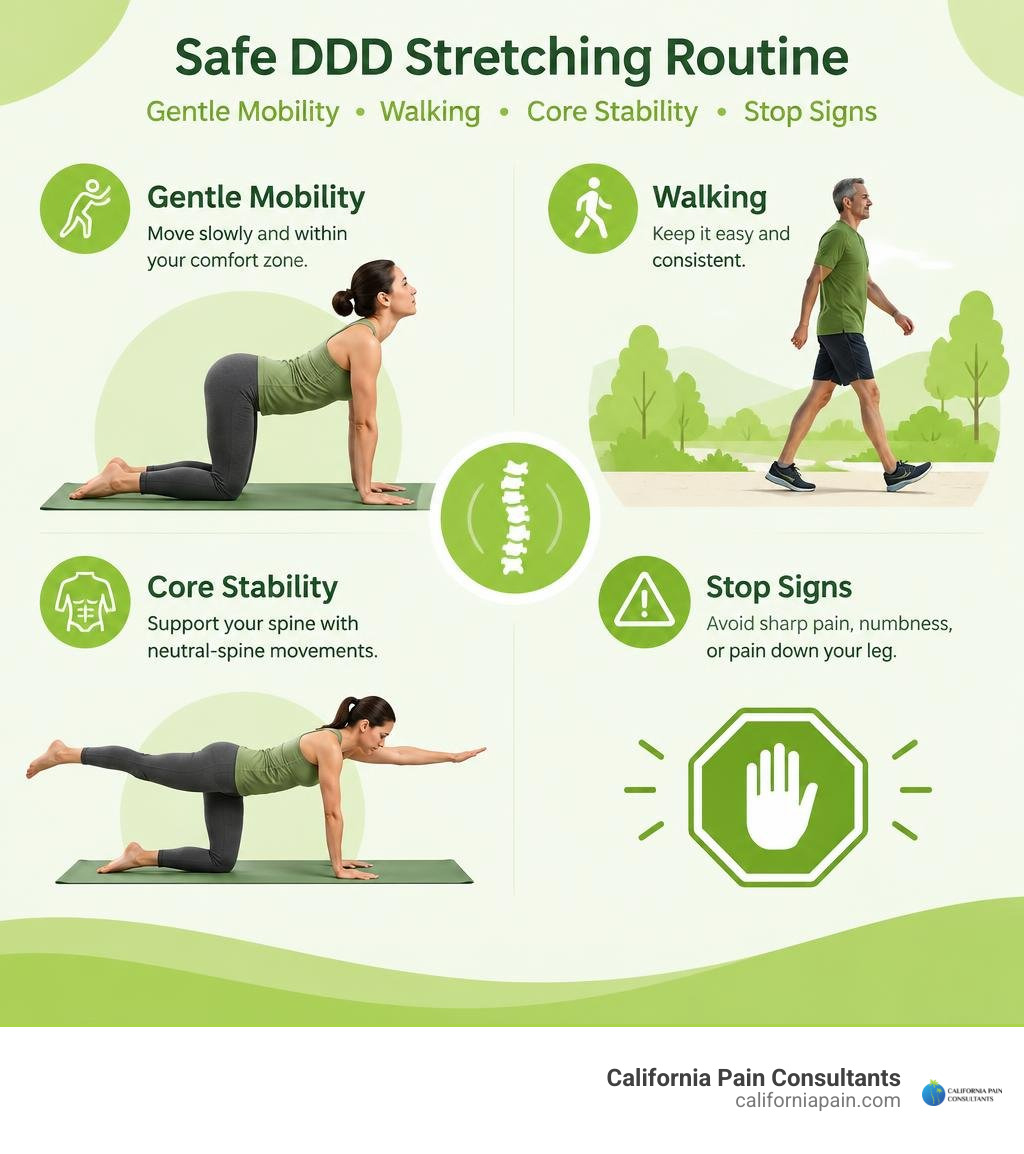
Stretching Exercises For Chronic Degenerative Disc Pain should be gentle, controlled, and tailored to the movements your back tolerates best. Start with small pelvic tilts, a comfortable knee-to-chest stretch, or slow cat-cow movements. Stay in a pain-free range, breathe normally, and stop if you feel sharp pain, numbness, or pain traveling down your leg.
A simple starting plan:
- Perform 5-10 slow repetitions of one gentle movement.
- Take short movement breaks rather than one long, intense session.
- Add easy walking, such as 20-30 minutes a day if comfortable.
- Build core stability with neutral-spine movements instead of doing crunches or sit-ups.
Degenerative disc disease, or DDD, describes age-related changes in the cushioning discs between spinal bones. It can sound alarming, but an MRI finding does not automatically explain pain: disc degeneration appears in many people without symptoms, including about 80% of pain-free adults in their 50s. Cleveland Clinic likewise notes that almost everyone has some disk degeneration after age 40, even without symptoms, and that low-impact activity such as walking or swimming can strengthen back muscles and relieve some pain. The goal is not to force a “bad disc” to move. It is to reduce stiffness, improve confidence with movement, and support the muscles that help share load through the spine.
I am Dr. Zachary Cohen, a double board-certified anesthesiologist and chronic pain physician who helps patients use personalized, non-surgical strategies for chronic spine pain. In this guide to Stretching Exercises For Chronic Degenerative Disc Pain, I will explain how to move safely, recognize unhelpful movements, and know when expert evaluation is needed.
Stretching Exercises For Chronic Degenerative Disc Pain vocabulary:
- Stretching Exercises For Chronic Nerve Pain
- Stretching Exercises For Chronic Peripheral Neuropathy Pain
- dynamic stretching exercises
Understanding Degenerative Disc Disease and Why Movement Heals
Hearing that your spinal discs are “degenerating” sounds intimidating, but the condition is better understood as a natural aging process—much like getting gray hair or wrinkles. Your intervertebral discs are fibrocartilaginous pads that act as shock absorbers between your vertebrae. As we age, these discs naturally lose water content and height, altering spinal mechanics.
A key reason this condition causes confusion is that imaging findings do not always correlate with what you actually feel. A landmark study revealed that disc degeneration is present on MRI in 37% of pain-free 20-year-olds, 52% of 30-year-olds, 68% of 40-year-olds, 80% of 50-year-olds, and over 96% of 80-year-olds who have no symptoms at all. By age 60, roughly 90% of all MRI scans show disc degeneration. Because about 80% of adults experience lower back pain during their lives, it is easy to blame an abnormal scan, even when muscular imbalances, facet joint stiffness, or localized inflammation are the true culprits.
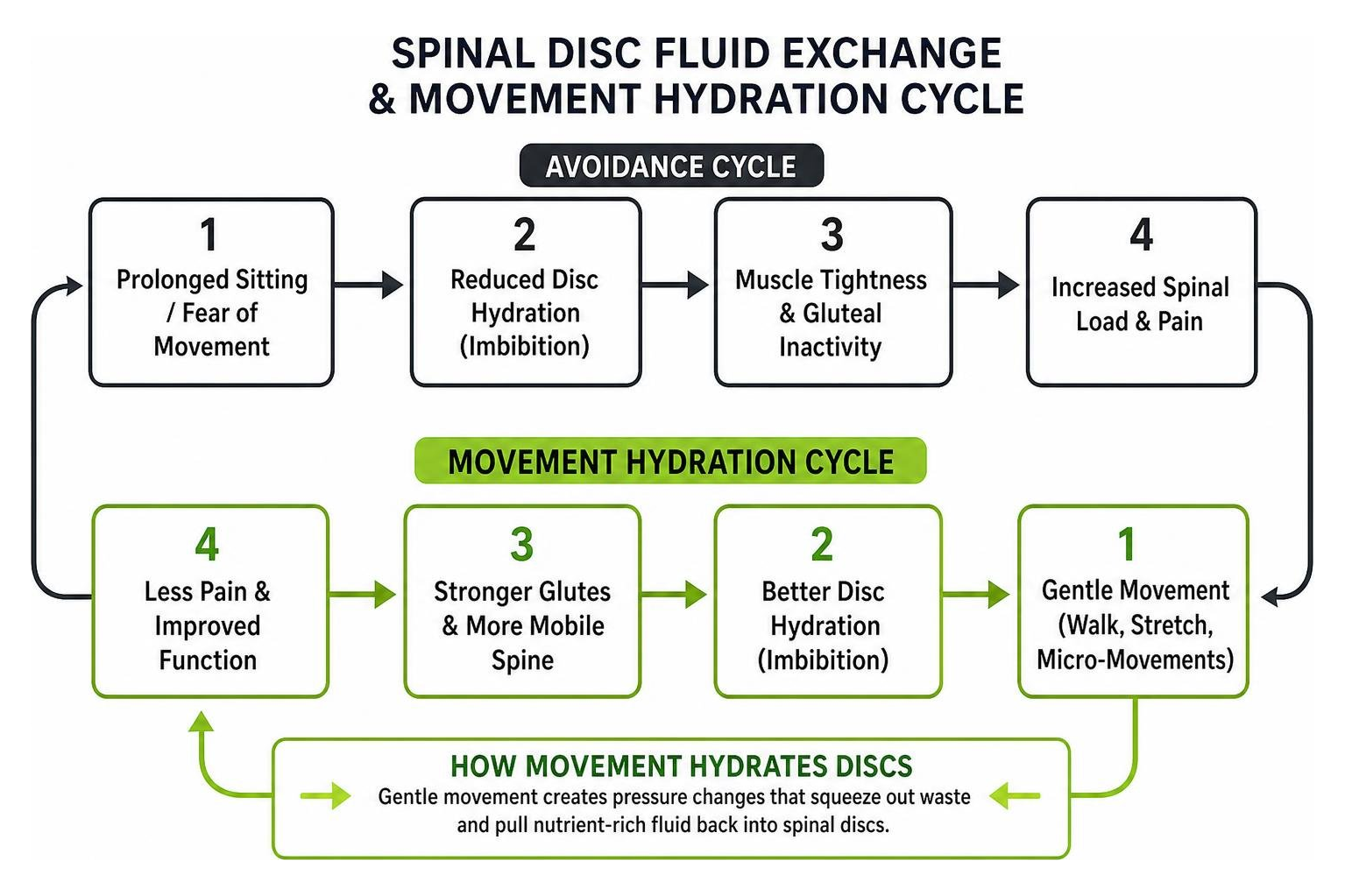
Why does gentle movement bring relief? Unlike muscles, spinal discs have almost no direct blood supply in adulthood. Instead, they rely on a process called imbibition—an osmotic pumping mechanism driven by gentle movement. When you gently bend, walk, and stretch, fluctuating pressures squeeze waste products out and pull nutrient-rich fluid back into the discs.
When pain strikes, many people fall into a fear-avoidance trap: they stop moving, which starves the discs of nutrients, stiffens surrounding ligaments, and leads to muscle wasting. Gluteal weakness, in particular, is one of the strongest predictors of recurrent low back pain. Pursuing natural back pain relief through frequent micro-movements breaks this cycle. Clinical evidence on exercises for degenerative disc disease demonstrates that low-impact cardiovascular activity, such as a daily 20-to-30-minute walk, provides gentle axial loading that hydrates spinal tissues while reducing inflammatory markers.
Essential Stretching Exercises for Chronic Degenerative Disc Pain
When starting an exercise routine for degenerative discs, form, alignment, and listening to your body matter far more than how far you can stretch. Maintaining a neutral spine—where your back retains its gentle, natural inward curve without excessive rounding or arching—protects discs from shear stress.
Rather than performing one exhausting 45-minute stretching marathon, patients see far better outcomes using micro-sessions: 2 to 3 minutes of gentle mobility spread throughout the day. Pair every stretch with slow, diaphragmatic breathing: inhale through your nose to expand your belly, and exhale fully through your mouth to relax tense lumbar muscles. Explore our foundational exercises for lower back pain to build a safe daily habit.
Core Floor Stretching Exercises for Chronic Degenerative Disc Pain
These floor stretches relieve compressive loads on your lumbar spine while encouraging safe, gentle mobility:
-
Pelvic Tilts
- How to do it: Lie on your back on a comfortable mat with knees bent and feet flat on the floor. Gently flatten your lower back against the floor by tightening your abdominal muscles and tilting your pelvis slightly upward. Hold for 3–5 seconds, then relax back to neutral.
- Reps: 8–10 repetitions, 2–3 times daily.
- Why it helps: Mobilizes the lumbosacral junction without adding axial load.
-
Supine Knee-to-Chest Stretch
- How to do it: Lie on your back. Slowly bring one knee toward your chest, grasping behind your thigh (not over the kneecap) with both hands. Keep your opposite foot flat on the floor with the knee bent to protect your lumbar spine.
- Reps: Hold gently for 15–20 seconds per side. Repeat 2 times.
- Why it helps: Decompresses the posterior disc space and relieves tension in the deep gluteal stabilizers.
-
Cat-Cow Mobilization
- How to do it: Position yourself on all fours with wrists under shoulders and knees under hips. Inhale as you gently drop your belly toward the floor, lifting your chest (Cow). Exhale as you slowly arch your back upward toward the ceiling, tucking your chin slightly (Cat).
- Reps: 6–8 slow, rhythmic cycles. Keep the range small and comfortable.
- Why it helps: Promotes fluid imbibition across all 24 mobile vertebrae.
-
Modified Child’s Pose
- How to do it: From all fours, widen your knees slightly, bring your big toes together, and slowly push your hips back toward your heels while walking your hands forward. Rest your forehead on the mat or a yoga block.
- Reps: Hold for 20–30 seconds while breathing deeply into your lower back.
- Why it helps: Opens the spinal canal and gently stretches the latissimus dorsi and erector spinae muscles. For step-by-step progressions, review how to learn lower back stretches in 5 easy to follow steps.
Functional Stability and Standing Stretching Exercises for Chronic Degenerative Disc Pain
Transitioning from floor-based mobility to standing function trains your stabilizing muscles to protect your spine during everyday activities:
-
Standing Lumbar Extension (Back-Bends)
- How to do it: Stand tall with feet shoulder-width apart. Place the palms of your hands on your lower back/sacrum for support. Inhale, and gently lean your upper body backward, arching your spine slightly within a pain-free range.
- Reps: 5–8 smooth repetitions every 1–2 hours during prolonged sitting.
- Why it helps: Counters the hunched postures of desk work and drives disc fluid anteriorly away from sensitive nerve roots.
-
Glute Bridges
- How to do it: Lie on your back with knees bent and feet flat, hip-width apart. Squeeze your buttocks and press through your heels to lift your hips until your thighs and torso form a straight line. Avoid over-arching your lower back at the top.
- Reps: Hold for 3 seconds; perform 2 sets of 8–10 reps.
- Why it helps: Strengthens the gluteus maximus, preventing the lumbar spine from taking on excessive mechanical loads.
-
Modified Bird-Dog
- How to do it: On all fours, brace your core as if preparing for a light tap to the stomach. Slowly extend your right arm forward and left leg backward until they align with your torso. Avoid letting your lower back sag or your hips rotate.
- Reps: Hold for 3 seconds, return to the start, and alternate sides for 6–8 reps per side.
- Why it helps: Builds deep multifidus and transverse abdominis endurance without placing compressive stress on spinal discs. Combine these stability movements with dynamic stretching exercises to improve overall mobility.
Movements to Avoid and Safe Stretching Progression
Not all back exercises support healing discs. Exercises that combine forward spinal flexion (bending forward) with twisting or heavy loads put substantial hydrostatic pressure on your disc walls. Traditional sit-ups, for example, generate hundreds of pounds of compressive force across the lumbar spine—well beyond what an irritated disc can comfortably handle.
Exercise Category
Unsafe / High-Risk Movement
Safe, Disc-Friendly Alternative
Clinical Rationale
Abdominal Work
Sit-ups, standard crunches, hanging leg raises
Neutral-spine planks, Bird-Dogs, Dead Bugs
Prevents severe intradiscal pressure spikes and excessive lumbar shear.
Hamstring Stretches
Standing toe-touches, seated straight-leg stretches
Supine strap hamstring stretch with opposite knee bent
Avoids lumbar flexion while protecting the sciatic nerve from mechanical tension.
Spinal Rotation
Machine torso twists, rapid seated twists
Gentle standing open-book thoracic rotations
Keeps rotational torque in the mobile mid-back rather than the vulnerable lower lumbar discs.
Lower Body Loading
Heavy unsupported deadlifts or deep squats
Bodyweight glute bridges, sit-to-stand box squats
Offloads the posterior annulus fibrosus while building gluteal support.
Aggressive hamstring stretching can also backfire. Hamstring tightness is often a protective muscular response to sciatic nerve sensitivity rather than true muscle shortening. Pulling forcefully on tight hamstrings tensions the sciatic nerve, increasing muscle spasms and pain. Managing disc health requires the same careful balance applied in herniated disc pain management.
Building a Sustainable Weekly Progression
Use a structured weekly plan with built-in active rest days to give tissues time to adapt:
- Monday & Thursday (Gentle Mobility & Hydration): 10 minutes of Pelvic Tilts, Cat-Cows, Supine Knee-to-Chest, plus a 20-minute flat walk.
- Tuesday & Friday (Core Stabilization & Glute Activation): 10 minutes of Bird-Dogs, Glute Bridges, and modified side planks, plus standing back-bend posture breaks.
- Wednesday & Saturday (Active Recovery): 20–30 minutes of low-impact walking or gentle swimming, focusing on deep breathing.
- Sunday (Rest & Reset): Relaxed stretching as needed, avoiding prolonged sitting.
When to Seek Professional Interventions for Discogenic Pain
While gentle stretching and regular walking help manage everyday DDD discomfort, home exercises are not always enough. If an irritated disc inflames an adjacent spinal nerve, or if structural wear narrows the spinal canal, you may need a medical evaluation.
Consult a spine specialist immediately if you experience any of these red-flag symptoms:
- Pain that shoots below the knee (sciatica) accompanied by burning, tingling, or “pins and needles”
- Progressive muscle weakness in your leg, ankle, or foot (such as foot drop or tripping when walking)
- Sudden loss of bowel or bladder control, or numbness around your groin/saddle area (medical emergency)
- Persistent pain that worsens at night or disrupts sleep despite resting
At California Pain Consultants, we specialize in comprehensive, non-surgical pain management for patients across San Diego, Kearny Mesa, Chula Vista, Rancho Bernardo and La Mesa. Our board-certified physicians provide personalized treatment plans—ranging from targeted epidural therapy and facet joint injections to physical therapy coordination—to calm inflammation and restore your mobility. Learn more in our overview of non-surgical pain management.
Frequently Asked Questions About Degenerative Disc Pain Relief
Can stretching exercises cure degenerative disc disease?
Stretching exercises cannot reverse the anatomical aging of an intervertebral disc or restore lost disc height. However, they can resolve the pain, stiffness, and muscle spasms associated with the condition. By improving fluid flow through imbibition, strengthening stabilizing muscles, and offloading vulnerable segments, targeted exercise helps you live an active, comfortable life without surgery.
Why do standard hamstring stretches worsen my degenerative disc symptoms?
When a degenerative disc bulges or leaks inflammatory chemicals onto nearby spinal nerve roots, the sciatic nerve becomes sensitive to tension. Standard hamstring stretches (like reaching for your toes) pull the sciatic nerve taut over the disc, triggering a protective reflex spasm. To stretch safely, lie on your back with a strap around your foot, keeping your spine neutral and your opposite knee bent.
How often should I perform these stretches for optimal relief?
Consistency beats intensity. Performing 2-to-3-minute micro-stretch sessions two or three times a day is far more effective for disc hydration than one long workout a week. During symptom flare-ups, scale back to gentle pelvic tilts and short, frequent walks until your pain settles. For practical daily routines, refer to our daily back stretches guide.
Conclusion
Living with degenerative disc disease does not mean accepting a lifetime of chronic pain or giving up the activities you enjoy. Disc degeneration is a normal part of aging, not an automatic disability sentence. By moving consistently, maintaining a neutral spine, and practicing targeted core stabilization, you can keep your discs hydrated, strengthen your supporting muscles, and protect your back.
Pay close attention to your body’s feedback: gentle muscular stretching is helpful, but sharp, radiating, or pinching pain is a clear signal to ease off. If you are struggling with persistent disc pain and need personalized guidance, our team of board-certified specialists at California Pain Consultants is here to help throughout San Diego County. Explore our tailored stretching exercises and comprehensive pain programs to take your next step toward lasting relief and renewed mobility.