
Back Exercises for Better Posture: Start With These Simple Moves
Dealing with this in San Diego? Same-day appointments are often available at our 4 clinics.
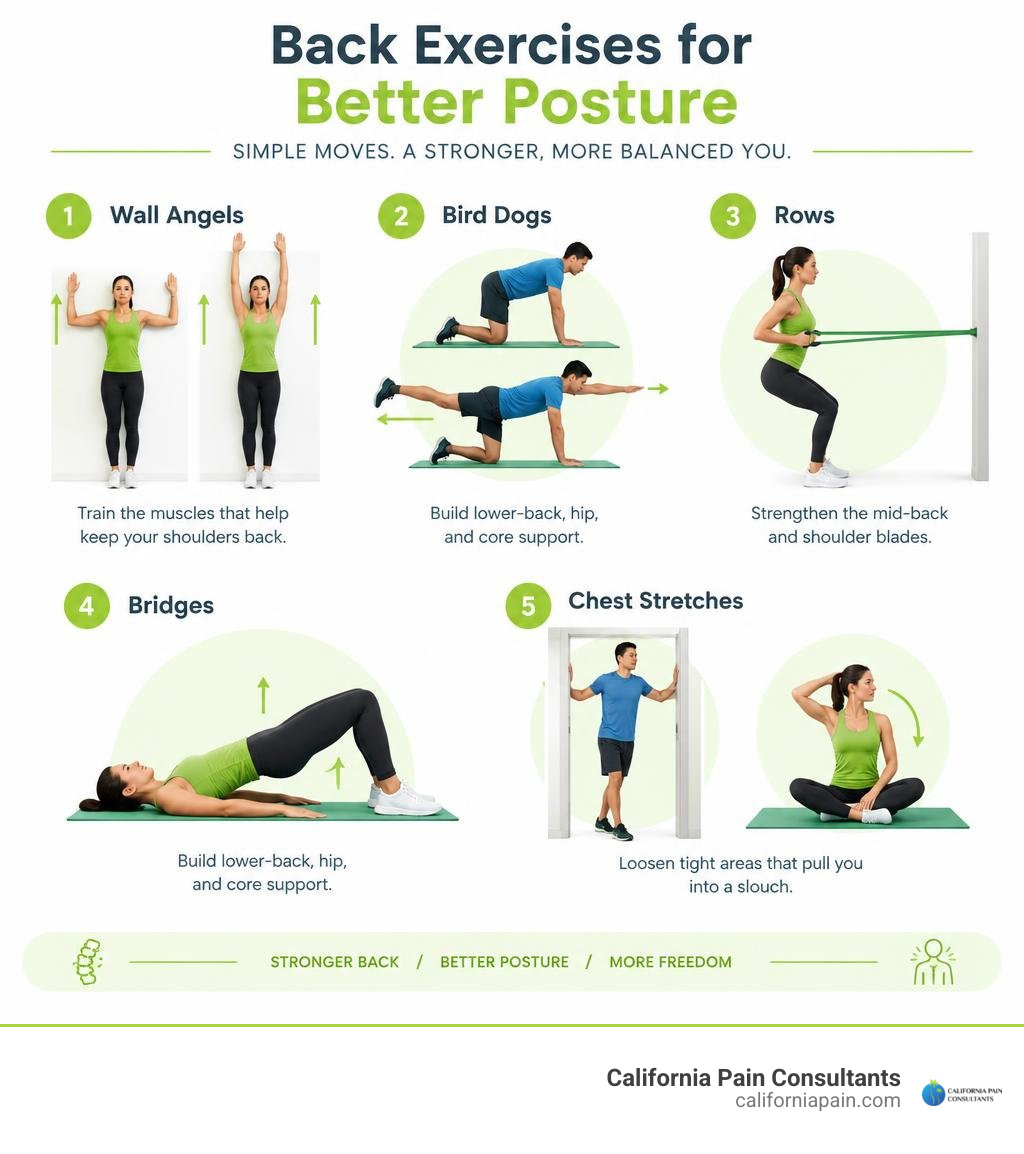
The most effective back exercises for better posture combine upper-back strength, core control, and chest and spine mobility. Start with a few gentle, controlled movements:
- Wall angels to train the muscles that help keep your shoulders back.
- Bird dogs and glute bridges to build lower-back, hip, and core support.
- Band rows or shoulder-blade squeezes to strengthen the mid-back.
- Doorway chest stretches and thoracic rotations to loosen tight areas that pull you into a slouch.
Good posture is not about forcing yourself to stand rigidly. It is about having enough strength, mobility, and endurance to keep your head, rib cage, pelvis, and spine in a comfortable, balanced position during daily life.
Long periods of sitting, phone use, weak back muscles, pain, and tight chest or hip muscles can all contribute to rounded shoulders, forward head posture, a hunched upper back, or a flattened lower-back curve. Consistent exercise can help, but sharp pain, numbness, tingling, new weakness, or bowel or bladder changes require prompt medical care.
I am Dr. Zach Cohen, a double board-certified physician in anesthesiology and chronic pain medicine who treats neck, back, joint, and nerve pain. In my work with patients, back exercises for better posture are often part of a personalized, non-surgical plan to restore movement, build confidence, and reduce strain on the spine.
Discover more about back exercises for better posture:
Why You Need Targeted Back Exercises for Better Posture
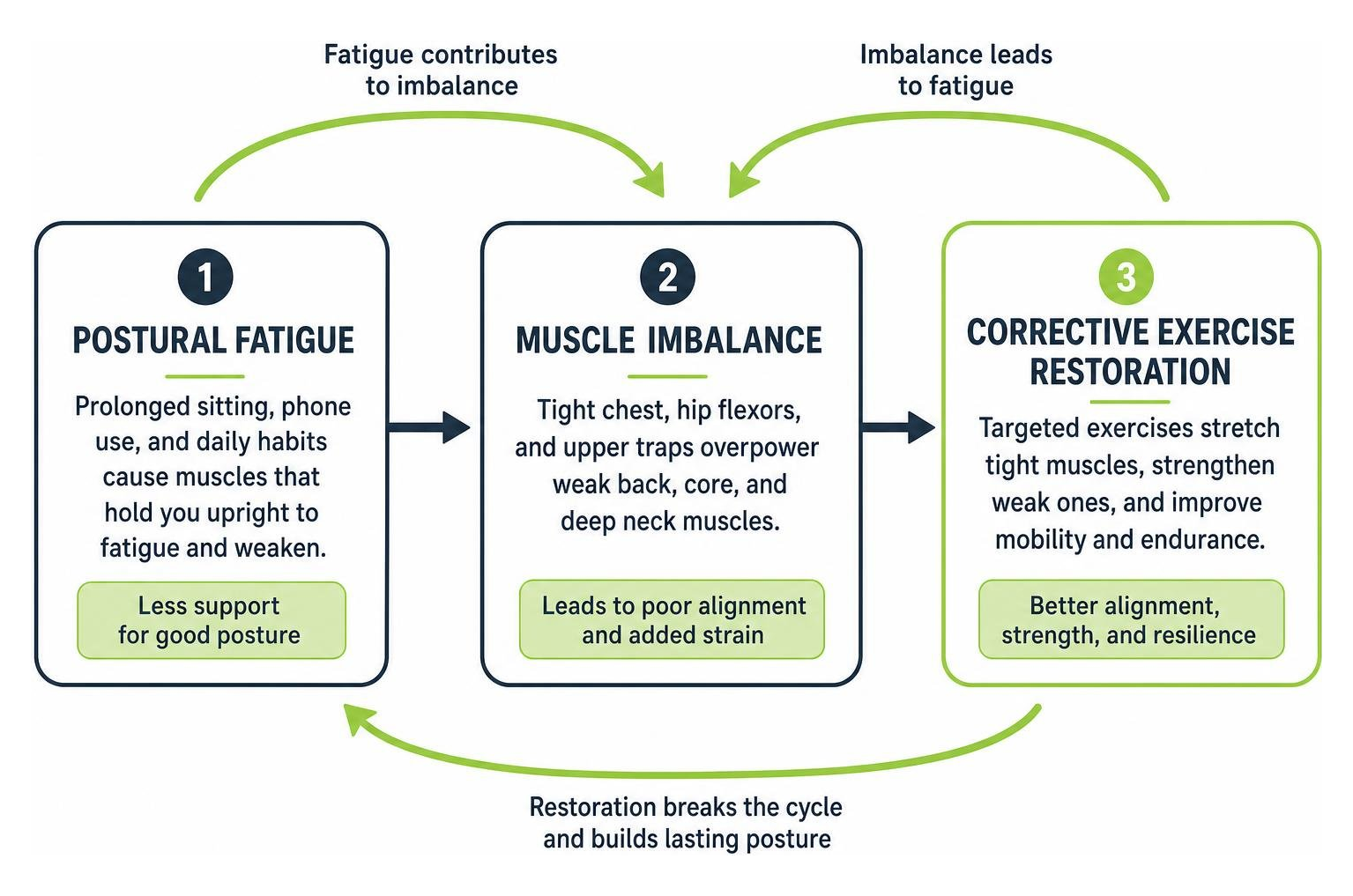
When we spend hours driving across San Diego or working at a desk, our bodies naturally take the path of least resistance. Gravitational pull wins, our shoulders roll inward, and the posterior muscles holding our spine upright begin to fatigue. Over time, this daily habit creates a distinct muscle imbalance: the muscles on the front of the body (pecs, anterior deltoids, hip flexors) become short and tight, while the structural muscles along our spine (rhomboids, middle and lower trapezius, erector spinae) become lengthened, weak, and overstretched.
Chronic low back pain affects up to 28% of adults and is projected to reach 843 million cases worldwide by 2050. Many of these issues begin as structural alignment problems. Two common postural distortions we see at our clinics are postural thoracic kyphosis and flat back syndrome.
- Postural Kyphosis: An excessive outward curve of the upper spine (greater than 45–50 degrees) that creates a hunched look, pulls the shoulder blades apart, and forces the head into forward extension.
- Flat Back Posture: A loss of the natural inward curve of the lower back (lumbar lordosis), usually caused by a chronic posterior pelvic tilt, tight hamstrings, and weak anterior hip flexors.
Addressing these imbalances requires intentional, structured movement rather than passive sitting. Integrating targeted movements with comprehensive back workouts allows you to rebuild the foundational strength necessary to stand tall effortlessly.
| Postural Dysfunction | Primary Causes | Overactive / Tight Muscles | Underactive / Weak Muscles | Corrective Exercise Focus |
|---|---|---|---|---|
| Thoracic Kyphosis (Hunched upper back) | Desk work, tech neck, prolonged slouching | Pectoralis major/minor, anterior deltoids, suboccipitals | Rhomboids, mid/lower trapezius, thoracic erectors | Chest stretching, thoracic extension, scapular retraction |
| Flat Back Syndrome (Loss of lumbar lordosis) | Tucked pelvis sitting, hamstring dominance | Hamstrings, glutes, rectus abdominis | Hip flexors (psoas), lumbar erector spinae | Hamstring lengthening, hip flexor marches, lumbar extension |
| Forward Head Posture (Cervico-thoracic drift) | Screen viewing, driving, weak upper back | Upper traps, levator scapulae, sternocleidomastoid | Deep cervical flexors, lower traps, multifidus | Chin tucks, stability ball extensions, face pulls |
How Poor Posture Impacts Daily Function and Spine Health
Poor alignment is not merely an aesthetic concern; it causes cascading mechanical consequences throughout your body. When the thoracic spine rounds excessively, it compresses the anterior rib cage. Clinical data indicates this forward slump can reduce total lung capacity by up to 30%, making deep diaphragmatic breathing significantly harder.
Furthermore, for every inch your head drifts forward past neutral alignment, the gravitational load on your cervical spine increases by roughly 10 pounds. This sustained tension strains the posterior neck muscles, compresses cervical nerve roots, and triggers tension headaches. Practicing an evidence-based clinical guide on kyphosis exercises helps decompress these spinal segments, opening up the chest cavity and relieving nerve irritation.
The Anatomy of Postural Support: Upper Back, Lower Back, and Core
Your spine relies on a complex web of deep and superficial muscles that act like guy-wires on a ship’s mast:
- Trapezius (Middle and Lower): The middle fibers retract the shoulder blades, while the lower fibers depress them, preventing your shoulders from creeping up toward your ears.
- Rhomboids (Major and Minor): Situated between your spine and scapulae, they squeeze the shoulder blades together to keep the upper torso open.
- Erector Spinae & Multifidus: Running along the entire vertebral column, the erector spinae provide vertical lift, while the deep multifidus muscle stabilizes individual vertebrae against shearing forces.
- The Deep Core & Pelvis: The transverse abdominis, internal obliques, and pelvic floor form an internal corset. Working alongside the lumbar extensors, these muscles stabilize your pelvis to maintain natural lumbar lordosis.
To maintain proper alignment, pair your back strengthening with targeted ab exercises for back support to protect the lower spine from taking on excessive mechanical load.
The Most Effective Posture Exercises for Upper Back and Shoulders
Correcting an upper-body slouch requires a dual approach: we must open the anterior chest wall while strengthening the muscles that retract and depress the scapulae. A 2025 review on spinal health demonstrated that strengthening and stabilizing exercises combined with regular movement provide significant improvements in spine mobility and daily comfort. When tackling upper back fatigue, incorporating gentle exercises for low back pain relief can also ensure your entire kinetic chain remains supported.
Essential Upper Back Exercises for Better Posture
These bodyweight and minimal-equipment movements help mobilize the stiff rib cage and wake up dormant postural stabilizers. For best results, explore clinical research on upper back posture exercises that emphasize thoracic extension.
1. Wall Angels
- How to Do It: Stand with your heels, buttocks, upper back, and head resting against a flat wall. Bring your arms up to a “goalpost” position (elbows bent at 90 degrees) with the backs of your hands touching the wall. Slowly slide your hands upward into a “Y” position, maintaining constant wall contact, then return to the start.
- Sets & Reps: 2–3 sets of 10–12 controlled reps.
- Form Cue: Keep your lower back from arching away from the wall by gently bracing your midsection.
2. Prone Y-T-W Raises
- How to Do It: Lie face down on a mat with your forehead resting on a small rolled towel. Extend your arms overhead at a 45-degree angle (thumbs up) to form a “Y.” Lift your arms toward the ceiling by squeezing your lower traps; lower slowly. Repeat with arms straight out to the sides for “T” (targeting mid-traps and rhomboids), and with elbows bent at your sides for “W” (targeting rotator cuff and scapular depressors).
- Sets & Reps: 2 sets of 8 reps per letter position.
- Form Cue: Do not lift your head; initiate all movement from your shoulder blades.
3. Doorway Chest Stretch
- How to Do It: Stand inside an open doorway. Place your forearms on the door frame with your elbows bent at 90 degrees. Step forward gently with one foot until you feel a comfortable stretch across the front of your chest and shoulders.
- Sets & Reps: Hold for 30–45 seconds; repeat 2–3 times per side.
- Form Cue: Breathe into your belly; do not allow your lower back to over-arch to force the stretch.
Strengthening Scapular Retractors and Mid-Back Muscles
To build muscular endurance for all-day upright posture, add light resistance to challenge your pulling mechanics. If you are starting out, integrating beginner dumbbell back exercises is a great way to load these muscles safely.
1. Resistance Band Pull-Aparts
- How to Do It: Hold a light resistance band in front of you at shoulder height, arms extended straight. Keeping your elbows soft, pull the band apart by squeezing your shoulder blades together until the band lightly touches your chest. Slowly return to the starting position.
- Sets & Reps: 3 sets of 15 reps.
- Form Cue: Keep your shoulders depressed away from your ears.
2. Cable or Band Face Pulls
- How to Do It: Anchor a resistance band at eye level. Grasp the ends with an overhand grip. Step back, brace your core, and pull the band directly toward the bridge of your nose, flaring your elbows wide and externally rotating your shoulders so your hands finish beside your ears.
- Sets & Reps: 3 sets of 12–15 reps.
- Form Cue: Focus on squeezing your rear deltoids and mid-back at the peak of the contraction.
Strengthening the Lower Back and Core to Rebuild Spinal Alignment
Your lower back and pelvis serve as the base of support for your entire torso. If the pelvis tilts too far forward (anterior tilt) or backward (posterior tilt), the upper back and neck are forced to compensate. Developing hip control and trunk stability using mobility exercises for beginners helps re-establish the spine’s natural S-curve.
Targeted Lower Back Exercises for Better Posture
These exercises isolate the lumbar extensors and glutes without placing excessive compressive stress on the intervertebral discs. Pair them with our daily back stretches guide to maintain balance between flexibility and tension.
1. Bird Dog
- How to Do It: Begin on all fours on a comfortable mat, with wrists under shoulders and knees directly below hips. Engage your core to keep your spine neutral. Simultaneously extend your right arm straight forward and left leg straight back until both are parallel to the floor. Hold for 2–3 seconds, then return smoothly and switch sides.
- Sets & Reps: 3 sets of 8–10 reps per side.
- Form Cue: Imagine balancing a cup of water on your lower back; avoid letting your hips rotate or your lower back sag.
2. Glute Bridge
- How to Do It: Lie flat on your back with knees bent and feet flat on the floor, hip-width apart. Drive through your heels to lift your hips toward the ceiling until your body forms a straight line from knees to shoulders. Squeeze your glutes firmly at the top for 2 seconds, then lower under control.
- Sets & Reps: 3 sets of 12 reps.
- Form Cue: Avoid hyperextending your lumbar spine at the top; the lift should come purely from your gluteal muscles.
3. Superman Hold
- How to Do It: Lie prone on your stomach with arms extended overhead. Lightly brace your abdomen, then simultaneously lift your chest, arms, and legs 2 to 3 inches off the floor. Keep your gaze directed at the floor to maintain a neutral cervical spine.
- Sets & Reps: 2–3 sets of 8 reps, holding each lift for 3–5 seconds.
- Form Cue: Focus on lengthening your body from fingertips to toes rather than lifting as high as possible.
Stabilizing the Core and Posterior Chain
True spinal stability requires muscles that resist unwanted twisting and bending. Learning to coordinate your hips and trunk through mastering back and glute routines builds the endurance you need to sit and stand comfortably.
1. Dead Bug
- How to Do It: Lie on your back with arms reaching toward the ceiling and hips/knees bent at 90 degrees. Press your lower back flat into the mat. Slowly lower your right arm overhead and left leg toward the floor simultaneously, stopping just before touching the ground. Return and repeat with the opposite side.
- Sets & Reps: 3 sets of 8–10 reps per side.
- Form Cue: If your lower back arches off the floor, shorten your range of motion.
2. Side Plank
- How to Do It: Lie on your side, propped up on your elbow with your forearm flat on the floor. Stack your feet and lift your hips until your body forms a straight line from ankles to shoulders.
- Sets & Reps: 2–3 sets of 20–30-second holds per side.
- Form Cue: Keep your top hip slightly rotated forward to engage the obliques and quadratus lumborum.
Building a Sustainable Daily Routine for Long-Term Posture Correction
Consistency is the single most important factor in postural retraining. A 2025 scoping review of 292 randomized clinical trials highlighted that the most effective home protocols for spine health combine motor control, core stability, and short, frequent exercise bouts. Rather than working out for an hour once a week, committing to our 15-minute back workout three to four times per week creates real tissue adaptation.
Furthermore, general cardiovascular activity plays a major role: a 2025 study in JAMA Network Open found that adults walking 101–124 minutes per day experienced a 23% lower risk of chronic low back pain than those who were sedentary.
Daily 10-Minute Posture Reset Protocol
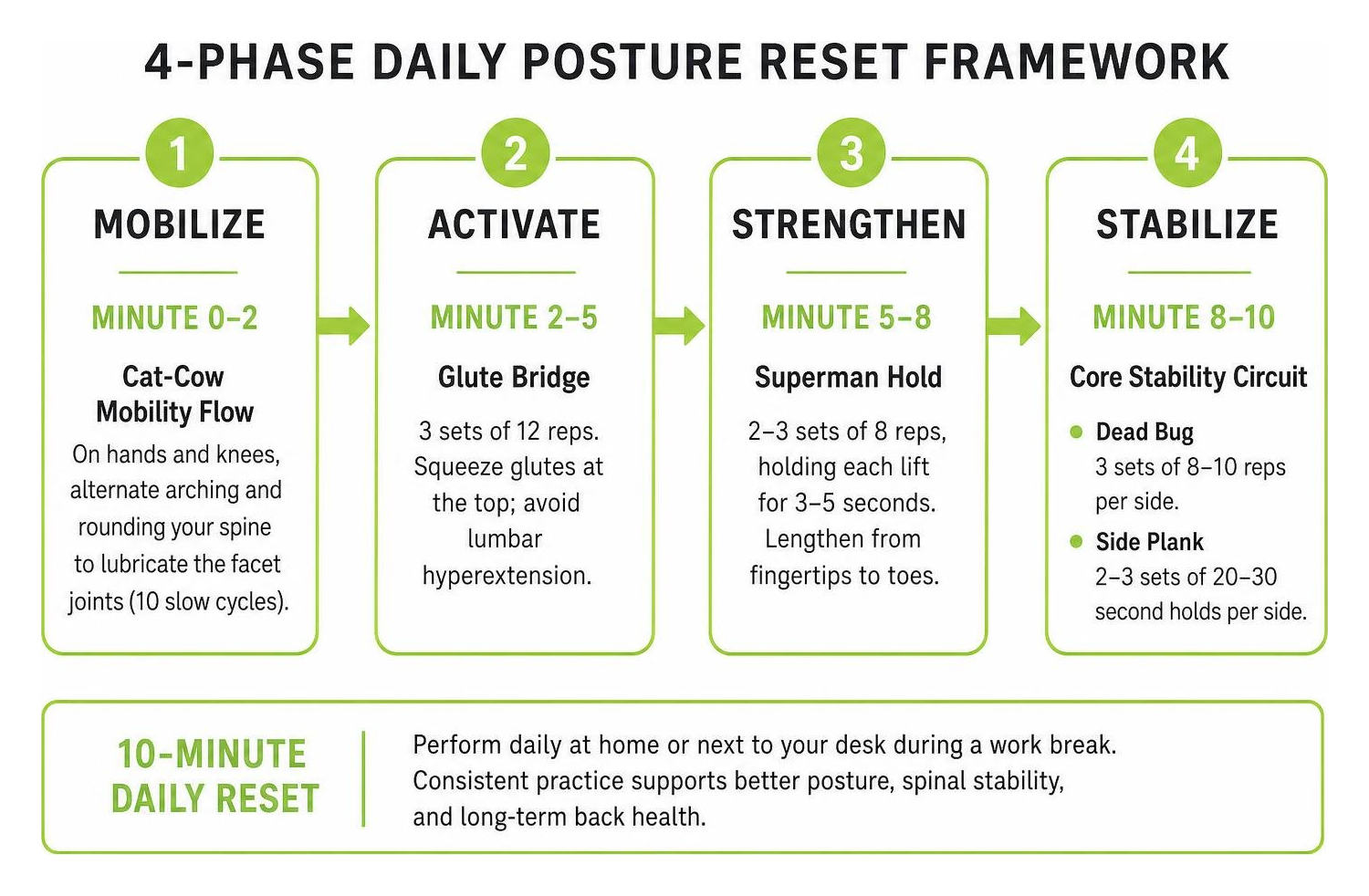
You can easily perform this reset at home or next to your desk during a work break. You can also supplement this routine with quick lower back stretches for mobility.
- Minute 0–2: Cat-Cow Mobility Flow. On hands and knees, slowly alternate between arching and rounding your spine to lubricate the facet joints (10 slow cycles).
- Minute 2–4: Thoracic Rotations (“Thread the Needle”). Mobilize the mid-back and rib cage by reaching one arm under your chest, then rotating up toward the ceiling (8 reps per side).
- Minute 4–6: Chin Tucks & Scapular Squeezes. Sit tall, draw your head straight backward (creating a slight double chin) to activate the deep neck flexors, while pinching your shoulder blades together for 5-second holds (10 reps).
- Minute 6–8: Wall Angels. Perform 2 sets of 10 smooth reps against a flat wall to open the chest and activate the lower trapezius.
- Minute 8–10: Glute Bridges. Finish on the floor with 15 strong glute bridges to reset your pelvic alignment.
Correcting Common Form Errors and Safety Precautions
When performing postural exercises, quality of movement matters far more than resistance or speed. Be mindful of these common training mistakes:
- Arching the Lower Back: During wall angels or rows, many people flare their ribs and arch their lumbar spine to compensate for stiff shoulders. Keep your core braced.
- Craning the Neck: Throwing the head back during Superman holds or back extensions pinches the cervical joints. Always look down at the floor.
- Rushing Repetitions: Postural muscles are rich in slow-twitch fibers; they respond best to controlled tempos and sustained isometric holds.
As you advance, you can transition into structured compound back movements to build functional full-body strength.
When to Seek Immediate Medical Evaluation:
Exercise should relieve postural stiffness, not cause sharp symptoms. If you experience persistent shooting pain down your leg (sciatica), numbness, tingling, motor weakness, pain following a fall, or changes in bowel/bladder function, consult a physician right away.
At California Pain Consultants, our double board-certified physicians specialize in non-surgical pain management across our clinics in San Diego, Kearny Mesa, Chula Vista, Rancho Bernardo, La Mesa, and Miramar. We provide thorough clinical evaluations and personalized treatments to help you safely restore pain-free movement.
Frequently Asked Questions About Posture Exercises
Can you fix years of bad posture with back exercises?
Yes. Thanks to tissue remodeling and neuromuscular adaptation, your body can adjust to healthier alignment at any age. While fixed bone changes (such as advanced structural scoliosis or wedge fractures) cannot be completely reversed with exercise alone, postural habits and muscular imbalances respond exceptionally well to training. Most individuals notice meaningful changes in posture, reduced neck stiffness, and improved stamina within 6 to 12 weeks of consistent daily or near-daily practice.
How often should you do back exercises to see noticeable results?
For best results, separate your routine into two parts: daily mobility work and periodic strength sessions. Spend 5 to 10 minutes every day performing dynamic movements like Cat-Cow stretches, chin tucks, and doorway chest openers to counteract daily desk work. For muscle strengthening (band pull-aparts, bird dogs, rows, and planks), aim for 3 to 4 dedicated sessions per week.
Are posture corrector braces more effective than back exercises?
No. Posture braces provide passive support, essentially doing the work your muscles should be doing. Relying on a rigid harness for extended periods can cause the stabilizing muscles along your spine to weaken further from disuse. While digital posture sensors that remind you to sit upright can be helpful tools, active strengthening and mobility exercises remain the gold standard for long-term postural health.
Conclusion
Rebuilding healthy posture is not about locking yourself into a rigid, military stance. It is about restoring balance, improving thoracic mobility, and developing the muscular endurance needed to move freely throughout your day. By making simple movements like wall angels, bird dogs, chest stretches, and glute bridges a regular part of your routine, you can take meaningful steps toward standing taller and relieving everyday aches.
If persistent discomfort or spinal stiffness is preventing you from living comfortably, our expert clinical team is here to support you. We invite you to schedule a comprehensive evaluation at any of our convenient California Pain Consultants offices throughout San Diego, Kearny Mesa, Chula Vista, Rancho Bernardo, La Mesa, and Miramar. Ready to take your movement to the next level? Start today and explore progressive back workouts designed to keep your spine strong, balanced, and resilient for years to come.