
Start With Spine-Friendly Ab Exercises for Back Pain
Dealing with this in San Diego? Same-day appointments are often available at our 4 clinics.
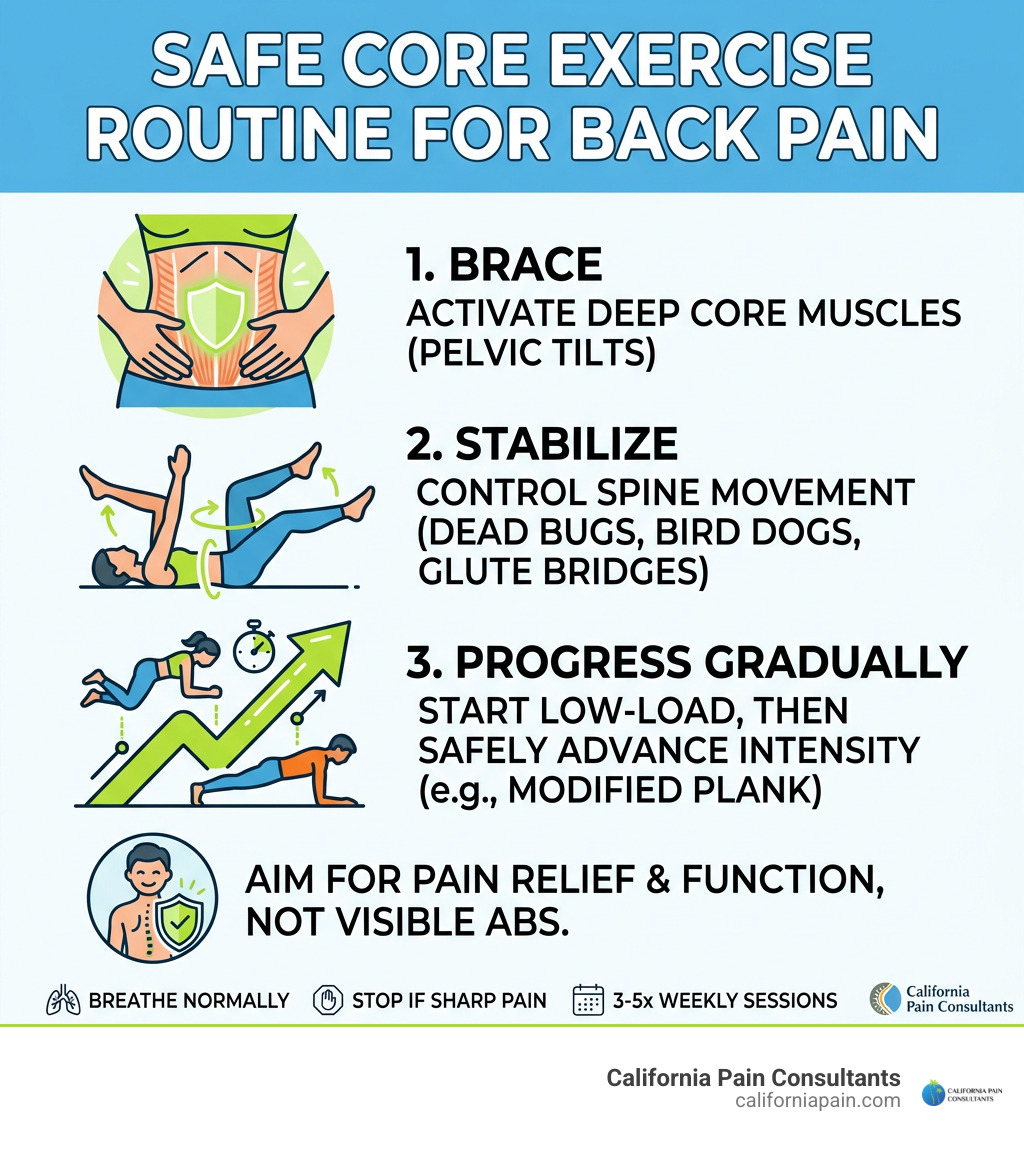
The safest ab exercises for back pain train your core to keep your spine steady, not to repeatedly bend or twist it. Start with low-load moves such as:
- Pelvic tilts to learn gentle abdominal bracing.
- Dead bugs to control arm and leg movement without arching your back.
- Bird dogs to build trunk and hip stability.
- Glute bridges to strengthen the hips and support the low back.
- Modified planks once you can hold a neutral spine without pain.
Move slowly, breathe normally, and stop if pain is sharp, shooting, spreads into a leg, or causes numbness or weakness. Traditional sit-ups, forceful crunches, and weighted twisting can aggravate some types of back pain, especially when form breaks down.
This approach is about more than building visible abs. Your core includes deep abdominal muscles, back muscles, the diaphragm, pelvic floor, and hips. Together, they help manage movement and load around the spine. Research supports exercise therapy for chronic non-specific low back pain, and a 2020 review found that core-focused sessions lasting 20 to 30 minutes, done three to five times weekly, produced the greatest improvements in pain and function.
I am Dr. Zach Cohen, a double board-certified anesthesiologist and chronic pain physician who helps people use personalized, non-surgical strategies for lasting relief. In my work with patients managing back pain, I often recommend carefully progressed ab exercises for back pain alongside physical therapy, low-impact activity, and a plan tailored to the source of their symptoms.
Key terms for ab exercises for back pain:
Why Core Stabilization Matters for Spinal Health
About 80 percent of adults experience low back pain at some point in their lifetimes, and more than a quarter report dealing with it in the past three months alone. It remains the most common cause of job-related disability worldwide. When lumbar discomfort strikes, many people assume their abdominal muscles are simply too weak. However, modern spine biomechanics tells a more nuanced story.
Spine stability relies far less on the superficial “six-pack” (rectus abdominis) and far more on deep neuromuscular control. Your core acts as a natural pressure cylinder:
- Transversus Abdominis (TrA): The deepest abdominal layer that wraps around your midsection like a supportive corset.
- Lumbar Multifidus: Small, deep stabilizing muscles that interlock between individual vertebrae along the spine.
- Pelvic Floor Muscles: The muscular base supporting intra-abdominal pressure from below.
- Diaphragm: The top “lid” of the cylinder that coordinates breathing mechanics with spinal stiffness.
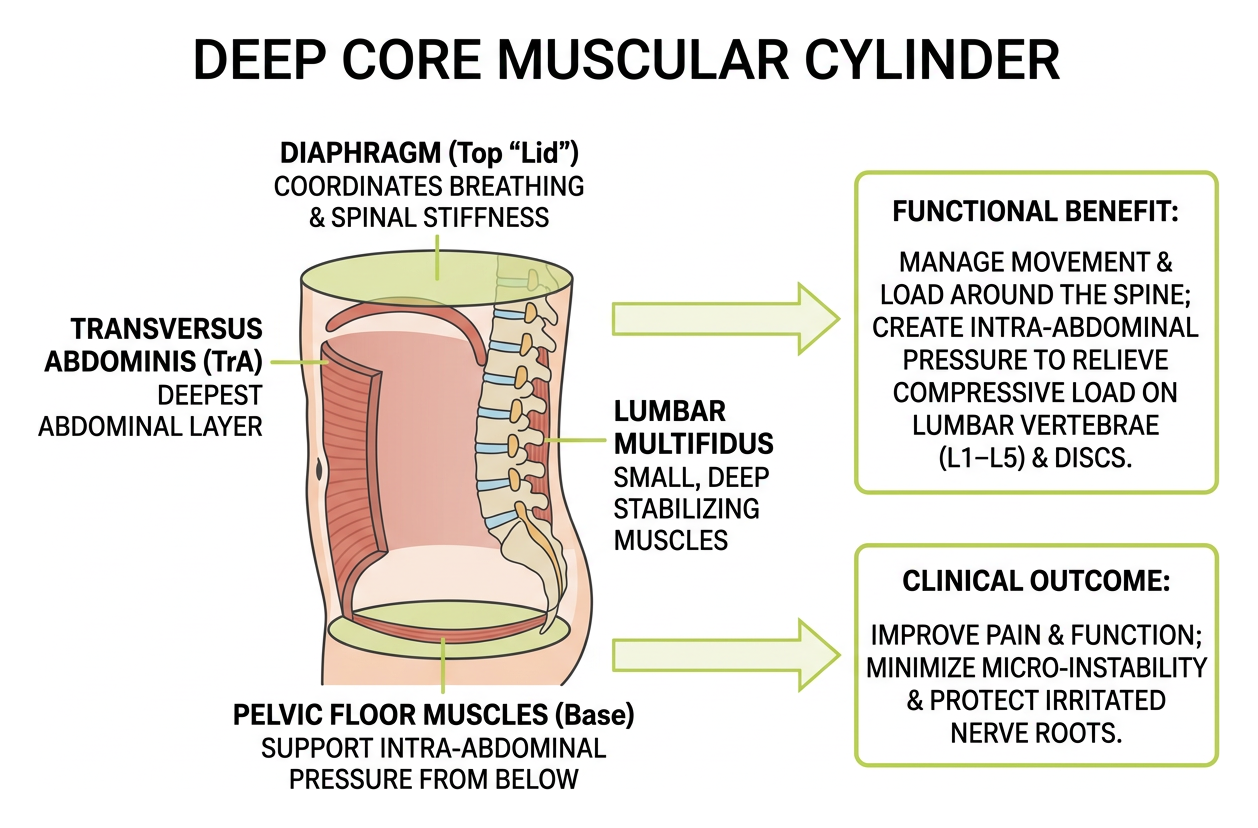
When these muscles fire cohesively, they create intra-abdominal pressure that relieves excessive compressive load on the lumbar vertebrae (L1–L5) and intervertebral discs. A major 2021 Cochrane review analyzing 249 clinical trials confirmed that exercise therapy improved pain scores by roughly 15 points on a 100-point scale compared to usual care. Furthermore, a 2025 randomized controlled trial demonstrated that dynamic neuromuscular stabilization—training deep stabilizing muscles—is superior to conventional core training for enhancing postural control and muscle contractility.
Understanding the underlying back pain causes helps clarify why motor-control training works: it minimizes micro-instability and protects irritated nerve roots. For an in-depth breakdown of lumbar spine anatomy and rehabilitation, explore our comprehensive lower back pain guide.
The Best Ab Exercises for Back Pain Relief
The primary role of the core during daily life is not to generate movement, but to prevent unwanted movement (anti-extension, anti-flexion, and anti-rotation). By performing targeted, spine-sparing movements, you build muscular endurance while keeping the lumbar spine in a neutral position.
Integrating these movements alongside broader targeted exercises for lower back pain establishes a durable foundation for pain-free daily activity.
Foundational Ab Exercises for Back Pain to Build Spinal Stability
Beginners or anyone recovering from an acute flare-up should master foundational movements that enforce low spinal loading while retraining deep neuromuscular bracing.
1. The Abdominal Drawing-In Maneuver & Pelvic Tilt
This exercise isolates the transversus abdominis without putting shear stress on the lumbar spine.
- How to do it: Lie on your back with knees bent and feet flat on the floor, hip-width apart. Inhale gently into your belly. As you exhale, draw your navel toward your spine and flatten your lower back flush against the floor.
- Form tip: Do not hold your breath. Maintain a steady conversation while keeping the abdominal wall braced.
- Dose: 2 sets of 10 to 12 repetitions (hold each contraction for 5 seconds).
2. The Dead Bug
The dead bug challenges your core to stabilize the pelvis and lumbar spine while your limbs move dynamically.
- How to do it: Lie on your back with your arms pointing toward the ceiling and your knees bent at 90 degrees in a tabletop position. Slowly lower your right arm overhead while extending your left leg straight out, hovering just above the floor. Return to the start position and switch to the left arm and right leg.
- Form tip: Your lower back must stay firmly anchored to the floor throughout the entire movement. If your back arches, do not lower your leg as far.
- Dose: 3 sets of 8 to 10 slow repetitions per side.
3. The Bird Dog
Recommended by spine researchers worldwide, the bird dog strengthens the multifidus, erector spinae, and gluteal muscles without placing the spine in flexion.
- How to do it: Start on your hands and knees in a tabletop position with wrists under shoulders and knees under hips. Keeping your spine completely neutral, extend your right arm forward and left leg backward until both are parallel to the floor. Hold for 3 seconds, then return smoothly.
- Form tip: Avoid rotating your hips or sagging through your lower back. Imagine balancing a cup of water on your tailbone.
- Dose: 3 sets of 8 to 10 repetitions per side.
4. The Glute Bridge
Strong glutes take excess mechanical strain off the lumbar vertebrae during standing, bending, and walking.
- How to do it: Lie on your back with knees bent, feet flat on the floor close to your hips. Engage your core, squeeze your glutes, and lift your hips toward the ceiling until your body forms a straight line from shoulders to knees. Hold for 3 deep breaths at the top, then slowly lower.
- Form tip: Drive the movement through your heels, not your toes, and avoid hyperextending your lower back at the top.
- Dose: 2 to 3 sets of 12 to 15 repetitions.
Intermediate Ab Exercises for Back Pain Progression
Once you can complete foundational exercises with flawless form and zero pain, advance to these isometric endurance drills.
1. The Modified Knee Plank & Incline Plank
Planking creates whole-body tension and trains anti-extension endurance.
- How to do it: Rest on your forearms and knees (or place your forearms on an elevated bench for an incline plank). Tighten your abdominal muscles, squeeze your glutes, and align your head, spine, and hips in a straight line.
- Form tip: A clean 20-second hold with a neutral spine is far more beneficial than a 60-second hold with sagging hips.
- Dose: 3 sets of 20 to 30-second holds.
2. The Side Plank (Knee or Full)
The side plank targets the quadratus lumborum and obliques, which provide lateral stability to the lumbar column.
- How to do it: Lie on your side propped up on your elbow, with knees bent at 90 degrees (beginner) or legs straight (intermediate). Lift your hips off the mat so your torso forms a straight line from head to knees/feet.
- Form tip: Keep your chest open and do not let your top hip roll forward.
- Dose: 2 to 3 sets of 15 to 30-second holds per side.
3. The McGill Curl-Up
Developed by renowned spine researcher Dr. Stuart McGill, this variation provides the rectus abdominis activation of a crunch without the destructive spinal flexion.
- How to do it: Lie on your back with one leg straight and the other knee bent with the foot flat on the floor. Place your hands under your lumbar spine to preserve its natural arch. Lift only your head, neck, and upper shoulders slightly off the mat as one rigid unit. Hold for 7 to 8 seconds while breathing, then slowly lower.
- Form tip: Do not tuck your chin into your chest or let your lower back flatten onto your hands.
- Dose: Perform a descending pyramid: 3 reps, then 2 reps, then 1 rep per side.
To combine these movements into an efficient daily habit, you can follow our structured 15-minute routine for a pain-free back.
Core Exercises and Movements to Avoid with Lower Back Pain
Strengthening your core shouldn’t come at the expense of your spinal discs. Certain traditional abdominal movements generate massive compressive and shear loads on the lumbar region. According to occupational health guidelines and biomechanical research, full sit-ups can impose several thousand Newtons of compression directly onto flexed lumbar discs.
Avoid the following high-risk exercises if you have low back pain, disc herniations, or sciatica:
- Full Sit-Ups: Pulling your torso up to your knees heavily recruits the psoas (hip flexor) muscles, tugging forward on the lumbar vertebrae and creating intense compressive forces.
- Repetitive Floor Crunches: Repeated spinal flexion under load can worsen disc bulges and aggravate nerve roots.
- Double Straight-Leg Raises: Lifting both extended legs from the floor creates a massive anterior pelvic tilt torque that arches the lower back aggressively unless you possess elite core strength.
- Weighted Russian Twists: Combining loaded lumbar flexion with rapid spinal rotation places tremendous shear stress on the outer fibers of intervertebral discs (annulus fibrosus).
- Standing Toe Touches: Flexing forward with locked knees stretches tight hamstrings by pulling directly on the lumbar fascia and spinal ligaments.
How to Structure a Safe Weekly Core Workout Routine
A 2020 dose-response review of 50 trials showed that performing core stabilization work 3 to 5 times per week produces the greatest reduction in chronic low back pain and disability. Keep sessions between 20 and 30 minutes to prioritize muscle quality over fatigue.
Before beginning your routine, spend 5 minutes on light dynamic movement to increase tissue temperature and joint lubrication. Incorporating structured dynamic stretching exercises like cat-camel mobilizations and hip circles prepares the spine safely.
| Day | Beginner Protocol (Foundational) | Intermediate Protocol (Progression) |
|---|---|---|
| Monday | Warm-up + Pelvic Tilts, Dead Bugs, Glute Bridges (20 min) | Warm-up + Dead Bugs, Bird Dogs, McGill Curl-Ups (25 min) |
| Tuesday | 20-30 min brisk walking | 30 min brisk walking + gentle mobility |
| Wednesday | Warm-up + Bird Dogs, Glute Bridges, Incline Plank (20 min) | Warm-up + Forearm Planks, Side Planks, Glute Bridges (25 min) |
| Thursday | Low-impact walking / Rest | 30 min low-impact cardio (walking/swimming) |
| Friday | Warm-up + Dead Bugs, Pelvic Tilts, Bird Dogs (20 min) | Warm-up + McGill Curl-Ups, Side Planks, Bird Dogs (25 min) |
| Weekend | Active recovery (light walking, daily stretches) | Active recovery & restorative stretching |
For individuals with persistent discomfort, combining home exercises with chronic pain physical therapy treatments ensures your routine is continuously tailored to your movement patterns and recovery rate.
Frequently Asked Questions About Core Workouts and Back Pain
Can ab workouts worsen existing lower back pain?
Yes. If an exercise relies on hip flexors instead of deep abdominal stabilizers, or if poor form causes your lumbar spine to arch or round excessively, core training can irritate spinal joints and discs. Swapping high-flexion movements for isometric stabilizers like the dead bug or bird dog protects your spine while building strength.
How often should you do core strengthening for back pain?
Aim for 3 to 5 short sessions per week, lasting about 20 to 30 minutes each. Deep stabilizing muscles consist largely of slow-twitch muscle fibers, which respond best to frequent, endurance-focused work rather than infrequent, high-intensity workouts to exhaustion.
When should you see a doctor for back pain during exercise?
Stop exercising immediately and seek evaluation if you experience sharp or shooting pain, numbness, tingling, or weakness radiating into your legs or feet, or any loss of bowel or bladder control. Professional pain management physical therapy can help diagnose the underlying issue and guide a safe recovery.
Conclusion
Rebuilding core stability is one of the most effective, research-backed ways to manage lower back discomfort and regain everyday mobility. By trading outdated sit-ups for spine-sparing movements like dead bugs, bird dogs, and planks, you protect your spine while reinforcing deep stabilizing muscles.
At California Pain Consultants, our board-certified physicians specialize in comprehensive, non-surgical pain management across Southern California, including San Diego, Kearny Mesa, Chula Vista, Rancho Bernardo, La Mesa, and Miramar. We work closely with you to identify the root cause of your pain and develop a personalized treatment plan. To learn more about progressive strengthening strategies, explore our full library of evidence-based back workouts today.