
The Science of Spinal Mobility and Back Pain Relief
Dealing with this in San Diego? Same-day appointments are often available at our 4 clinics.
Understanding how the spine moves is the first step when you want to Improve back flexibility. The human spine contains 33 individual vertebrae, including 5 robust vertebrae in the lumbar region (lower back) and 12 in the thoracic region (mid-to-upper back). These bones are cushioned by intervertebral discs that rely on regular movement to absorb nutrients and stay hydrated. When we remain seated for prolonged periods, these discs experience static compression, leading to stiffness and decreased joint range of motion.
Spinal mobility does not exist in isolation. The lower back works as a team with surrounding muscle groups, especially the hamstrings and gluteals. Tight hamstrings pull down on the pelvis, flattening the natural curve of the lower spine and forcing the lumbar muscles to work overtime.
When you target both lumbar spine flexibility and hamstring mobility, you relieve tension across the entire kinetic chain. Research demonstrates that focusing on spinal flexibility can decrease chronic low back pain significantly:
- Improving lower back (lumbar) flexibility alone correlates with an 18% to 30% reduction in chronic low back pain.
- Improving hamstring flexibility alone leads to a 25% to 40% reduction in low back pain.
- Combining both lumbar and hamstring flexibility work offers a synergistic effect, cutting chronic low back pain by 40% to 58%.
By incorporating structured routines like our A to Z Guide to At Home Back Pain Relief or reviewing Research on back stretches and pain reduction, you provide your spine with the space it needs to move freely.
Common non-structural causes of low back pain and stiffness include:
- Repetitive forward bending or heavy, unassisted lifting
- Prolonged sitting at unsupportive desks or driving long distances
- Muscle imbalances between tight hip flexors and weak gluteal muscles
- Sedentary lifestyle habits that reduce blood flow to spinal tissues
- Stress-induced muscular tension along the erector spinae complex
Dynamic vs. Static Stretching: Timing and Frequency
To build an effective routine that helps you Improve back flexibility, you must match the right type of stretch to the right time. Dynamic stretching involves controlled, continuous movements that warm up muscles and gently take joints through their current range of motion. Static stretching involves holding a single, comfortable position for 15 to 30 seconds (or up to 60 seconds) to allow muscle fibers to lengthen safely.
Before engaging in workouts, heavy lifting, or daily chores, dynamic stretches prepare your nervous system and increase tissue temperature. Post-workout or during evening cooldowns, static stretches help release residual muscle tightness and promote joint flexibility.
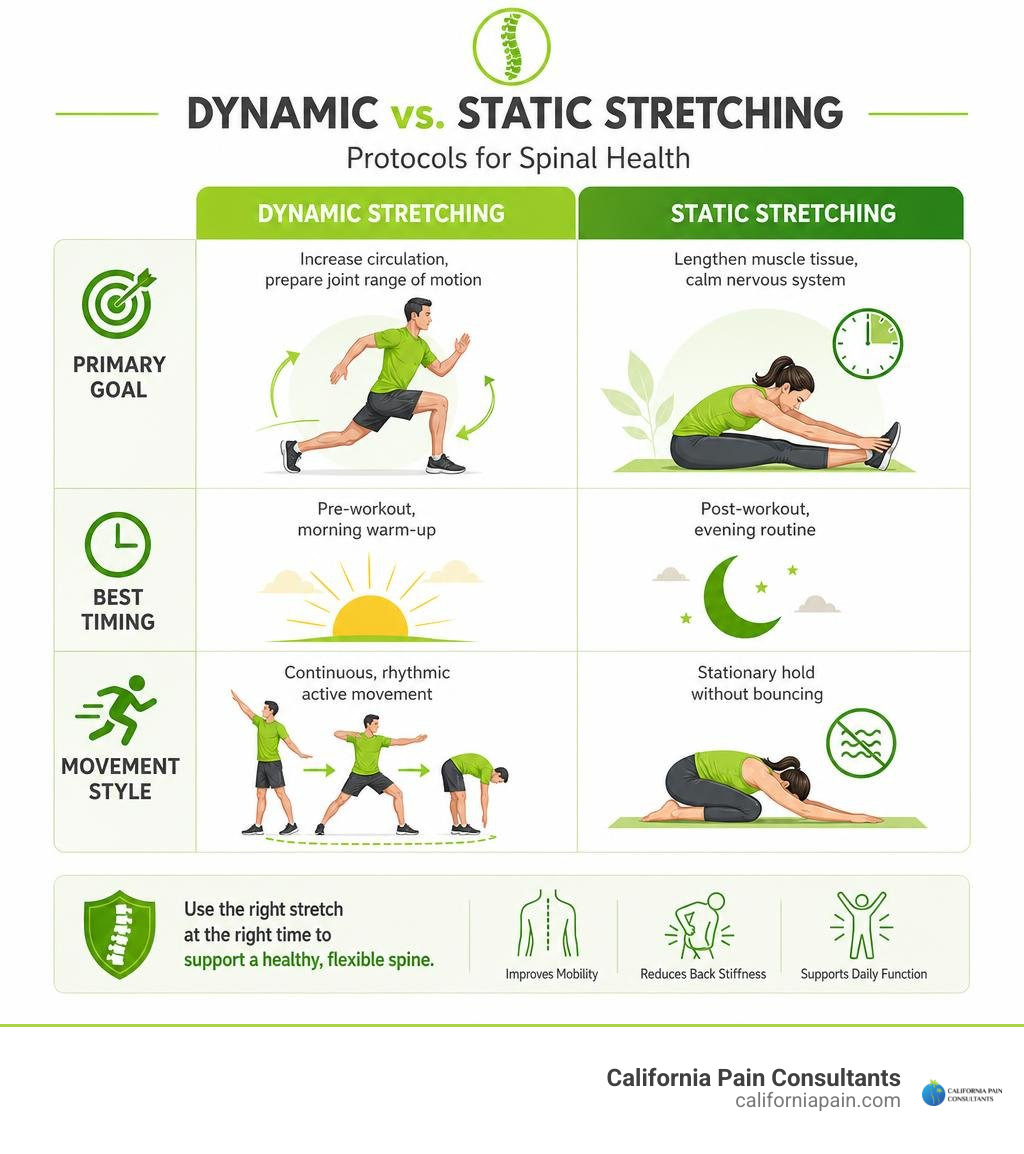
| Aspect | Dynamic Stretching | Static Stretching |
|---|---|---|
| Primary Goal | Increase circulation, prepare joint range of motion | Lengthen muscle tissue, calm nervous system |
| Best Timing | Pre-workout, morning warm-up | Post-workout, evening routine |
| Movement Style | Continuous, rhythmic active movement | Stationary hold without bouncing |
| Hold Duration | 1 to 2 seconds per repetition | 15 to 60 seconds per position |
| Example Move | Cat-Cow flow, Arm circles, Leg swings | Child’s Pose, Supine Spine Twist |
For optimal gains, aim for short, frequent sessions. The American College of Sports Medicine recommends stretching at least 2 to 3 times per week, though daily 10-minute maintenance sessions yield the most noticeable long-term improvements. You can explore our Complete guide to dynamic stretching exercises to learn how to incorporate continuous movements into your morning routine.
Proven Stretches and Techniques to Improve Back Flexibility
Developing a balanced spine requires addressing both the upper thoracic region and the lower lumbar region. Each area serves a different functional purpose in daily movement.
Thoracic and Upper Body Moves to Improve Back Flexibility
The thoracic spine is built primarily for rotation and extension, but forward-slouching desk posture often locks this area in excessive flexion (hyperkyphosis). Opening the thoracic spine directly relieves compensation strain in the lower back and shoulders. You can read more about Thoracic backbend techniques to deepen your understanding of upper back mechanics.
- Cat-Cow Pose: Begin on hands and knees. Inhale as you drop your belly toward the mat, lift your chest, and look slightly upward (Cow). Exhale as you arch your spine toward the ceiling, tucking your chin and tailbone (Cat). Repeat gently for 8 to 10 breath cycles.
- Wall Angels: Stand with your head, upper back, and hips resting lightly against a wall. Place your arms against the wall in a ‘W’ shape. Slowly slide your arms up into a ‘Y’ shape while keeping your back flat, then slide back down. Perform 10 controlled repetitions.
- Open Book Rotations: Lie on your side with knees bent at 90 degrees and arms extended together in front of you. Inhale as you lift the top arm up and open it out to the opposite side, rotating your mid-back while keeping your hips stacked. Hold for a deep breath and return. Complete 8 reps per side.
- Foam Rolling Thoracic Spine: Place a foam roller horizontally across your upper back, beneath your shoulder blades. Support your head with your hands, keep your hips on the floor, and gently lean back over the roller to extend your thoracic spine. Avoid rolling down into the soft lower back area.
Lumbar and Hip Exercises to Improve Back Flexibility
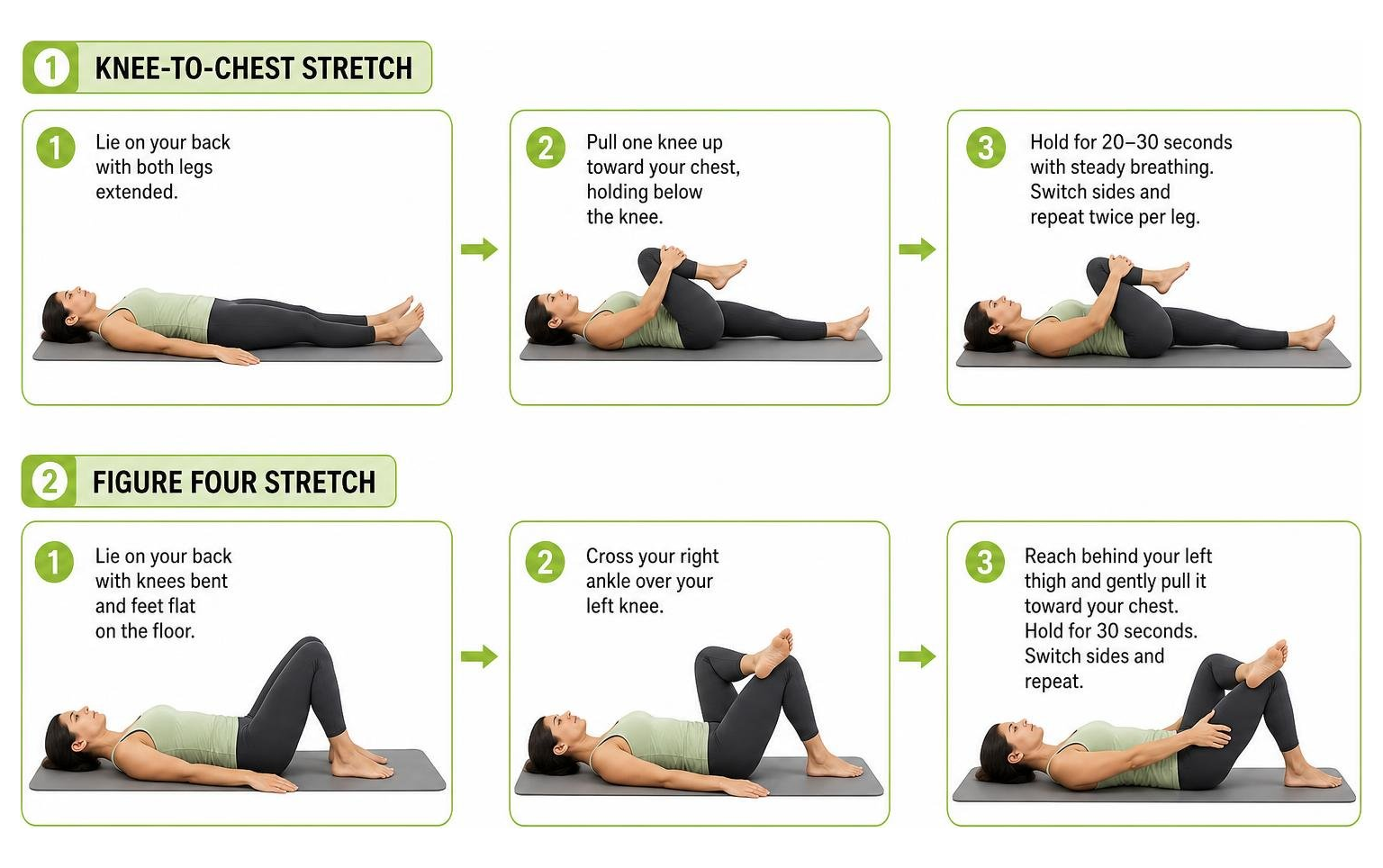
The lumbar spine requires controlled movement paired with glute and hip mobility to relieve chronic tightness. Utilizing our Lower back stretches guide and our detailed Step-by-step lower back stretching guide will help you perform these moves with correct form.
- Knee-to-Chest Stretch: Lie on your back with legs extended. Pull one knee gently up toward your chest using your hands, keeping your opposite leg relaxed on the floor. Hold for 20 to 30 seconds, maintaining steady breathing. Switch sides and repeat twice per leg.
- Piriformis / Figure Four Stretch: While lying on your back with knees bent, cross your right ankle over your left knee. Reach behind your left thigh and gently pull the thigh toward your chest until you feel a deep, comfortable stretch in the right glute and lower back. Hold for 30 seconds on each side.
- Supine Spine Twist: Lie on your back with arms extended out in a ‘T’ position. Bend your knees and drop them together to the right side while keeping both shoulders flat on the floor. Take 5 deep belly breaths, return to center, and drop knees to the left side.
Core Strengthening and Safe Backbends: Protecting Your Spine
Flexibility without strength can lead to joint instability. To safely Improve back flexibility, you must pair stretch routines with core exercises that stabilize the spine.
Core Exercises That Support Spine Mobility
A strong core acts like an internal corset, supporting the lumbar spine during movement. However, traditional core exercises like sit-ups or crunches impose mechanical spinal loads that exceed safe thresholds, squeezing intervertebral discs into flexion under pressure. Instead, rely on neutral-spine exercises.
- Abdominal Bracing: Imagine ‘crushing a soda can’ around your entire midsection, engaging your abdominal wall without pulling your belly button inward or holding your breath. Practice holding this brace while sitting, standing, or lifting objects.
- Planks and Side Planks: Place forearms on the floor with knees or toes extended behind you. Maintain a straight line from ears to ankles or knees, preventing your lower back from sagging. Hold for 15 to 30 seconds.
- Bridge Pose: Lie on your back with knees bent and feet flat on the floor, hip-width apart. Press through your heels and squeeze your glutes to lift your hips until your body forms a straight line from shoulders to knees. Hold for 5 seconds at the top, lower down, and repeat for 10 to 12 reps.
To build a well-rounded fitness framework, explore our guides on Exercises for lower back pain and try The 15 Minute Workout For A Pain Free Back.
How to Perform Safe Backbends Without Pain
Backbends are fantastic for opening the anterior chain, but they frequently cause low back discomfort if you bend exclusively from the hyper-mobile lumbar joints. Because there are 12 thoracic vertebrae compared to only 5 lumbar vertebrae, opening each thoracic joint by just 1 degree significantly decreases the bending burden on your lower back.
Follow this safe progression when practicing backbends, referencing our Backbend flexibility exercises guide:
- Sphinx Pose (Beginner): Lie on your stomach with forearms flat on the floor, elbows under shoulders. Gently draw your breastbone forward and upward while pressing your pelvis flat into the floor. Keep lower abdominals lightly braced to protect your low back. Hold for 30 seconds.
- Cobra Pose (Intermediate): Place palms under shoulders on the floor. Press through your hands to lift your chest higher, keeping hips grounded and elbows slightly bent. Focus on pulling your collarbones wide rather than jamming into your lower spine.
- Camel Pose (Advanced): Kneel upright with knees hip-width apart. Place hands on your lower back for support. Engage your glutes, lift your chest toward the ceiling, and gently lean back. If comfortable, reach hands down to hold your heels.
- Wheel Pose (Full Extension): Achieving a full wheel pose requires exceptional shoulder, hip, and thoracic mobility. Beginners typically require 4 to 8 weeks of consistent practice for basic bridge or camel poses, while deep backbends like wheel pose can take several months or a year to master safely. Never force this position.
Using Props and Safety Precautions for Stiff Backs
If you experience severe stiffness, forcing your body into deep positions without support can trigger muscle guarding—a natural nervous system reflex where muscles contract to prevent perceived injury. Supportive props make stretches accessible and safe.
- Yoga Blocks: Place a block under your upper back (at a low, 4-inch height) and a second block under your head during passive chest openers to support rigid thoracic joints without straining the neck.
- Walls: Use a wall to perform wall slides or supported downward-facing dog variations to control the depth of spinal extension without worrying about losing balance.
- Resistance Bands or Towels: Loop a band around the foot during seated or supine hamstring stretches to keep the spine straight rather than rounding your back to reach your toes.
When practicing at home, follow our guides on Taking care of your back at home and keep in mind these Clinical guidelines for low back pain.
Medical Precautions and Red Flags: Always pause your exercise routine and consult a qualified pain management specialist if you experience any of the following symptoms:
- Sharp, stabbing, or electric pain during or after movement
- Radiating pain, numbness, or tingling traveling down the buttocks, legs, or feet (signs of nerve root impingement like sciatica)
- Recent traumatic injury, fall, or accident causing sudden back pain
- Unexplained weakness in the feet or legs, or sudden loss of bowel or bladder control (emergency red flags requiring immediate medical evaluation)
Frequently Asked Questions About Back Flexibility
How often should I stretch my back to see noticeable improvements?
Consistency is much more critical than duration. Performing gentle daily maintenance sessions lasting 10 to 15 minutes is significantly more effective than doing one long session once a week. Most people notice improved movement ease within 2 to 4 weeks of regular practice.
Can stretching help prevent chronic lower back pain?
Yes. Gentle, consistent stretching keeps intervertebral discs hydrated, releases tight muscle groups that skew pelvic posture, and enhances functional range of motion. Combining regular spinal stretches with hamstring flexibility work can reduce chronic low back pain risk by up to 58%.
Should I stretch my lower back if I am currently in pain?
If you have acute, sharp, or severe back pain, immediate aggressive stretching can aggravate inflamed tissues or nerve roots. Gentle movements like light walking, pelvic tilts, or Child’s Pose are often helpful for mild stiffness, but active pain flare-ups should be evaluated by a medical professional before starting a new exercise regimen.
Restoring Mobility with California Pain Consultants
Improving your spinal flexibility is an empowering, step-by-step process. By balancing upper thoracic extension, lower back stretches, hamstring mobility, and core stability, you give your body the support it needs to stay active and comfortable.
At California Pain Consultants, we specialize in comprehensive, non-surgical pain management to restore patient mobility and quality of life. Serving San Diego, Kearny Mesa, Chula Vista, Rancho Bernardo, La Mesa, and Miramar, California, our team of board-certified doctors offers personalized care tailored to your specific needs.
If back pain or joint stiffness is preventing you from reaching your movement goals, we invite you to Explore structured back workouts and learn more about our Back pain physical therapy options. Contact us today to schedule a consultation at one of our convenient Southern California locations.