
Continuous catheter nerve blocks provide region-specific pain relief through a small flexible catheter positioned next to a target nerve or nerve bundle. A pump delivers a low, controlled dose of local anesthetic for longer relief than a single injection can provide. They are most often used for adults recovering from shoulder, hip, knee, and other orthopedic surgery or serious injury. The board-certified pain specialists at California Pain Consultants in San Diego can help you understand whether a continuous catheter nerve block fits your procedure and recovery plan.
Continuous catheter nerve blocks are most commonly used around surgery or major injury to support comfort, breathing, sleep, and early rehabilitation while reducing reliance on systemic medication. Some programs allow carefully selected patients to continue treatment at home.
Safe continuous catheter nerve blocks depend on ultrasound-guided placement, clear written instructions, monitoring, access to the care team, and prompt recognition of catheter, nerve, infection, or local-anesthetic complications.
Continuous catheter nerve blocks use a perineural catheter and infusion pump to deliver ongoing local anesthetic near a selected nerve for postoperative or injury-related pain control.
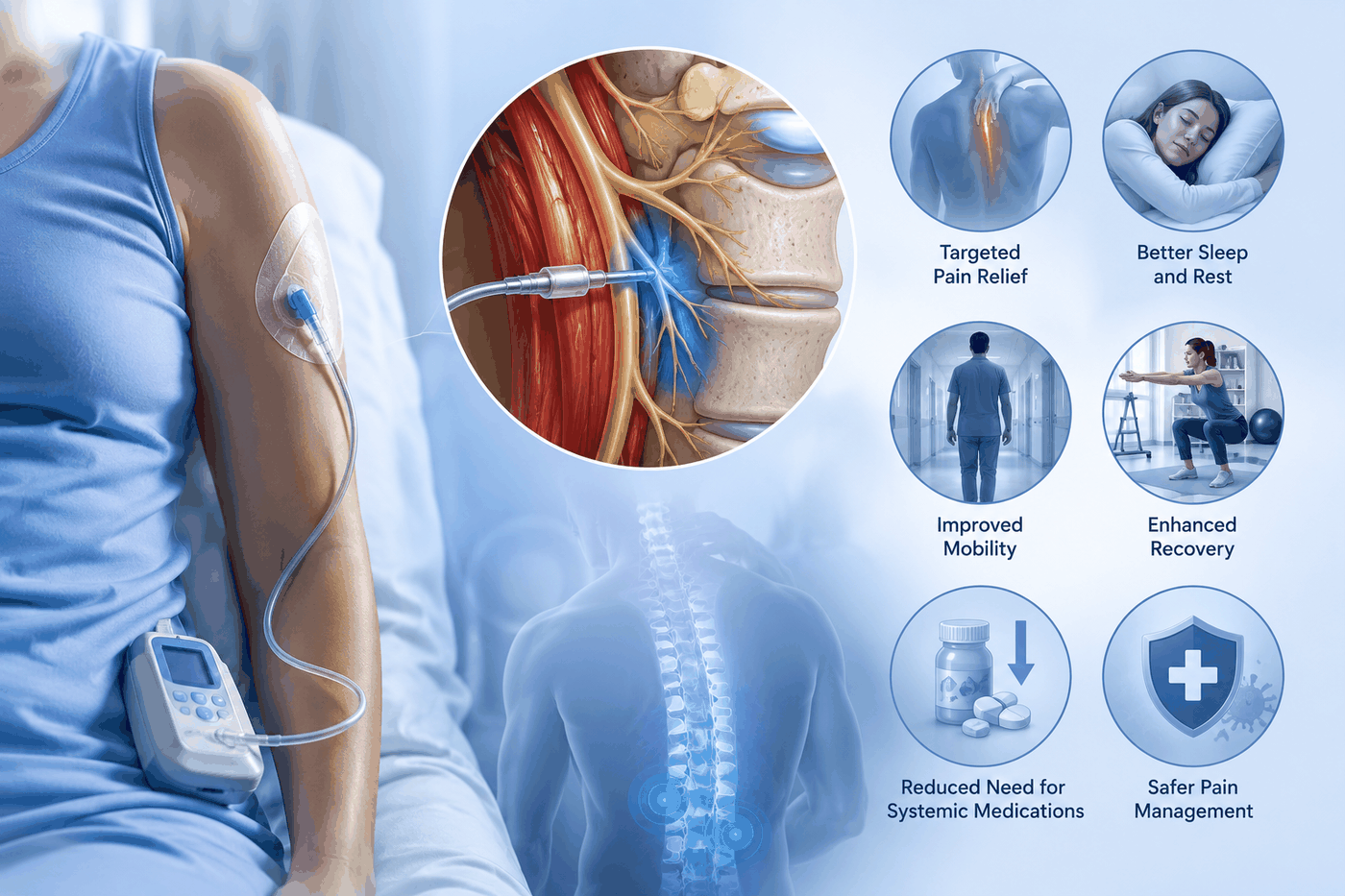
What Is a Continuous Catheter Nerve Block?
Unlike a single-shot nerve block, a continuous block leaves a flexible catheter near the nerve so medication can be infused for a planned period. The difference in duration is significant. The American Society of Regional Anesthesia and Pain Medicine explains that a single-shot block typically provides about 4 to 24 hours of pain relief after surgery, while a catheter generally provides relief for as long as it remains in place.
Local anesthetic reduces pain-signal transmission from a specific body region. Depending on the nerve, dose, and program, sensation and muscle strength may also be reduced, so fall and injury precautions are essential.
Common catheter locations include the shoulder and upper limb, abdominal wall, hip, knee, and lower limb. For shoulder surgery, the catheter is often placed with the same technique used for an interscalene block. The selected approach is determined by the surgical site, anatomy, rehabilitation goals, and safety factors.
When Continuous Catheter Nerve Blocks Are Used
The technique is especially useful when significant regional pain is expected to last longer than a single injection.
Orthopedic Surgery
Shoulder, arm, hand, hip, knee, ankle, and foot procedures may be supported with a catheter placed near the relevant nerve or plexus. Joint replacement and rotator cuff repair are common examples, and our knee pain page describes other options for knee conditions.
Major Injury or Reconstruction
Selected fractures, trauma, or staged procedures may benefit from sustained regional analgesia while other treatment continues.
Enhanced Recovery
Better region-specific pain control may support earlier participation in breathing exercises, walking, joint motion, and physical therapy.
Opioid-Sparing Care
Continuous local anesthetic may reduce the amount of opioid medication needed and therefore limit nausea, sedation, constipation, or respiratory effects.
What Patients May Experience
Expected block effects must be separated from warning signs. The care team should explain what is normal for the specific catheter.
- Reduced pain in the targeted surgical or injury region
- Warmth, tingling, numbness, or heaviness in the blocked area
- Temporary weakness depending on the target nerve and dose
- Improved ability to rest or participate in therapy
- Breakthrough pain if the catheter moves or the pump empties
- Fluid leakage or loosening of the dressing
- Increasing redness, tenderness, drainage, or fever
- Ringing in the ears, metallic taste, severe dizziness, or seizure as toxicity warning signs
How Candidacy Is Evaluated
The anesthesia or pain team evaluates the procedure, expected pain, nerve anatomy, anticoagulation, infection risk, home support, and ability to follow catheter instructions.
Detailed Symptom History
The evaluation covers how symptoms began, their location and timing, triggers, prior treatments, and the ways the condition affects function, sleep, work, and quality of life.
Focused Examination
A condition-specific examination may assess movement, strength, sensation, tenderness, swelling, circulation, balance, and other findings that help identify the likely source.
Selective Testing
Imaging, laboratory work, nerve studies, or other tests are ordered when the results are likely to clarify the diagnosis, exclude another condition, or change treatment.
Safety and Goal Review
Your clinician reviews medications, allergies, medical conditions, prior procedures, and realistic goals so the plan reflects both safety and the activities you want to regain.
Continuous Catheter Nerve Block Placement
Catheter placement is commonly performed before or after surgery with sterile technique, monitoring, and ultrasound guidance.
Step 1: Preparation
The target side and procedure are confirmed, monitoring is applied, and the skin is cleaned and numbed.
Step 2: Ultrasound Identification
Ultrasound displays the target nerve, nearby blood vessels, muscles, and other structures in real time.
Step 3: Needle and Test Injection
A needle is advanced near the nerve. Small injections confirm appropriate spread while symptoms and resistance are monitored.
Step 4: Catheter Placement
A flexible catheter is threaded through the needle, the needle is removed, and the catheter is secured with a sterile dressing.
Step 5: Pump and Education
The catheter is connected to an infusion pump. The patient and caregiver receive instructions about protection, dosing controls, warning signs, contact numbers, and removal.
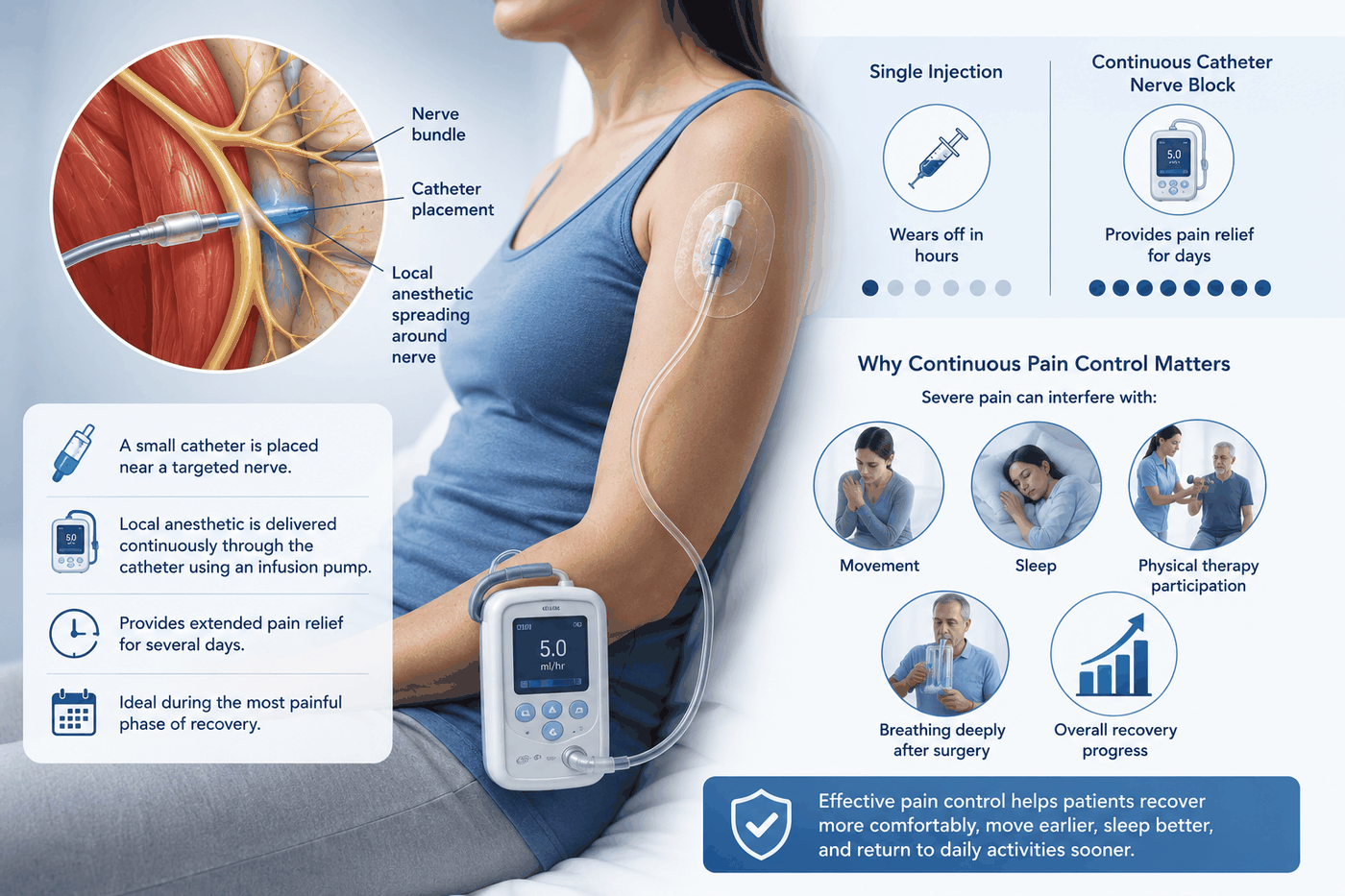
Living Safely With a Nerve Block Catheter
The blocked limb or region may not provide normal protective sensation or strength. Follow the program’s safety rules even when pain control is excellent.
Protect the Numb Area
Use prescribed sling, brace, walker, or assistance. Avoid heat, pressure, sharp objects, and unassisted weight bearing when strength or sensation is reduced.
Monitor the Site and Pump
Check the dressing, tubing, medication reservoir, and pump display as instructed. Do not reconnect a catheter that becomes disconnected.
Daily Communication
Outpatient programs may use scheduled calls. Report pain breakthrough, excessive weakness, leakage, redness, fever, or pump concerns promptly.
Catheter Removal
Removal may occur in the clinic or at home after specific instructions. Confirm that the tip appears intact when instructed and report resistance or uncertainty. Home catheters typically stay in place for a few days; ASRA notes an average of 3 to 4 days for most orthopedic surgeries, and an ASRA review advises that outpatient catheters be removed after 2 to 3 days of infusion.
Potential Benefits and Realistic Expectations
Continuous catheter nerve blocks can support recovery when the program has appropriate selection, education, monitoring, and follow-up.
- Extends regional pain control beyond a single injection
- May reduce opioid use and systemic side effects
- Can support sleep, breathing exercises, walking, and therapy
- Uses an adjustable pump for a planned infusion
- May support earlier discharge for selected procedures
- Targets the painful region while preserving whole-body alertness
Catheter Risks and Emergency Warning Signs
Risks include infection, bleeding, nerve injury, catheter migration, inadequate block, falls, pump malfunction, leakage, and local-anesthetic systemic toxicity. Serious infection is uncommon; in one large series summarized by ASRA, 1.9% of catheters developed an infection, all limited to the insertion site and resolved after removal. Leakage at the site is a more frequent nuisance and usually does not mean the block has failed.
- Stop the infusion and use the emergency instructions for ringing ears, metallic taste, severe dizziness, confusion, seizure, or heart symptoms
- Call for fever, pus, spreading redness, or increasing pain at the catheter site
- Protect a weak or numb limb from falls, burns, pressure, and accidental injury
- Report new breathing difficulty, especially with neck or upper-chest catheter approaches
- Review blood thinners, infection, neurologic disease, and allergies before placement
- Keep the pump, catheter, and written contact information with the patient as instructed
Call 911 for seizure, severe breathing difficulty, collapse, chest symptoms, or another suspected life-threatening reaction.
Continuous Nerve Blocks in Multimodal Recovery
A catheter supports recovery but does not replace nonopioid medication, rehabilitation, wound care, or treatment of the underlying injury.
Scheduled Nonopioid Medication
Acetaminophen, anti-inflammatory medication, or other agents may be used when safe so pain remains controlled as the block changes or ends.
Rehabilitation
The surgical and therapy teams coordinate safe movement while accounting for temporary sensory or motor changes.
Breakthrough-Pain Plan
Written instructions explain what to do if pain rises, the pump alarms, the catheter leaks, or the infusion ends.
Caregiver and Follow-Up Support
A reliable adult, daily contact, and access to the regional anesthesia team may be required for outpatient use.
Plan Better Regional Pain Control for Recovery
California Pain Consultants can review the procedure, expected pain, medication risks, and recovery setting to determine whether continuous catheter nerve blocks are appropriate.
Continuous Nerve Block Care at California Pain Consultants
Planning pain control before surgery can make recovery smoother. At California Pain Consultants, your care team reviews the planned procedure, your health history, medications, and home support, and coordinates with your surgeon and anesthesia team about whether a catheter, a single-shot block, or another approach best fits your needs. For patients whose pain persists long after surgery, we also evaluate and treat chronic post-surgical pain.
We see patients at four clinics across San Diego County: Kearny Mesa, Rancho Bernardo, La Mesa, and Chula Vista. We accept most insurances. Request your appointment or call (858) 571-3630 to talk with your care team.
Book Your AppointmentTrusted Information and Related Care
Medical references: ASRA: Continuous peripheral nerve blocks · ASRA: Pain relief after surgery.
Related California Pain resources: Post-surgical chronic back pain · Shoulder pain · Conditions and treatments.
This article is for general education and does not replace an individualized medical evaluation. Recommendations depend on the diagnosis, health history, current medications, imaging, examination, and personal goals.
Frequently Asked Questions
How long does a continuous nerve block catheter stay in?
Most catheters stay in for a few days. ASRA reports that home catheters remain in place for an average of 3 to 4 days after most orthopedic surgeries, and hospital catheters may be used longer when needed. Your care team will tell you exactly when and how the catheter will be removed.
Does it hurt to have a nerve block catheter placed?
Placement is usually well tolerated. The skin is numbed first, sedation is often given, and ultrasound guidance helps the physician position the needle precisely. You may feel pressure or brief tingling. Once the catheter is in place, most people barely notice the thin tube under the dressing.
Can I go home with a nerve block catheter?
Yes, many patients go home with a catheter connected to a small portable pump. Home use requires clear written instructions, a responsible adult to help, a way to reach the care team, and careful protection of the numb limb. Not everyone is a good candidate, and the decision depends on the surgery and your health.
Will I still need pain medication with a catheter?
Usually yes, but often less. A continuous nerve block is typically combined with scheduled nonopioid medications such as acetaminophen or anti-inflammatory drugs when safe. This multimodal approach helps keep pain controlled as the block wears off and may reduce the need for opioids and their side effects.
What should I do if my pain suddenly gets worse?
Sudden breakthrough pain may mean the catheter has moved, the pump is empty, or the infusion has stopped. Check the pump and tubing as instructed and call your care team promptly. Do not try to reposition or reconnect the catheter yourself. Follow your written instructions for backup pain medication.
How is the catheter removed?
Removal is usually quick and painless. After the infusion ends, the dressing is taken off and the catheter is gently pulled out, either in the clinic or at home following specific instructions. You may be asked to check that the tip looks intact and to report any resistance, bleeding, or unusual findings.