
Why Knee Pain and Joint Stiffness Affect Millions — and What’s Actually Causing It
Dealing with this in San Diego? Same-day appointments are often available at our 4 clinics.
Knee pain and joint stiffness are among the most common reasons adults seek medical care — and for good reason. These two symptoms can make everyday tasks like climbing stairs, getting out of a chair, or walking to the car feel genuinely difficult.
Here are the most common causes at a glance:
| Cause | Type | Key Feature |
|---|---|---|
| Osteoarthritis | Degenerative | Gradual cartilage wear, worse with activity |
| Rheumatoid arthritis | Inflammatory (autoimmune) | Morning stiffness, often affects both knees |
| Meniscus tear | Injury | Locking, swelling, sudden onset |
| ACL/ligament injury | Injury | Instability, often follows a specific event |
| Gout or pseudogout | Crystal arthropathy | Sudden, intense pain and swelling |
| Bursitis or tendinitis | Overuse | Localized tenderness, repetitive strain |
| Inactivity stiffness | Mechanical | Stiffness after rest, eases with movement |
The causes range from acute injuries to slow-developing conditions like arthritis — and more than 100 different types of arthritis alone can affect the knee joint. That complexity is exactly why so many people struggle to get clear answers.
Knee pain is not just a problem for older adults or athletes. About 70% of adults over 40 report stiffness after periods of inactivity, and the knee is one of the most injury-prone joints in the body at any age.
Whether your discomfort started after a sports injury, crept up gradually over years, or flares up every time you sit still for too long — the underlying cause matters. Understanding it is the first step toward real, lasting relief.
I’m Dr. Zach Cohen, double board-certified in Anesthesiology and Chronic Pain, and I’ve spent my career helping patients in San Diego and beyond find non-surgical solutions for knee pain and joint stiffness — from early-stage arthritis to complex chronic conditions. In this guide, I’ll walk you through exactly what’s happening in your knee, why it matters, and what your options are.
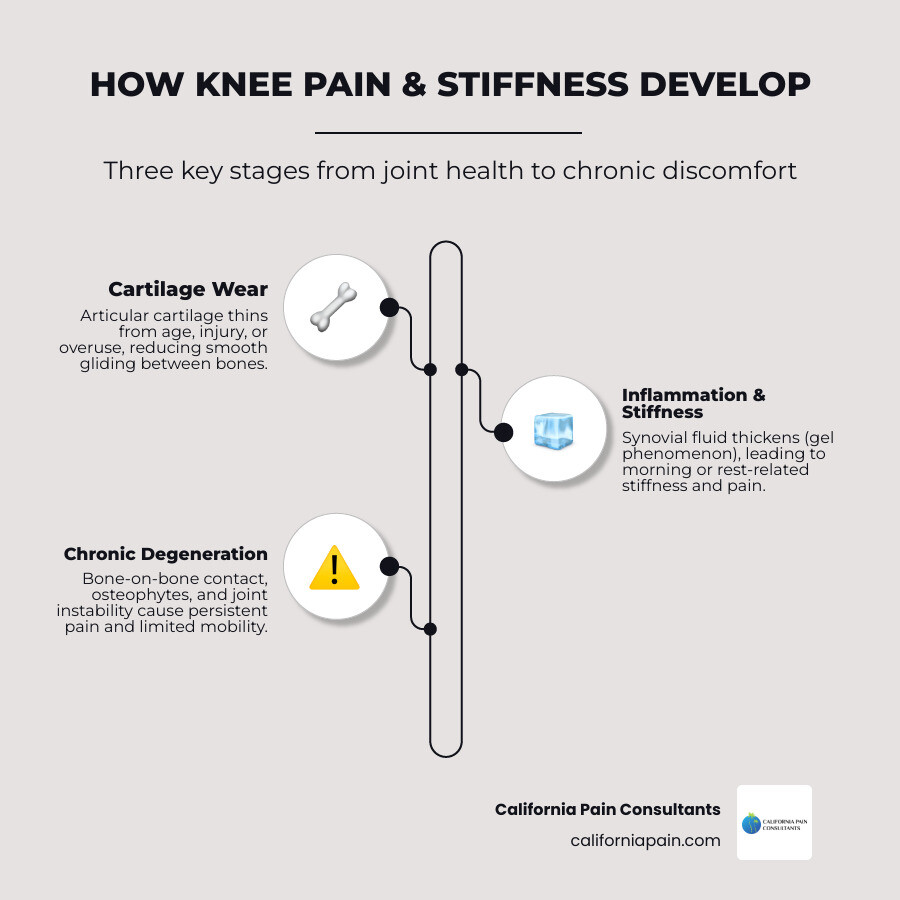
Understanding Knee Pain and Joint Stiffness: Common Causes
To understand why your knees are complaining, we have to look at how the joint is built. The knee is a complex hinge joint where three major bones meet: your thighbone (femur), shinbone (tibia), and kneecap (patella). Cradling these bones are two C-shaped pieces of cartilage called the menisci, which act as shock absorbers, along with a slippery layer of articular cartilage that covers the bone ends so they can glide smoothly.
When any part of this complex machinery is damaged or worn down, the result is often knee pain and joint stiffness.
Here are the primary culprits we diagnose at our clinics in San Diego, La Mesa, and Chula Vista:
- Cartilage Degeneration (Osteoarthritis): This is the classic “wear-and-tear” condition. Over time, the protective cartilage on the ends of your bones wears away. Without this cushion, bone rubs against bone, leading to friction, inflammation, and the formation of bony growths called osteophytes (bone spurs).
- Meniscus Tears: The meniscus can tear suddenly during a sudden twist or pivot on the sports field. However, it can also tear gradually over time due to age-related degeneration. A torn meniscus often causes a catching or locking sensation in the joint.
- Ligament Sprains and Tears: Your knee is held together by major ligaments, including the Anterior Cruciate Ligament (ACL) and Medial Collateral Ligament (MCL). A sprain or a complete tear from a sudden change of direction can destabilize the joint and cause severe swelling.
- Patellar Tendinitis: Often called “jumper’s knee,” this is an overuse injury that inflames the tendon connecting your kneecap to your shinbone. It is highly common in people who perform repetitive jumping or running.
- Arthrofibrosis: Also known as “stiff knee syndrome,” this condition occurs when excessive scar tissue builds up inside the joint, typically following a surgery like an ACL reconstruction or knee replacement. An estimated 2% to 35% of people experience arthrofibrosis post-reconstruction, severely limiting their range of motion.
For a deeper dive into how we isolate these conditions during a clinical evaluation, you can read our guide on moving From Ache To Answer Understanding Your Joint Pain Diagnosis. Additionally, you can explore the clinical overview of Stiff knee: Causes, treatment, and exercises to learn more about how tissue damage translates into physical limitation.
How Knee Pain and Joint Stiffness Differ from Acute Injuries
It is crucial to distinguish between a sudden, acute injury and chronic degenerative wear. If you twist your knee playing soccer and hear a loud “pop” followed by immediate swelling, you are dealing with an acute soft-tissue injury.
Chronic conditions, such as knee osteoarthritis, behave very differently:
- Gradual Onset: Unlike a sports injury, which has a clear “before and after,” arthritic pain starts so gradually that you might not be able to pinpoint exactly when it began. It might start as a mild ache after a long walk and slowly progress to a daily nuisance.
- Crepitus: This is the medical term for the clicking, grinding, popping, or creaking sensations you feel or hear when bending your knee. Unlike the harmless pops of gas bubbles in healthy joints, arthritic crepitus is a physical, bone-on-bone sensation caused by rough, worn-down cartilage surfaces rubbing together.
- Weather Sensitivity: It is not an old wives’ tale — many patients find their symptoms worsen during cold, damp weather. Changes in barometric pressure can cause the tissues inside the joint to expand and contract, triggering pain receptors.
To understand how these wear-and-tear symptoms progress over time, we highly recommend reading our Degenerative Joint Disease Complete Guide. For a detailed clinical breakdown of the physical stages of wear, refer to the Cleveland Clinic’s resource on Knee Osteoarthritis: Symptoms, Stages, Causes & Treatment.
Risk Factors and Complications of Knee Arthritis
Knee arthritis does not develop in a vacuum. Several factors can increase your likelihood of developing this chronic wear:
- Ageing: The risk of developing osteoarthritis increases significantly after age 50, as the body’s natural cartilage-repair mechanisms slow down.
- Obesity: Carrying extra weight places substantial mechanical stress on your knees. (We will look at the exact physics of this shortly!)
- Genetics: If your parents or siblings struggled with joint wear, you may have inherited structural alignments or cartilage characteristics that make you more vulnerable.
- Joint Alignment: Being naturally bowlegged or knock-kneed shifts your weight unevenly across the knee joint, accelerating wear on one side.
- Previous Injuries: Even if a meniscus or ligament tear healed years ago, it alters the joint’s mechanics, frequently leading to post-traumatic osteoarthritis down the road.
If left untreated, chronic knee wear can lead to complications like joint instability, muscle weakness (from avoiding movement), and even mood disorders like anxiety or depression due to limited mobility. You can explore these long-term impacts further in our article on Chronic Knee Pain.
Why Knees Feel Stiff After Periods of Inactivity
Have you ever sat on the couch to watch a movie, only to find that your knees feel like they have been filled with concrete when you try to stand up? You are not alone. This common phenomenon is known as inactivity stiffness or “start-up pain.”
To understand why this happens, we have to look at the joint’s natural lubricant: synovial fluid.
Synovial fluid is a thick, egg-white-like substance that resides inside your joint capsule. Its job is to reduce friction and deliver nutrients to the cartilage. However, synovial fluid has a unique physical property: it is thixotropic. This means it behaves like honey. When it is cold or static, it becomes incredibly thick and viscous. When you move, the joint warms up, and the fluid thins out, flowing easily to lubricate the joint surfaces.
When you sit still, this fluid thickens, and your surrounding muscles and tendons tighten up. This sets off a predictable cycle:
This explains why the first 5 to 10 steps after resting are the most uncomfortable. Once you start walking, the “honey” thins out, and the joint begins to glide smoothly again. For a deeper look at this process, check out the article Knees Hurt After Resting? Inactivity Stiffness.
Morning Stiffness vs. Sitting Stiffness
While both involve start-up pain, there is a key clinical difference between the stiffness you feel after a short daytime rest and the stiffness you experience first thing in the morning:
- Sitting Stiffness (Daytime Inactivity): This typically builds up after just 20 to 30 minutes of being still. Because it is brief, it usually resolves within 2 to 5 minutes of gentle walking.
- Morning Stiffness: This occurs after 6 to 8 hours of overnight sleep. Because of the prolonged rest, the thickening of the synovial fluid (known as the “gel phenomenon”) is much more pronounced.
- The Diagnostic Rule of Thumb: If your morning stiffness loosens up within 30 minutes of waking, it is highly characteristic of osteoarthritis (degenerative). If the stiffness lasts longer than an hour, is symmetrical (affecting both knees or hands), and is accompanied by warmth, it may point to an inflammatory autoimmune condition like rheumatoid arthritis.
If morning stiffness is your primary hurdle, you can find a highly practical, step-by-step approach to loosening up in the guide Morning Knee Stiffness: 3-Step Routine to Fix It (2026).
Effective Home Remedies and Lifestyle Modifications
Managing knee pain and joint stiffness does not always require immediate medical intervention. There are several highly effective strategies you can employ at home to keep your joints happy and moving.
First, let’s look at how to use temperature to your advantage:
| Therapy | When to Use | How It Works | Best Practice |
|---|---|---|---|
| Heat Therapy | Before exercise, first thing in the morning, or for chronic stiffness. | Dilates blood vessels, boosts circulation, and thins thick synovial fluid. | Apply a moist heating pad or warm towel for 15 to 20 minutes. Avoid if the joint is actively swollen. |
| Cold Therapy | After a workout, during an active flare-up, or for sudden swelling. | Constricts blood vessels, numbs sharp pain, and reduces active inflammation. | Apply an ice pack wrapped in a thin towel for 15 minutes on, 15 minutes off. |
For acute swelling or minor injuries, we always recommend starting with the RICE Protocol:
- Rest: Avoid activities that place high impact or repetitive stress on the joint.
- Ice: Apply cold therapy in 15-minute intervals to keep swelling at bay.
- Compression: Wear a light, supportive compression sleeve to retain joint warmth and prevent fluid buildup.
- Elevation: Prop your leg up on a few pillows so your knee is resting above heart level.
Beyond temperature and rest, what you put into your body matters. Staying consistently hydrated is essential for maintaining the volume and quality of your synovial fluid. Additionally, natural anti-inflammatories like curcumin (the active compound in turmeric) can help reduce background joint inflammation. Just remember: curcumin is fat-soluble and has low natural absorption, so always pair it with black pepper extract (piperine) and a healthy fat for it to be effective!
To learn how to safely combine these home remedies with a structured mobility routine, explore our In Depth Guide To Stretching Exercises For Chronic Osteoarthritis Pain.
Targeted Exercises to Relieve Stiffness and Strengthen the Joint
It can feel counterintuitive, but movement is actually medicine for an arthritic or stiff knee. Avoiding movement altogether leads to muscle wasting (sarcopenia) and tighter joints, which only makes the pain worse.
The goal is to perform exercises that strengthen the muscles supporting your knee—specifically your quadriceps, hamstrings, and glutes—without grinding the joint. Here are four excellent moves to start with:
- Heel Slides: Lie on your back on a flat surface. Slowly slide your heel toward your buttocks, bending your knee as far as comfortable, then slide it back out. This gently circulates synovial fluid through its full range of motion.
- Straight Leg Raises: Lie on your back, bend one knee, and keep the other leg straight. Slowly lift the straight leg about 12 inches off the ground, hold for 5 seconds, and lower it. This builds quadriceps strength without placing any compression on the knee joint.
- Hip Bridges: Lie on your back with both knees bent and feet flat on the floor. Squeeze your glutes and lift your hips toward the ceiling. Weak glutes and hips can cause your knees to cave inward during daily movement, so building hip strength is vital for proper knee alignment.
- Low-Impact Cardio: Cycling on a stationary bike with low resistance or swimming are fantastic ways to get your heart rate up and keep your joints moving without the high-impact pounding of running.
For a step-by-step visual walkthrough of these safe, joint-friendly movements, read our guide on Knee Sy Does It Low Impact Moves For Pain Relief.
Preventing Knee Pain and Joint Stiffness Through Lifestyle Changes
If you want to protect your knees for the long haul, proactive lifestyle habits are your best defense:
- Weight Management: Every pound of body weight you carry translates to extra mechanical pressure on your knees. (We will break down the exact math in the FAQ section below!)
- Core and Hip Strength: Your body works as a kinetic chain. Building a strong core and strong hips keeps your pelvis stable, ensuring that your knees track in a straight, healthy line when you walk or run.
- Proper Footwear: Avoid shoes with worn-down soles, which can alter your gait and shift uneven stress to your knees. If you have flat feet, custom orthotics can help stabilize your entire lower body.
- Vary Your Workouts: If you love high-impact sports, try rotating them with low-impact alternatives like yoga, Pilates, or swimming to give your joints a chance to recover.
If you are already experiencing lower-body discomfort, you might also find our resources on hip health useful, such as our guide on Hip Pain Relief Exercises.
Advanced Non-Surgical Treatment Options for Knee Pain
When home remedies and exercises are not quite enough to keep you moving comfortably, it is time to explore advanced, non-surgical medical treatments. At California Pain Consultants, our primary goal is joint preservation—helping you find relief and restore mobility without the need for major surgery.
Many patients benefit immensely from a structured, targeted physical therapy program. A physical therapist can identify specific muscle imbalances, correct your walking form, and use specialized modalities to reduce localized tissue tightness.
Additionally, wearable medical devices can make a massive difference. For instance, an unloader knee brace is custom-molded to shift pressure away from the worn-out side of your knee joint to the healthier side, instantly reducing bone-on-bone friction during daily walks.
To understand how these therapies fit into a comprehensive care plan, you can read our overview of Non Surgical Knee Pain treatments, or check out our guide Joint Venture Finding Relief Without Going Under The Knife.
Interventional Injections and Regenerative Medicine
For moderate to severe chronic pain, interventional joint injections can provide targeted, medium-to-long-term relief, creating a “window of opportunity” for you to strengthen your muscles without pain.
- Corticosteroid Injections: These are highly powerful anti-inflammatory medications injected directly into the joint space. They are incredibly effective at knocking down acute, severe swelling and pain, though we use them selectively to protect joint tissue over time.
- Hyaluronic Acid (Viscosupplementation): Also known as “gel shots,” this treatment injects a gel-like substance directly into the knee joint. It acts as a physical lubricant and shock absorber, mimicking your body’s natural synovial fluid to ease bone-on-bone friction.
- Platelet-Rich Plasma (PRP) Therapy: A form of regenerative medicine where we take a small sample of your own blood, spin it in a centrifuge to concentrate the healing platelets, and inject it back into the knee. PRP helps reduce background inflammation and supports your body’s natural tissue-repair processes.
- Genicular Nerve Blocks and Radiofrequency Ablation (RFA): If you suffer from severe pain but are not a candidate for surgery (or wish to avoid it), we can target the genicular nerves—the sensory nerves that transmit pain signals from your knee to your brain. By temporarily blocking or using gentle heat to stun these nerves, we can interrupt the pain signals, providing long-lasting relief.
To learn more about how these targeted treatments work, explore our guides on Knee Pain Injections, Regenerative Medicine, and Knee D A Lift With Regenerative Injections.
Non-Surgical Alternatives to Knee Surgery
Many patients visit our offices in San Diego, La Mesa, and Chula Vista believing that a total joint replacement is their only option. However, modern interventional pain management offers a wide array of highly effective alternatives that can successfully delay or completely eliminate the need for surgery.
By combining physical therapy, weight management, custom bracing, and advanced injections, we can manage symptoms of even advanced (Stage 3 or 4) osteoarthritis. This multi-pronged approach preserves your natural joint anatomy, avoids the lengthy recovery times associated with surgery, and helps you return to the activities you love.
You can read more about these long-term management strategies in our guide on the Treatment For Chronic Knee Pain.
Frequently Asked Questions about Knee Stiffness
When should I see a doctor for knee pain or stiffness?
While minor stiffness after a long workout or a brief rest is common, you should seek professional medical evaluation if you experience any of the following warning signs:
- Inability to Bear Weight: If your knee buckles or you cannot stand on that leg without sharp pain.
- Joint Instability: If you feel like your knee is giving way, catching, or physically locking up.
- Signs of Infection: If your knee is hot to the touch, visibly red, heavily swollen, or accompanied by a fever (which could point to septic arthritis).
- Persistent Stiffness: If your morning or rest-related stiffness lasts longer than 30 to 60 minutes and does not improve with gentle movement.
For a complete checklist of symptoms that require a specialist’s eye, consult our Complete Knee Pain Treatment Guide.
How does excess weight affect the knee joints?
Carrying extra weight places a disproportionate mechanical load on your knees. When you walk on flat ground, the force across your knees is actually 4 times your body weight. If you climb stairs, that force increases to about 8 times your body weight.
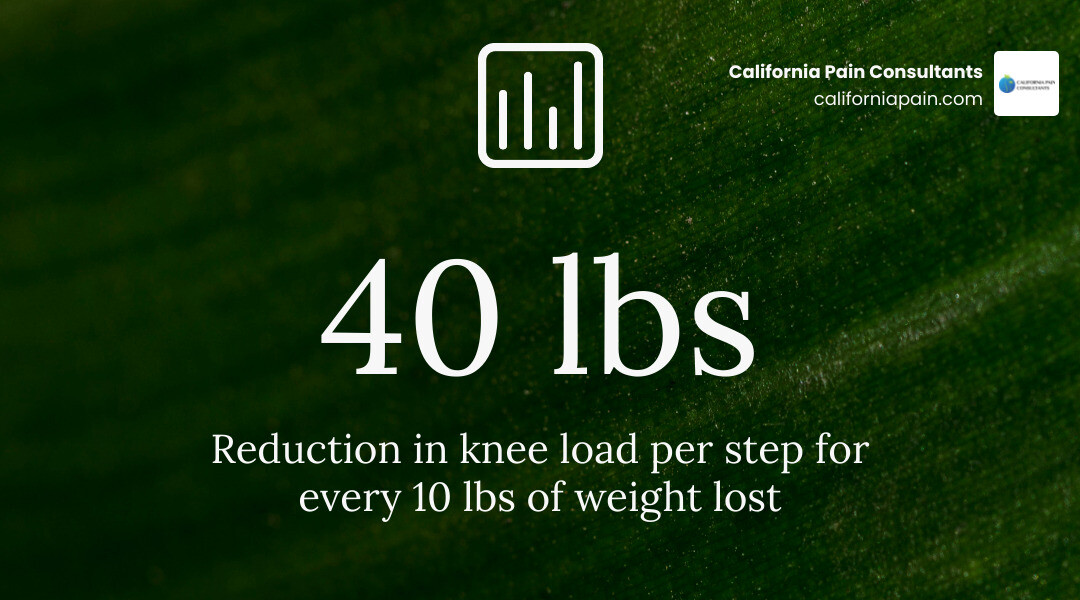
This means that losing just 10 pounds can reduce the load on your knees by up to 40 pounds per step! Furthermore, clinical studies show that losing just 10% of your body weight can significantly reduce your overall risk of developing knee osteoarthritis. To explore how weight loss and metabolic health impact joint wear, read our article on What Is The Best Pain Treatment For Chronic Osteoarthritis.
What is the difference between gout and pseudogout in the knee?
Both are forms of “crystal arthropathy”—conditions where microscopic crystals deposit inside the joint fluid, causing sudden, incredibly painful inflammatory flares. However, they are caused by different chemical compounds:
- Gout: Caused by a buildup of uric acid crystals. It is often linked to diet (such as consuming high amounts of red meat, alcohol, or shellfish) and frequently starts in the big toe before affecting other joints like the knee.
- Pseudogout: Properly known as Calcium Pyrophosphate Deposition (CPPD), it is caused by calcium crystals. It most commonly targets the knee joint and is frequently mistaken for gout, though its triggers and long-term management are clinically distinct.
If you are experiencing sudden, intense joint swelling, you can read more about finding targeted relief in our guide on Joint Pain Relief San Diego.
Conclusion
Living with knee pain and joint stiffness can make your world feel smaller, turning simple daily movements into major physical hurdles. But as we have explored in this guide, you do not have to just tolerate the discomfort, nor do you have to jump straight to major surgery.
At California Pain Consultants, we specialize in comprehensive, non-surgical pain management. Our board-certified doctors are dedicated to creating personalized, multifaceted treatment plans designed to reduce your pain, preserve your natural joints, and restore your mobility. With convenient locations throughout the region—including San Diego, Kearny Mesa, Chula Vista, Rancho Bernardo, La Mesa, and Miramar—compassionate, expert care is always close to home.
If you are ready to stop managing your pain and start reclaiming your active lifestyle, we are here to help. Explore our dedicated page on Pain Management For Knee Pain and schedule your personalized consultation with our specialists today.