
Gentle Lower Back Stretches for Older Adults Can Ease Stiffness
Dealing with this in San Diego? Same-day appointments are often available at our 4 clinics.
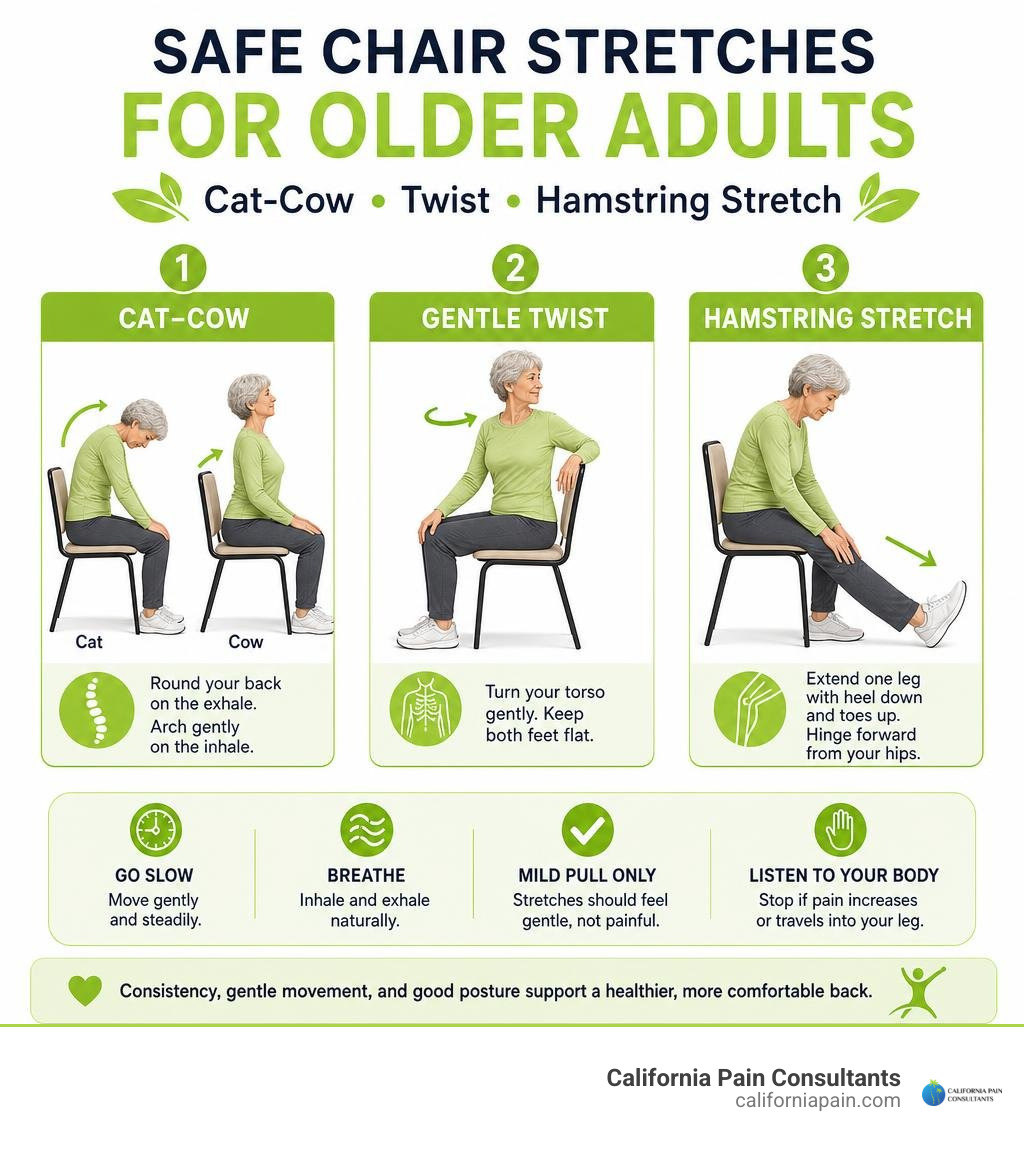
Safe lower back stretches for older adults should feel like a mild pull, never sharp or shooting pain. Start with a sturdy chair: sit tall with both feet flat, then try slow seated cat-cow movements, a gentle torso turn without forcing it, and a seated hamstring stretch. Move slowly, breathe normally, and stop if pain travels into your leg or gets worse.
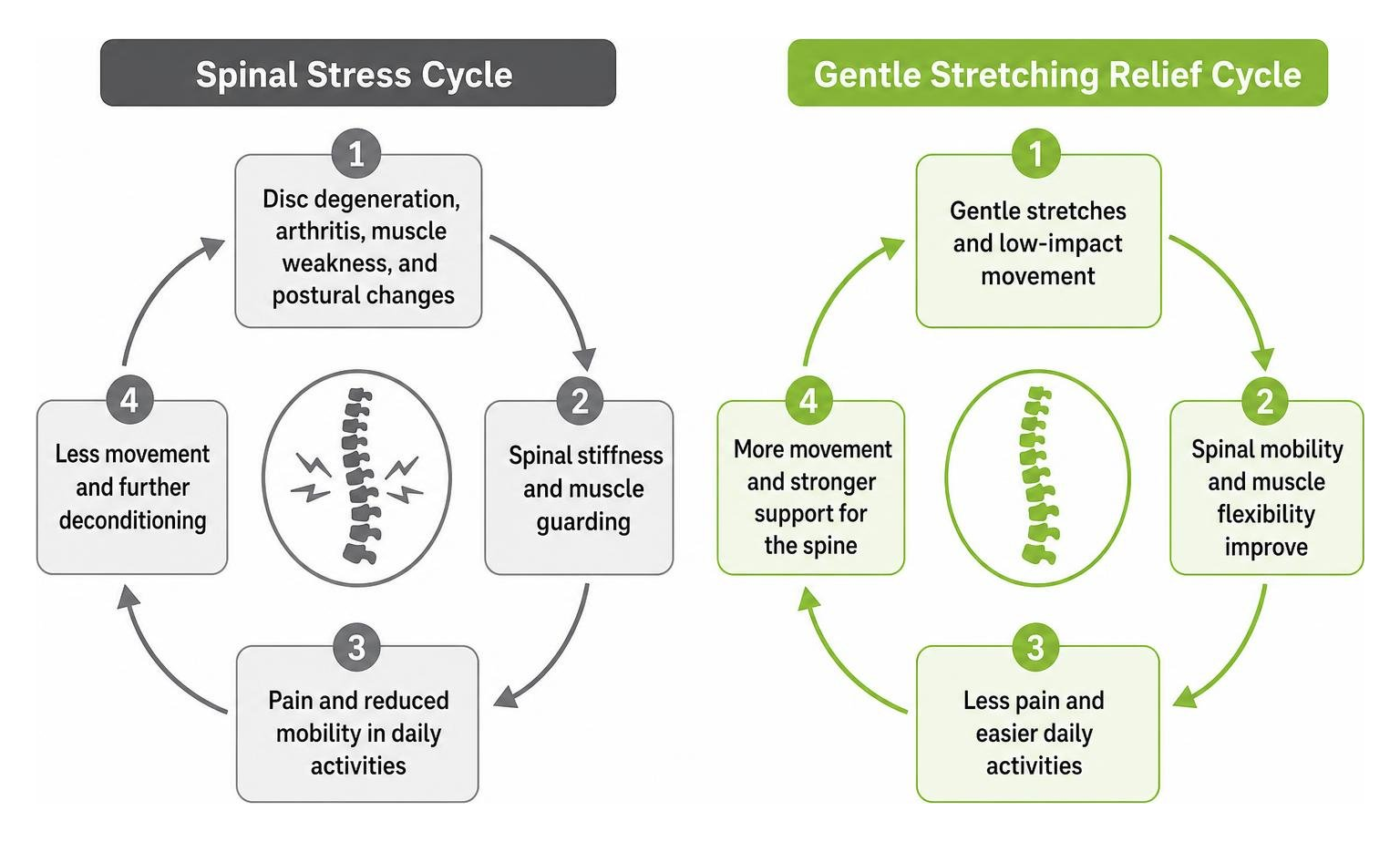
Lower back pain becomes more common with age because spinal discs lose flexibility, joints can develop arthritis, and the muscles that support the spine may weaken with less activity. Gentle movement can help reduce stiffness, improve posture, and make everyday tasks – such as standing from a chair, walking, or putting on shoes – feel easier.
I am Dr. Zach Cohen, a double board-certified physician in anesthesiology and chronic pain medicine who treats lower back, joint, and nerve pain. In my work with patients, I encourage individualized, low-impact approaches to lower back stretches for older adults as part of a broader plan for safer movement and lasting function.
Lower back stretches for older adults definitions:
- lower back stretches for muscle spasms
- lower back stretches for office workers
- stretches for the lower back
Why Lower Back Pain Affects Older Adults and How Stretching Helps
As we move through our golden years, our bodies undergo natural mechanical shifts. As many as 75% of adults over the age of 60 experience lumbar discomfort at some point, and at least one-fourth of U.S. adults report experiencing back pain in the past three months alone.
Understanding what causes these symptoms makes managing them far less intimidating:
- Disc Degeneration: Over decades, intervertebral discs gradually lose their water content and shock-absorbing bounce, leading to reduced spinal cushioning.
- Lumbar Osteoarthritis: The small facet joints guiding spinal motion can experience cartilage wear, causing localized inflammation and morning stiffness.
- Muscle Deconditioning: Natural muscle loss (sarcopenia) combined with sedentary habits can weaken the deep postural muscles that hold our spine upright.
- Postural Changes: Aging often encourages rounded shoulders and a forward head posture, tilting the pelvis and placing uneven strain across the lumbar spine.
Targeted, consistent movement provides a reliable first line of defense. When we practice gentle stretching, we promote spinal decompression, improve local circulation, and calm protective muscle guarding. In fact, clinical research shows that consistent, low-intensity exercise reduces chronic lower back pain in adults over 60 by an average of 30% to 40% within 8 to 12 weeks.
Furthermore, evidence published on the effects of combined hip exercise and passive stretching on muscle stiffness, pain perception and pain related disability, and physical function in older adults with low back pain demonstrates that lengthening tight connective tissues around the pelvis directly relieves compensatory strain on the lumbar vertebrae. By incorporating supportive protocols from our guide on Elderly Pain Management: Keeping Seniors Comfortable, older adults can safely preserve their spinal flexibility and enjoy active, fulfilling routines.
Essential Precautions and Setup Before Starting
Starting a mobility routine should bring peace of mind, not stress. Establishing a safe environment and respecting your body’s daily boundaries ensures you gain the benefits of stretching without risking a setback.
Equipment and Setup for Lower Back Stretches for Older Adults
You do not need an expensive home gym or specialized athletic gear to stretch effectively. A few simple household items will support your routine:
- A Sturdy Chair: Choose a firm, armless dining chair without wheels. A rigid seat encourages an upright pelvis and proper spinal alignment.
- A Cushioned Mat or Firm Bed: If you transition to floor exercises, use a non-slip yoga mat. If getting down to the floor is difficult, a firm mattress works well.
- A Rolled Towel or Small Cushion: Placing a small towel roll behind your lower back or under your head provides targeted spinal support.
- Warm-Up Movement: Always precede stretching with 3 to 5 minutes of light walking around your living room or gentle seated marching to warm the muscles.
- Diaphragmatic Breathing: Inhale deeply through your nose, letting your belly expand, and exhale slowly through your mouth. Never hold your breath while holding a stretch.
Exercises and Stretches Seniors Should Avoid
Not all popular fitness movements are suitable for mature spines. Exercises that force deep forward bending under tension can compress degenerative discs or exacerbate spinal joint wear.
We recommend avoiding the following movements:
- Standing Toe Touches: Bending forward with straight legs places excessive shear stress on lumbar discs and tight hamstrings.
- Full Sit-Ups and Crunches: Repetitive spinal flexion under load strains both the neck and lower lumbar vertebrae.
- Aggressive Torso Twisting: Rapid or forced rotational movements can pinch spinal nerves and irritate arthritic facet joints.
- Heavy Bending with Rounded Posture: Lifting objects while rounding your back shifts physical loads entirely onto your ligaments rather than your leg muscles.
Warning Signs and When to Seek Medical Evaluation
While a mild, therapeutic pulling sensation is normal during a stretch, pain is your body’s stop sign. If you experience any of the following “red flag” symptoms, discontinue exercises immediately and seek evaluation from a healthcare provider:
- Sharp, electric, or stabbing pain in the spine or hips.
- Numbness, tingling, or “pins and needles” traveling down your buttocks, thighs, calves, or feet.
- Sudden muscle weakness, such as difficulty lifting your toes (foot drop) or feeling your knees buckle.
- Any sudden change in bowel or bladder function, which may indicate a rare but serious spinal nerve compression called cauda equina syndrome.
- Pain following a direct fall, trauma, or accompanied by an unexplained fever.
7 Safe and Gentle Lower Back Stretches for Older Adults
Below is an overview of seven gentle stretches adapted for varying comfort levels, whether you prefer sitting upright, resting comfortably on a firm mattress, or standing with counter support.
| Stretch Name | Position | Primary Target | Recommended Hold / Reps |
|---|---|---|---|
| 1. Seated Cat-Cow | Seated in Chair | Lumbar & Thoracic Spine | 5 to 8 slow breaths |
| 2. Gentle Seated Twist | Seated in Chair | Obliques & Spinal Rotators | 15–20 seconds per side |
| 3. Seated Hamstring Stretch | Seated on Edge | Posterior Thigh & Pelvis | 20–30 seconds per leg |
| 4. Pelvic Tilts | Supine (Bed / Floor) | Transverse Abdominis & Low Back | 8 to 10 repetitions |
| 5. Single Knee-to-Chest | Supine (Bed / Floor) | Gluteus Maximus & Lumbar Flexors | 20–30 seconds per leg |
| 6. Supine Bridge | Supine (Bed / Floor) | Glutes & Core Stabilizers | 5–8 slow repetitions |
| 7. Standing Back Extension | Standing Supported | Anterior Hips & Postural Extensors | 5 to 10 seconds (3 reps) |
Seated Lower Back Stretches for Older Adults with Limited Mobility
Chair-based movements allow you to isolate and mobilize the spine while remaining fully supported. Reviewing our foundational techniques on How to Stretch Lower Back will help you maintain ideal posture during these seated variations.
1. Seated Cat-Cow
Sit near the front half of your sturdy chair with your feet flat on the floor, hip-width apart. Rest your hands gently on your knees.
- Inhale: Gently lift your chest upward, draw your shoulder blades slightly back, and allow your lower back to arch gently into an open posture.
- Exhale: Slowly round your spine forward, tucking your chin toward your chest and drawing your navel gently inward.
- Move smoothly between these two shapes for 5 to 8 breaths, focusing on fluid spinal movement.
2. Gentle Seated Spinal Twist
Sit tall with your feet firmly planted. Rest your right hand on your left thigh and place your left hand on the side of the chair seat.
- Inhale to lengthen your spine toward the ceiling.
- Exhale and gently rotate your upper torso to the left.
- Avoid using your arms to wrench or force the rotation; let the muscles of your torso guide the turn.
- Hold for 15 to 20 seconds while taking slow, deep breaths, then slowly unwind and repeat on the right side.
3. Seated Hamstring Stretch
Tight hamstrings tug downward on your pelvis, flattening the natural curve of your lower spine and causing stiffness.
- Sit on the front edge of your chair. Extend your right leg straight out in front of you with your heel resting on the floor and toes pointing upward.
- Keep your left knee bent at a 90-degree angle with the foot flat for stability.
- Place your hands on your bent left thigh. Keep your spine straight, hinge forward gently at your hips, and lean your chest forward until you feel a comfortable stretch along the back of your right thigh.
- Hold for 20 to 30 seconds, breathe evenly, and switch legs.
Bed and Floor-Based Stretches for Spinal Mobility
If you can comfortably recline on a firm bed or a carpeted floor, these supine movements provide gentle decompression for the lumbar vertebrae. For additional structured options, exploring our collection of Exercises for Lower Back Pain offers complementary mobility exercises, while clinical routines like the Mayo Clinic’s Back exercises in 15 minutes a day highlight how brief, supported movement preserves back health.
4. Supported Pelvic Tilts
Lie on your back with your knees bent and feet flat on the surface, about hip-width apart.
- Relax your shoulders and arms by your sides.
- Gently flatten your lower back against the mattress or floor by drawing your belly button in toward your spine and tilting your hips slightly upward.
- Hold this flattened position for 5 seconds while breathing smoothly, then relax back to your neutral starting position.
- Perform 8 to 10 slow repetitions to wake up deep abdominal stabilizers.
5. Single Knee-to-Chest Stretch
Lie flat on your back with both knees bent and feet resting flat.
- Slowly raise your right knee toward your chest. Clasp your hands around the back of your right thigh (or behind the knee) rather than over the shin to protect your knee joint.
- Gently pull the thigh toward your torso until you feel a mild release in your lower back and hip.
- Hold for 20 to 30 seconds, maintaining steady breathing.
- Lower the foot slowly and repeat with the left leg. (Tip: If reaching your thigh is difficult, loop a soft bath towel behind your thigh and hold both ends).
6. Supine Bridge (Gentle Glute Activation)
A healthy lower back depends on supportive gluteal muscles.
- Begin on your back with knees bent and feet flat, arms resting along your sides.
- Engage your abdominal core and squeeze your glutes.
- Press down through your heels to raise your hips a few inches off the surface, creating a straight, comfortable diagonal line from your knees to your hips and shoulders.
- Hold at the top for 3 full seconds, then slowly lower down one vertebra at a time. Repeat 5 to 8 times.
7. Supported Standing Back Extension
This gentle movement counteracts the hunched posture that develops from sitting or reading.
- Stand upright with feet shoulder-width apart. For added stability, stand near a kitchen counter or wall that you can touch if needed.
- Place the palms of your hands against your lower back or upper buttocks, fingers pointing downward.
- Inhale deeply, lift your chest, and gently lean your torso backward just a few degrees.
- Keep your neck neutral (do not drop your head back excessively) and hold the extension for 5 to 10 seconds while breathing normally.
- Slowly return upright and repeat 3 times.
How to Build a Safe Daily Stretching Routine
Consistency creates lasting mobility. You do not need to set aside an hour of strenuous effort; dividing your stretching into brief 5-to-10-minute movement sessions throughout the day is both safer and more sustainable for older adults.
- Morning Wake-Up: Perform 5 pelvic tilts and single knee-to-chest stretches while still in bed to ease overnight joint stiffness.
- Midday Posture Reset: Take 5 minutes after lunch to perform the seated cat-cow and seated hamstring stretches from your favorite chair. Reviewing our Daily Back Stretches Guide can help you structure these short breaks seamlessly.
- Evening Wind-Down: Complete gentle seated twists and supported standing back extensions before relaxing for the evening to release physical tension accumulated during the day.
Pairing your flexibility routine with light hip-strengthening movements (like mini-squats to a chair or standing side leg lifts) provides stable pelvic support, keeping you balanced, confident, and functionally independent.
Frequently Asked Questions About Lower Back Stretches for Older Adults
How often should older adults stretch their lower back?
Older adults benefit most from gentle stretching performed daily or at least 3 to 4 times per week. Brief, 10-to-15-minute sessions are far more effective at reducing muscle stiffness than long, irregular workouts. Always progress slowly, adding repetitions only as movements feel comfortable.
Is it safe to do back stretches in bed instead of the floor?
Yes. Performing supine movements (such as pelvic tilts, knee-to-chest stretches, and bridges) on a firm mattress is safe and eliminates the fall risk or joint strain associated with getting down to and up from the floor. If your mattress is very soft, seated chair stretches provide an ideal alternative.
Can hip exercises make lower back stretching more effective?
Yes. The hips and lumbar spine function as an interconnected unit. When hip muscles become tight or weak, the lower back is forced to compensate by absorbing extra movement and mechanical load. Combining gentle hip stretches with pelvic stabilization exercises significantly reduces strain across the lower lumbar spine.
Conclusion
Managing lower back pain does not require aggressive workouts or complicated routines. By introducing safe, low-impact seated, supine, and supported standing stretches into your daily routine, you can ease joint stiffness, improve your posture, and maintain your everyday physical independence. Always prioritize smooth, pain-free motion, synchronize your stretches with relaxed breathing, and listen closely to your body’s feedback.
When at-home stretching is not providing sufficient relief, or if chronic pain interferes with your favorite daily activities, our team at California Pain Consultants is here to help. Serving patients across San Diego, Kearny Mesa, Chula Vista, Rancho Bernardo, La Mesa, and Miramar, California, our board-certified physicians specialize in compassionate, non-surgical pain management plans tailored to your specific lifestyle. Explore our comprehensive pain management services to take the next step toward comfortable, confident movement.