
Hip Arthritis Doesn’t Have to End in Surgery
Dealing with this in San Diego? Same-day appointments are often available at our 4 clinics.
Stem cell hip arthritis treatment is a minimally invasive option that uses your body’s own healing cells to reduce pain and slow joint damage — without replacing the hip.
Quick answers for people exploring stem cell therapy for hip arthritis:
| Question | Short Answer |
|---|---|
| Who is it best for? | Mild to moderate hip osteoarthritis (grades I–III) |
| How well does it work? | 60–90% of patients report meaningful pain relief |
| How long do results last? | Typically 2–5+ years |
| Is it surgery? | No — outpatient injection procedure |
| Is it covered by insurance? | Generally not; it’s out-of-pocket |
| When should I consider hip replacement instead? | Severe (bone-on-bone) arthritis, grade IV |
Hip arthritis affects hundreds of millions of people worldwide. By 2050, the hip joint is projected to see the largest growth in osteoarthritis cases of any joint — a 78.6% increase globally.
Yet more than 450,000 Americans undergo total hip replacement every year. Many don’t realize there are non-surgical options worth exploring first.
That’s the gap stem cell therapy is starting to fill.
If you have mild to moderate hip arthritis and you’re not ready for surgery — or want to avoid it entirely — this guide walks you through everything you need to know.
I’m Dr. Zach Cohen, double board-certified in Anesthesiology and Chronic Pain, with fellowship training in Chronic Pain Medicine at UC San Diego. My work in regenerative and interventional pain management gives me a front-row view of how stem cell hip arthritis treatments are evolving — and who they actually help. In the sections below, I’ll break down the science, the realistic outcomes, and how to decide if this approach is right for you.
Stem cell hip arthritis terms to know:
Understanding Stem Cell Hip Arthritis Therapy and How It Works

To understand how stem cells help an arthritic hip, we first have to look at what is happening inside the joint.
In a healthy hip, the ball (femoral head) and socket (acetabulum) are coated in a slick, protective layer of articular cartilage. This cartilage allows the joint to glide smoothly. When osteoarthritis sets in, this protective cartilage slowly wears away. Because cartilage lacks its own blood supply, it has virtually no ability to repair itself. As the cartilage thins, the joint becomes inflamed, stiff, and painful.
This is where regenerative medicine steps in. When we perform cellular therapy, we use adult mesenchymal stem cells (MSCs) to target the root microenvironment of the damaged joint. You can read a broader overview of this in our guide: What is Stem Cell Therapy?.
For a long time, scientists believed that injected stem cells simply transformed directly into new cartilage cells. Today, we know the process is far more sophisticated. Stem cells primarily work through paracrine signaling. Think of stem cells as highly efficient “project managers” rather than construction materials. Once injected into the hip joint, they release a powerful cocktail of bioactive molecules:
- Anti-inflammatory Cytokines: These molecules actively quiet down the chronic, painful inflammation inside the joint.
- Growth Factors: These proteins stimulate your tissue’s natural repair pathways, encouraging cellular health and survival.
- Immunomodulatory Agents: They signal your immune system to stop attacking the joint lining, helping to preserve the cartilage you still have.
The clinical safety and biological potential of this approach are well-documented. For instance, a landmark study published in Mesenchymal stem cell therapy in the treatment of hip osteoarthritis demonstrated that patients receiving autologous mesenchymal stem cells experienced significant improvements in pain, joint stiffness, and overall physical function, with benefits sustained over a long-term follow-up of up to 40 months.
Who is a Candidate for Stem Cell Hip Arthritis Treatment?
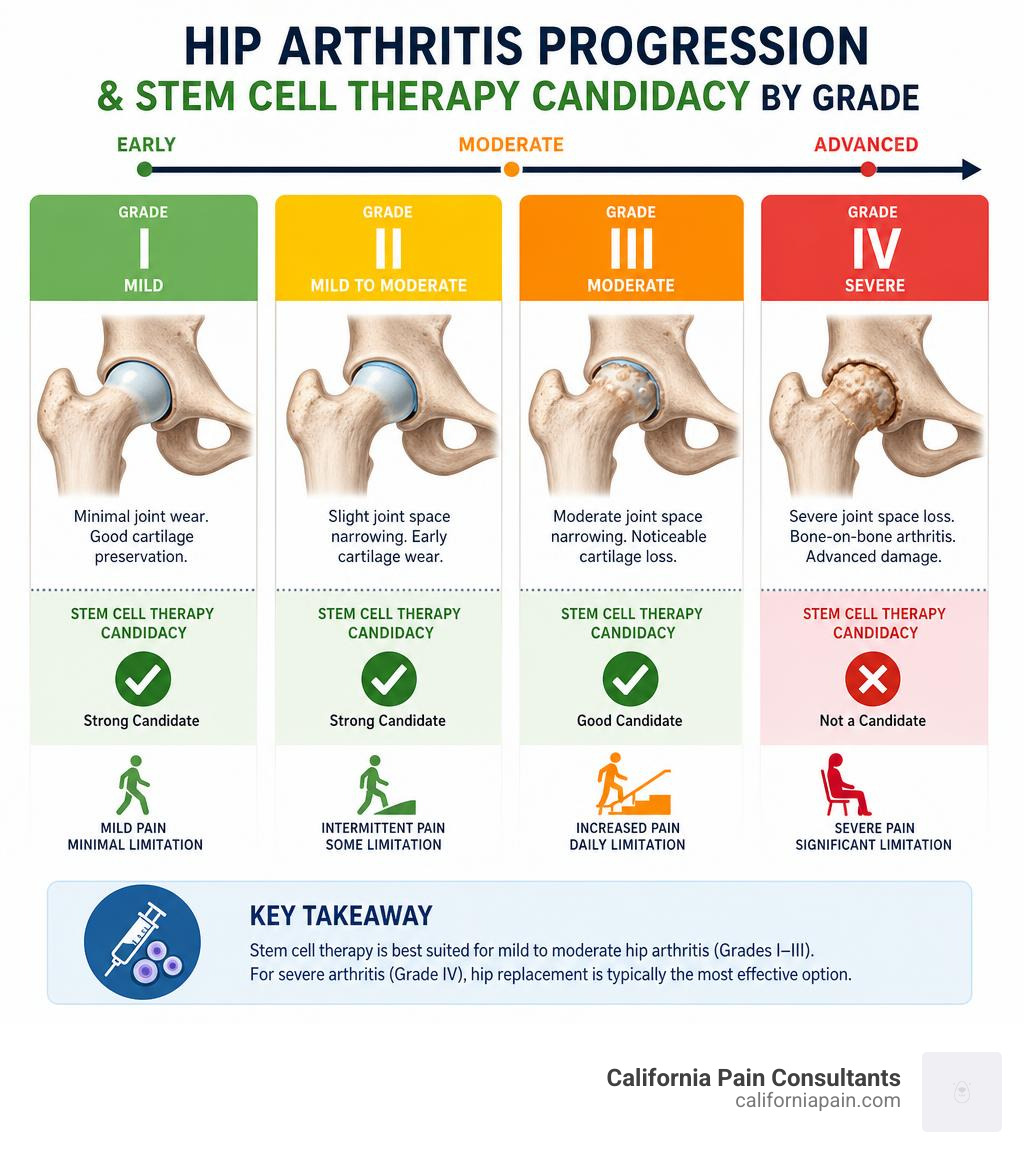
Not everyone with hip pain is a good candidate for cellular therapy. To determine if this treatment will work for you, we look closely at your joint damage using the Kellgren-Lawrence (KL) grading system, which stages osteoarthritis from Grade I to Grade IV:
- Grade I (Doubtful): Minor stretch of bone spurs (osteophytes), no pain. Usually managed with exercise or physical therapy.
- Grade II (Mild): Definite bone spurs, but the joint space remains normal. Excellent candidate for regenerative therapy.
- Grade III (Moderate): Moderate narrowing of the joint space. This is the “sweet spot” where stem cells can provide substantial, lasting relief and potentially delay surgery.
- Grade IV (Severe): Bone-on-bone contact with severe joint space narrowing. At this stage, regenerative treatments are far less effective, and joint replacement is often the most predictable option.
We dive deeper into how joint wear-and-tear progresses in our Degenerative Joint Disease Complete Guide.
The clinical importance of catching arthritis before it reaches Grade IV is supported by extensive medical literature. A comprehensive review in Management of hip osteoarthritis: harnessing the potential of mesenchymal stem cells—a systematic review confirmed that patients with moderate osteoarthritis (KL Grade II) achieved the most significant clinical improvements, whereas those with advanced bone-on-bone destruction (KL Grade IV) showed minimal benefits.
Stem Cell Sources: Bone Marrow Aspirate Concentrate (BMAC)
When performing stem cell hip arthritis treatments in our Southern California clinics, we prioritize the safest, most clinically proven, and FDA-compliant cell sources. The gold standard for orthopedic applications is Bone Marrow Aspirate Concentrate (BMAC).
BMAC is an autologous treatment, meaning the cells come directly from your own body. This completely eliminates the risk of tissue rejection or foreign cell contamination.
To obtain BMAC, we perform a quick, highly controlled harvesting procedure. Using local anesthesia and specialized comfort techniques, we extract a small amount of bone marrow from the back of your pelvic bone (the posterior iliac crest). This fluid is then placed in a specialized centrifuge that spins at high speeds. The spinning separates the healing elements—concentrating mesenchymal stem cells, platelets, and essential growth factors—into a highly potent “buffy coat” layer. This concentrated serum is what we inject back into your hip.
The therapeutic value of this isolated approach is supported by a scoping review published in The Efficacy of Bone Marrow Stem Cell Therapy in Hip Osteoarthritis: A Scoping Review. The review analyzed clinical trials utilizing bone marrow-derived stem cells for hip arthritis and found that patients consistently experienced notable pain reduction and functional improvements, even when BMAC was used as a standalone therapy.
Clinical Success Rates and Expected Outcomes

When we talk to patients in our San Diego, La Mesa, and Chula Vista offices, their primary question is simple: “What are my actual chances of feeling better?”
The clinical data for stem cell hip arthritis treatments is highly encouraging. Overall, 60% to 90% of patients with mild-to-moderate hip osteoarthritis report meaningful pain relief and improved joint mobility.
However, managing expectations is key. Regenerative medicine is not an “overnight cure.” Because the cells must work to change the inflammatory environment of your joint, the timeline of your recovery will look something like this:
- Weeks 1 to 2: You may experience temporary localized soreness from the injection itself.
- Weeks 3 to 6: The initial anti-inflammatory effects begin to take root. Many patients notice a gradual decrease in daily startup stiffness.
- Months 3 to 6: This is typically when peak therapeutic benefits are achieved. Patients report significantly smoother joint movement and a noticeable reduction in sharp pain.
- Years 2 to 5+: For most patients with moderate joint wear, the pain relief and functional improvements last between 2 and 5 years, often allowing them to postpone major surgery.
To understand how this fits into the broader landscape of osteoarthritis care, you can read our resource on What is the Best Treatment for Chronic Osteoarthritis?.
These real-world timelines and success rates are backed by peer-reviewed orthopedic research. For a detailed look at the clinical data, you can review the findings in Bone Marrow Aspirate Concentrate Injections for Hip Osteoarthritis, which tracks long-term patient outcomes, showing sustained functional improvements and delayed surgical timelines.
Comparing Regenerative Options to Traditional Treatments
To make an informed decision about your hip health, it helps to see how regenerative therapies stack up against traditional treatments:
| Treatment | Invasiveness | Recovery Time | Expected Durability | Primary Mechanism |
|---|---|---|---|---|
| Cortisone Injections | Minimal | Instant (1–2 days) | 4 to 12 weeks | Temporarily masks inflammation; can damage cartilage over time |
| Platelet-Rich Plasma (PRP) | Minimal | 3 to 7 days | 6 to 12 months | Concentrated growth factors jumpstart local tissue healing |
| Stem Cell Therapy (BMAC) | Moderate (Outpatient) | 2 to 4 weeks | 2 to 5+ years | Progenitor cells alter joint environment and quiet inflammation |
| Total Hip Replacement | High (Major Surgery) | 3 to 6 months | 15 to 20+ years | Removes joint and replaces it with metal/plastic implants |
We provide a comprehensive breakdown of these non-surgical avenues on our Regenerative Medicine service page.
Comparing PRP and Stem Cell Hip Arthritis Options
Many patients ask us whether they should start with Platelet-Rich Plasma (PRP) or go straight to stem cell therapy. Both are excellent tools, but they utilize different biological components.
PRP is created by drawing a standard sample of your blood and spinning it down to isolate concentrated platelets. These platelets are packed with growth factors that act as a biological “fertilizer” for your joint. Because it is easier to harvest, PRP is highly accessible and works beautifully for early-stage arthritis, mild tendon tears, or bursitis. You can explore our dedicated Platelet-Rich Plasma (PRP) Therapy options to see if this is a better starting point for you.
BMAC (stem cell therapy), on the other hand, contains both growth factors and active progenitor cells. This makes it a much stronger biological treatment, better suited for moderate joint degeneration (Grade II or III osteoarthritis) where the joint environment requires a more robust cellular signal to find relief. To learn more about how we select and perform these injections, check out our Regenerative Injection Therapy Guide.
Delaying or Avoiding Total Hip Replacement
A total hip replacement is a highly successful surgery, but it is still a major, irreversible operation. For younger, active patients—typically those under the age of 60—avoiding or delaying surgery is incredibly important.
Artificial hip implants have a limited lifespan, usually lasting 15 to 20 years. If you receive a hip replacement in your 40s or 50s, you will almost certainly require a complex “revision surgery” later in life. Revision surgeries carry higher risks of bone loss, infection, and nerve damage.
By utilizing stem cell hip arthritis treatments early in your diagnosis, we aim to preserve your natural joint anatomy. Delaying a major joint replacement by even 3 to 5 years can make a massive difference in your long-term quality of life. For more tips on managing joint health without surgery, read our Hip Pain Relief Complete Guide.
The Treatment Procedure and Recovery Timeline
At California Pain Consultants, we make the treatment process as smooth, transparent, and comfortable as possible. The entire procedure is performed on an outpatient basis in a single day. Here is what you can expect:
- The Harvest: After applying a local anesthetic to numb the area completely, we gently extract bone marrow from the back of your hip bone. Most patients describe this as a pressure sensation rather than sharp pain.
- The Concentration: While you rest comfortably, our laboratory team processes the marrow in a specialized centrifuge to isolate and concentrate your stem cells.
- The Injection: Using live, high-resolution ultrasound or fluoroscopic (X-ray) guidance, we precisely place the concentrated stem cells directly into the hip joint space. This imaging guidance is crucial; blind injections often miss the joint entirely, reducing the treatment’s effectiveness.
Your recovery is designed to be gradual and protective. For the first 48 to 72 hours, you will likely feel some localized soreness in your hip and at the harvest site. We recommend taking it easy during this window. Over the next 2 to 4 weeks, you can gradually return to your normal daily activities, though we advise avoiding high-impact exercises (like running or heavy lifting) to give the cells the best environment to settle.
Most patients benefit greatly from a structured, low-impact physical therapy program starting around week three to restore joint mechanics. You can read more about our comprehensive approach to recovery on our Non-Surgical Pain Management page.
Frequently Asked Questions about Stem Cell Hip Therapy
What are the costs and is it covered by insurance?
Because regenerative medicine is still considered “investigational” by major commercial insurance carriers and Medicare, stem cell hip arthritis treatments are currently not covered by insurance. This means the procedure is an out-of-pocket investment.
While the upfront cost of cellular therapy is a significant consideration, many patients find it highly valuable when compared to the hidden costs of surgery—such as insurance deductibles, co-pays, lost wages during a multi-month recovery, and ongoing physical therapy bills. To help make these treatments accessible, we offer flexible financing options and payment plans.
What are the risks and side effects of the procedure?
Because we use your own autologous cells, the risks associated with BMAC are incredibly low. There is zero risk of allergic reaction or tissue rejection.
The most common side effects are mild, temporary soreness at the bone marrow harvest site and temporary stiffness in the treated hip joint, both of which typically resolve within a few days. As with any injection that punctures the skin, there is a very small risk of local infection, which we minimize by performing all procedures under strict, sterile medical conditions in our accredited clinics.
How long do the results last and are repeat treatments needed?
For patients with mild-to-moderate hip osteoarthritis, the therapeutic benefits of a stem cell injection typically last between 2 and 5 years.
The exact durability of your treatment depends heavily on your lifestyle, your activity level, and the baseline health of your joint. While a single treatment is often enough to provide years of relief, some patients choose to undergo a “booster” injection of PRP or a repeat stem cell treatment down the road to maintain their active, pain-free lifestyle. If you are struggling with ongoing discomfort, you can read more about our approach to lasting relief in our guide to Pain Management for Hip Pain.
Conclusion
Your journey with hip pain doesn’t have to lead straight to the operating room. At California Pain Consultants, we believe in treating the individual, not just the X-ray. By offering advanced, non-surgical pain management options like cellular therapy, we help patients across San Diego, Kearny Mesa, Chula Vista, Rancho Bernardo, La Mesa, and Miramar find lasting relief and regain their mobility.
If you are ready to explore whether stem cell hip arthritis treatment is the right path for you, we invite you to take the next step.
Schedule a consultation with California Pain Consultants today, and let’s work together to keep you moving comfortably.