
How Flexibility Exercises for Seniors Restore Mobility and Ease Joint Pain
Dealing with this in San Diego? Same-day appointments are often available at our 4 clinics.
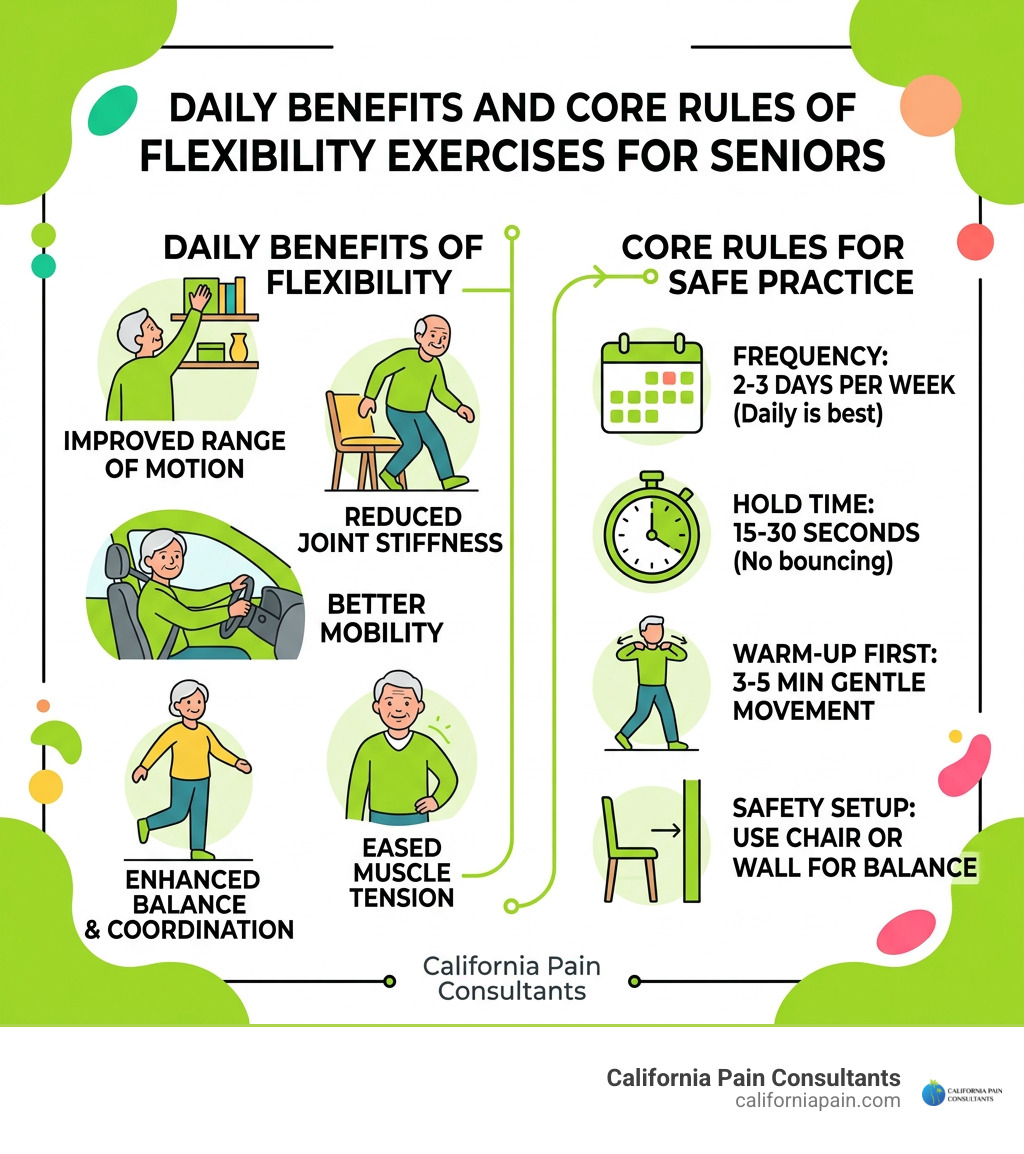
The safest and most effective approach to flexibility exercises for seniors focuses on gentle, static stretches held for 15 to 30 seconds without bouncing. Practicing these movements just 2 to 3 days per week—or 10 to 15 minutes daily—lubricates stiff joints, eases muscle tension, and improves balance for everyday life.
Here is the essential blueprint to get started safely:
- Frequency: Stretch at least 2 to 3 days per week (daily practice is best for stubborn stiffness).
- Hold Time: Stay in each comfortable stretch for 15 to 30 seconds, repeating 2 to 4 times per side.
- Warm-Up First: Spend 3 to 5 minutes walking in place or rolling your shoulders so you never stretch cold muscles.
- Safety Setup: Keep a sturdy chair or wall nearby to maintain full balance and protect your joints.
Age-related joint stiffness often sneaks up on us. It turns simple daily tasks—like reaching for a top shelf, turning your neck while driving, or rising from a low chair—into frustrating challenges.
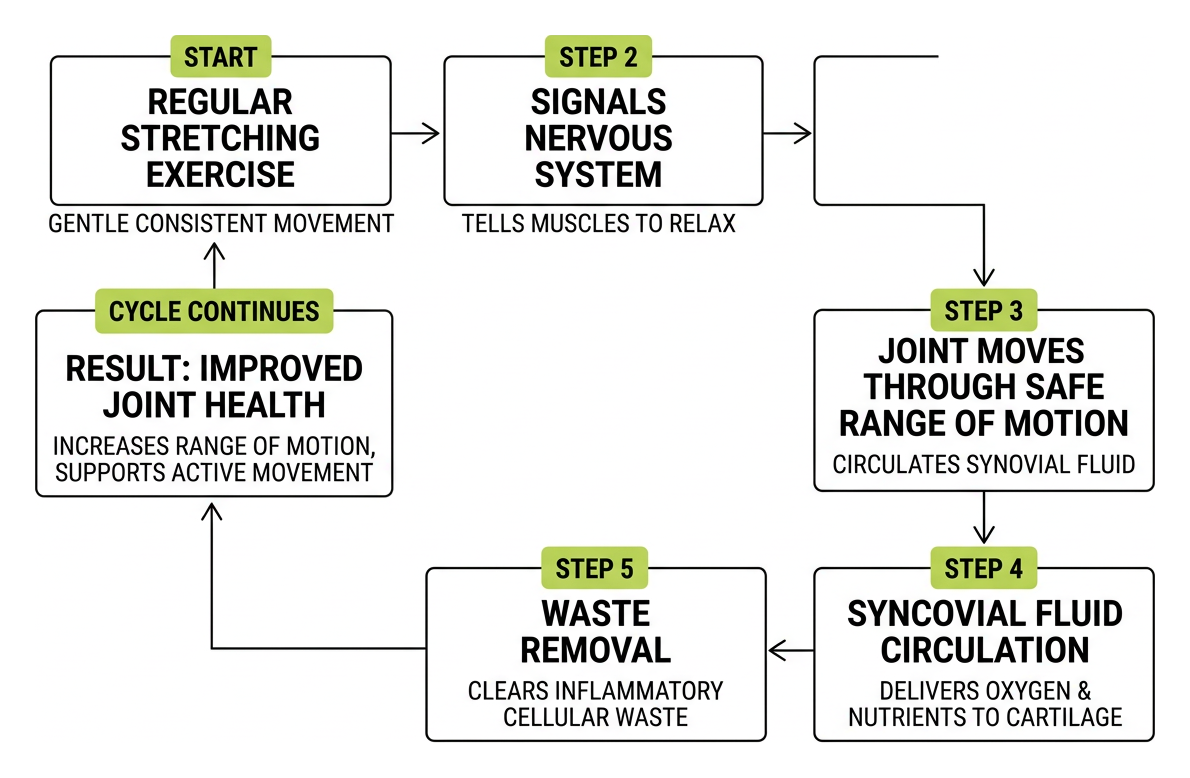
You do not need complicated gym gear or painful contortions to stay limber. Gentle, consistent movement signals your nervous system to relax tight muscles, increases joint range of motion, and protects your independence without relying on heavy medications.
I am Dr. Zach Cohen, a double board-certified pain management physician at California Pain Consultants dedicated to non-surgical recovery. Throughout my practice, I routinely help patients implement safe flexibility exercises for seniors to relieve chronic joint discomfort and restore active, confident movement.
Quick flexibility exercises for seniors definitions:
- Stretching Exercises For Chronic Nerve Pain
- Stretching Exercises For Chronic Osteoarthritis Pain
- dynamic stretching exercises
Why Joint Health and Mobility Matter After 60
As our bodies mature past 60, our connective tissues undergo natural physiological changes. Tendons and ligaments lose some water content and elasticity, while cartilage thins. Concurrently, the production of synovial fluid—the natural biological lubricant that cushions our joints—tends to decrease. Without adequate movement, joints become stiff, dry, and prone to ache.
Engaging in regular stretching acts like a fresh oil change for the body. Moving a joint through a safe range of motion circulates synovial fluid, delivering oxygen and vital nutrients directly to articular cartilage while clearing inflammatory cellular waste. Beyond joint mechanics, maintaining muscle length helps correct forward-slumping posture, reduces excessive strain on spinal discs, and supports our center of gravity.
Stretching plays a substantial role in fall prevention. According to the Centers for Disease Control and Prevention (CDC), one in four adults aged 65 and older falls each year in the United States. Maintaining supple ankles, hips, and lower back muscles allows you to step over unexpected obstacles, catch your balance smoothly, and walk with greater confidence. Incorporating stretching alongside personalized elderly pain management strategies ensures that aging joints remain supported rather than stressed.
What Scientific Research Says About Aging and Flexibility
Clinical researchers have closely evaluated the direct impact of flexibility training on aging adults. A comprehensive systematic review examining flexibility programs in older adults revealed that stretching interventions reliably improve joint range of motion (ROM) across major muscle groups (Stathokostas et al., 2012). While studies demonstrate that flexibility alone does not solve all functional challenges—such as extreme muscular weakness—targeted programs produce quantifiable mobility benefits:
- Ankle Dorsiflexion and Walking Speed: In an 8-week stretching trial for older women, maximal passive dorsiflexion angle increased from 11.1° to 16.2°, directly translating to an improved 10-meter walk time from 6.44 seconds down to 5.99 seconds.
- Agility and Fall Risk: A 4-week static stretching program for older adults improved Timed Up-and-Go (TUG) scores from 8.4 seconds to 7.2 seconds, with these balance gains persisting for a month post-intervention.
- Gait Velocity: In a study involving healthy older adults with a mean age of 72, an 8-week hip and ankle static stretching routine performed twice weekly boosted freely chosen gait speed from 1.23 m/s to 1.30 m/s.
Community organizations throughout Southern California support these findings; for example, the county’s community physical activity initiatives promote group-based mobility classes to help older residents maintain independence.
| Metric / Assessment | Baseline (Before Stretching) | Post-Intervention (After Stretching) | Primary Functional Benefit |
|---|---|---|---|
| Ankle Dorsiflexion Angle | 11.1° | 16.2° (8-week protocol) | Smoother toe clearance, lower tripping risk |
| 10-Meter Walk Time | 6.44 seconds | 5.99 seconds | Increased walking efficiency and speed |
| Timed Up-and-Go (TUG) | 8.4 seconds | 7.2 seconds (4-week protocol) | Faster, safer transitions from chairs |
| Freely Chosen Gait Speed | 1.23 m/s | 1.30 m/s (Twice weekly) | Greater stride length and walking ease |
Key Guidelines and Flexibility Exercises for Seniors
Stretching after 60 requires a measured, gentle touch. We are not training for Olympic gymnastics; our goal is functional, pain-free freedom of motion. Adhering to evidence-based safety guidelines ensures every session protects your cartilage and connective tissues.
- Warm Up First: Never stretch cold, resting muscles. Spend 3 to 5 minutes doing low-impact movement—such as gentle arm swings, marching seated or standing, or taking a warm shower—to raise muscle temperature.
- Hold, Never Bounce: Avoid ballistic bouncing, which triggers the muscle spindle reflex, causing muscles to tighten defensively. Practice static holds of 15 to 30 seconds.
- Breathe Continuously: Inhale deeply through your nose and exhale slowly through your mouth. Avoid holding your breath, which elevates blood pressure.
- Respect Pain Boundaries: You should feel a mild, tension-relieving pull, never sharp, pinching, or stabbing sensations. Aim for a comfortable 3 to 4 out of 10 on the stretch-intensity scale.
Applying structured dynamic stretching principles during your warm-up readies your tissues, setting the stage for calm, effective static stretching afterward.
Safe Daily Flexibility Exercises for Seniors: Upper Body and Core
These upper-body and spinal movements counteract the rounded posture caused by driving, reading, and computer use.
1. Gentle Neck Rotation and Side Tilt
- Why it helps: Restores cervical mobility, making it easier to check blind spots while driving or look side to side.
- How to do it: Sit tall in a firm chair with shoulders relaxed. Slowly turn your head to the right until you feel a gentle stretch along the left side of your neck. Hold for 15 seconds. Return to center, then turn to the left. Next, gently drop your right ear toward your right shoulder without lifting the shoulder. Hold for 15 seconds, return to center, and repeat on the left.
- Reps: 2 to 3 per side.
2. Shoulder Blade Squeeze and Rolls
- Why it helps: Opens the chest and strengthens postural stabilizers between the shoulder blades.
- How to do it: While seated or standing, draw your shoulders upward toward your ears, roll them backward, and slide your shoulder blades downward along your spine. In the back position, gently squeeze the blades together for 5 seconds.
- Reps: 5 to 8 smooth rolling circles.
3. Doorway Chest Opener
- Why it helps: Lengthens tight pectoral muscles to relieve upper back tension.
- How to do it: Stand inside an open doorway. Place your forearms flat against the doorframe with elbows bent at 90 degrees. Step forward gently with one foot until you feel a comfortable opening across your chest and front shoulders. Keep your neck relaxed and head neutral.
- Reps: Hold for 20 to 30 seconds; repeat twice.
4. Seated Spinal Twist
- Why it helps: Improves rotational mobility through the thoracic and lumbar spine, keeping the core limber.
- How to do it: Sit upright with your feet flat on the floor. Place your right hand on the outside of your left thigh and gently rest your left hand on the chair back or armrest. Inhale tall, and as you exhale, gently rotate your torso to the left. Keep your hips anchored to the chair.
- Reps: Hold for 15 to 30 seconds; repeat 2 times on each side. Integrating these movements alongside established daily back stretching routines promotes sustained spinal decompression.
Essential Flexibility Exercises for Seniors: Hips, Knees, and Calves
Tightness in the lower extremities directly impacts walking mechanics and lower back comfort. These lower body stretches keep your hips and legs moving freely.
1. Seated Hamstring Stretch
- Why it helps: Relieves tight back-thigh muscles that pull on the pelvis and aggravate lower back discomfort.
- How to do it: Sit on the front edge of a sturdy chair. Extend your right leg straight out in front of you with the heel on the floor and toes pointing upward. Keep your spine tall, place your hands on your left thigh for support, and hinge forward from your hips (not your waist) until you feel a mild stretch behind the right thigh.
- Reps: Hold for 20 to 30 seconds; repeat 2 to 3 times per leg.
2. Supported Standing Hip Flexor Stretch
- Why it helps: Counteracts the shortening of hip flexors caused by prolonged sitting, allowing full hip extension when walking.
- How to do it: Stand beside a sturdy wall or heavy table for balance. Step your right foot back about one to two feet, keeping the back heel lifted or resting lightly. Tuck your pelvis slightly under, bend your front left knee, and keep your upper body upright until you feel a gentle lengthening across the front of your right hip.
- Reps: Hold for 20 to 30 seconds; switch sides and repeat.
3. Wall Calf Stretch
- Why it helps: Enhances ankle dorsiflexion, which prevents shuffling and tripping while climbing stairs or walking on uneven surfaces.
- How to do it: Stand facing a wall about arm’s length away. Place your palms against the wall at shoulder height. Step your left leg back, keeping the heel flat on the floor and toes pointing forward. Bend your front right knee while keeping the rear leg straight. Press your back heel down into the floor.
- Reps: Hold for 20 to 30 seconds; perform 3 repetitions per leg.
4. Seated Ankle Circles and Toe Flexes
- Why it helps: Stimulates joint fluid within the ankles and supports peripheral blood circulation.
- How to do it: Sit back comfortably in your chair. Lift your right foot slightly off the floor. Slowly draw large circles in the air with your big toe—5 circles clockwise, then 5 counter-clockwise. Point your toes away from you, then pull them up toward your shin.
- Reps: Repeat 2 sets per ankle. Incorporating these simple ankle moves with proven exercises for hip pain relief creates a complete lower-body mobility routine.
How to Modify Stretches for Balance and Limited Mobility
Adapting your stretching routine to match your current functional abilities is the key to longevity in exercise. Whether dealing with joint osteoarthritis, spinal stenosis, or general balance instability, modifications allow you to gain all the benefits of flexibility training without risking a fall or joint injury.
- Anchor Your Balance: Always keep an immovable support within arm’s reach—such as a heavy dining chair, a secure grab bar, or a clear wall.
- Control Your Surfaces: Perform all movements on firm, non-slip flooring. Remove loose throw rugs, and wear non-skid athletic shoes rather than socks or loose slippers.
- Adjust Range Over Depth: Never force a limb to achieve a picture-perfect angle. A 10-degree stretch that feels comfortable and supported produces far better results than a forced 30-degree stretch that triggers joint inflammation.
Following structured approaches for managing pain safely in older adults ensures you progress at a gentle, sustainable pace.
Chair-Assisted and Supported Stretching Techniques
Using props allows seniors with limited stamina or balance concerns to stretch with total peace of mind.
- The Seated Figure-Four (Hip Opener): Instead of trying to stretch the glutes while lying on the floor, sit in a sturdy chair. Place your right ankle across your left knee (or across your left shin if hip mobility is restricted). Sit tall and gently lean forward from the hips until a gentle release is felt in the outer hip and glute.
- Towel-Assisted Shoulder Stretch: If reaching behind your back is uncomfortable, hold a small hand towel in your right hand. Drape it over your right shoulder down your back. Reach your left hand behind your lower back to grasp the lower end of the towel, gently guiding the arm into a comfortable stretch without forcing the joint.
- Wall-Supported Standing Side Reach: Stand with your left side toward a wall, placing your left hand on the wall for balance. Sweep your right arm up toward the ceiling (or rest your hand on your shoulder if the overhead reach is uncomfortable) and lean your upper body slightly toward the wall, creating a mild stretch down the side of your torso.
If you are just beginning, exploring introductory mobility exercises can help you build confidence before advancing to more dynamic routines.
Building a Complete Weekly Routine for Total Joint Protection
Consistency produces lasting flexibility. You will achieve much better results from a 10-to-15-minute daily routine than from a single, exhausting 60-minute session once a week.
According to guidelines from leading clinical institutions like the Mayo Clinic, stretching major muscle groups at least 2 to 3 days per week is necessary to maintain baseline range of motion, while daily sessions provide optimal relief from chronic morning stiffness.
Here is a balanced weekly stretching schedule designed for older adults:
- Monday & Thursday (Upper Body & Posture): Doorway chest opener, shoulder blade squeezes, and gentle neck rotations to relieve tension from daily activities.
- Tuesday & Friday (Lower Body & Mobility): Seated hamstring stretch, supported standing hip flexor stretch, and wall calf stretch to improve gait and stability.
- Wednesday & Saturday (Full-Body Gentle Flow): Seated spinal twists, seated figure-four hip stretches, and ankle circles to maintain continuous joint lubrication.
- Sunday (Active Rest & Mindful Movement): Gentle walking, deep diaphragmatic breathing, and light mobility work to keep joints loose without strain.
Pairing this weekly schedule with structured at-home back care routines gives your spine and weight-bearing joints comprehensive, daily protection.
Integrating Flexibility With Strength and Balance
Flexibility training works best as part of a well-rounded fitness plan. While stretching elongates tight muscles and mobilizes joints, strength training reinforces joint stability, and balance training sharpens proprioception to prevent falls.
- Combine Stretches with Sit-to-Stands: Use your chair for functional strength by performing 5 to 10 controlled sit-to-stand repetitions before cooling down with your seated hamstring and chest stretches.
- Post-Walk Cool-Downs: After a light 15-minute walk, your muscles are warm and pliable. Take 5 minutes immediately following your walk to stretch your calves, quads, and hip flexors.
- Mindful Movement Modalities: Consider incorporating elements of Tai Chi, gentle chair yoga, or the Feldenkrais Method, which blend slow, mindful movement with joint flexibility.
To take your joint mobility further, explore our complete guide to targeted stretching exercises to customize your daily program.
Frequently Asked Questions About Senior Flexibility
How often should seniors perform flexibility exercises?
Seniors should aim to perform flexibility exercises at least 2 to 3 days per week, though a daily 10-to-15-minute session is ideal for easing chronic joint stiffness. Consistency is far more important than intensity; brief, gentle daily stretching keeps synovial fluid circulating and prevents muscles from tightening overnight.
Can stretching help reduce arthritis pain and back stiffness?
Yes. Regular, low-impact stretching eases osteoarthritis discomfort by stimulating synovial fluid production, which naturally lubricates stiff joint surfaces. Stretching the hamstrings, hip flexors, and thoracic spine also takes mechanical pressure off the lower back. For comprehensive joint relief, combining stretching with proven natural back pain relief options helps manage flare-ups effectively without over-relying on medications.
Are flexibility exercises safe for seniors with osteoporosis?
Yes, provided specific modifications are made. Seniors diagnosed with osteoporosis or osteopenia should avoid extreme spinal flexion (such as rounding forward to touch the toes) and rapid twisting movements, which place excess compressive load on fragile vertebral bodies. Instead, focus on chest openers, hip flexor stretches, and neutral-spine seated bends while holding onto stable supports. Always consult your physician before starting a new exercise regimen.
Conclusion
Protecting your joint health and mobility after 60 is an investment in your long-term independence. By dedicating just 10 to 15 minutes each day to safe, supported flexibility exercises, you can ease morning joint stiffness, enhance your walking stride, and move through your daily life with greater comfort and confidence.
Remember to start slowly, focus on smooth and controlled breathing, and never push through sharp pain. If chronic joint pain, severe stiffness, or nerve discomfort is limiting your ability to move freely, our double board-certified physicians at California Pain Consultants are here to help. Serving our communities across San Diego, Kearny Mesa, Chula Vista, Rancho Bernardo, La Mesa, and Miramar, we offer personalized, non-surgical pain management plans to help you restore your mobility and get back to enjoying life.
Scientific References
Stathokostas L, Little RM, Vandervoort AA, Paterson DH. “Flexibility training and functional ability in older adults: a systematic review..” Journal of aging research, 2012. PMCID PMC3503322.