
Discography is an image-guided diagnostic test in which contrast dye is injected into one or more spinal discs to see whether a specific disc reproduces your familiar back or neck pain. It may help adults with chronic, disabling spine pain when MRI and examination cannot identify the source and the answer will shape a major treatment decision. Board-certified pain specialists at California Pain Consultants in San Diego evaluate whether discography is appropriate and perform it for carefully selected patients.
It is not a routine test for back pain and is not used simply because an MRI shows disc degeneration. It may be considered when other evaluations remain inconclusive and the result is expected to influence a major treatment decision, such as a planned spine operation.
Because the test intentionally pressurizes discs and can cause pain, careful selection, sterile technique, comparison discs, and interpretation in the full clinical context are essential.
Discography uses fluoroscopic guidance and contrast injected into selected spinal discs to compare structure, pressure response, and whether the patient’s familiar pain is reproduced.
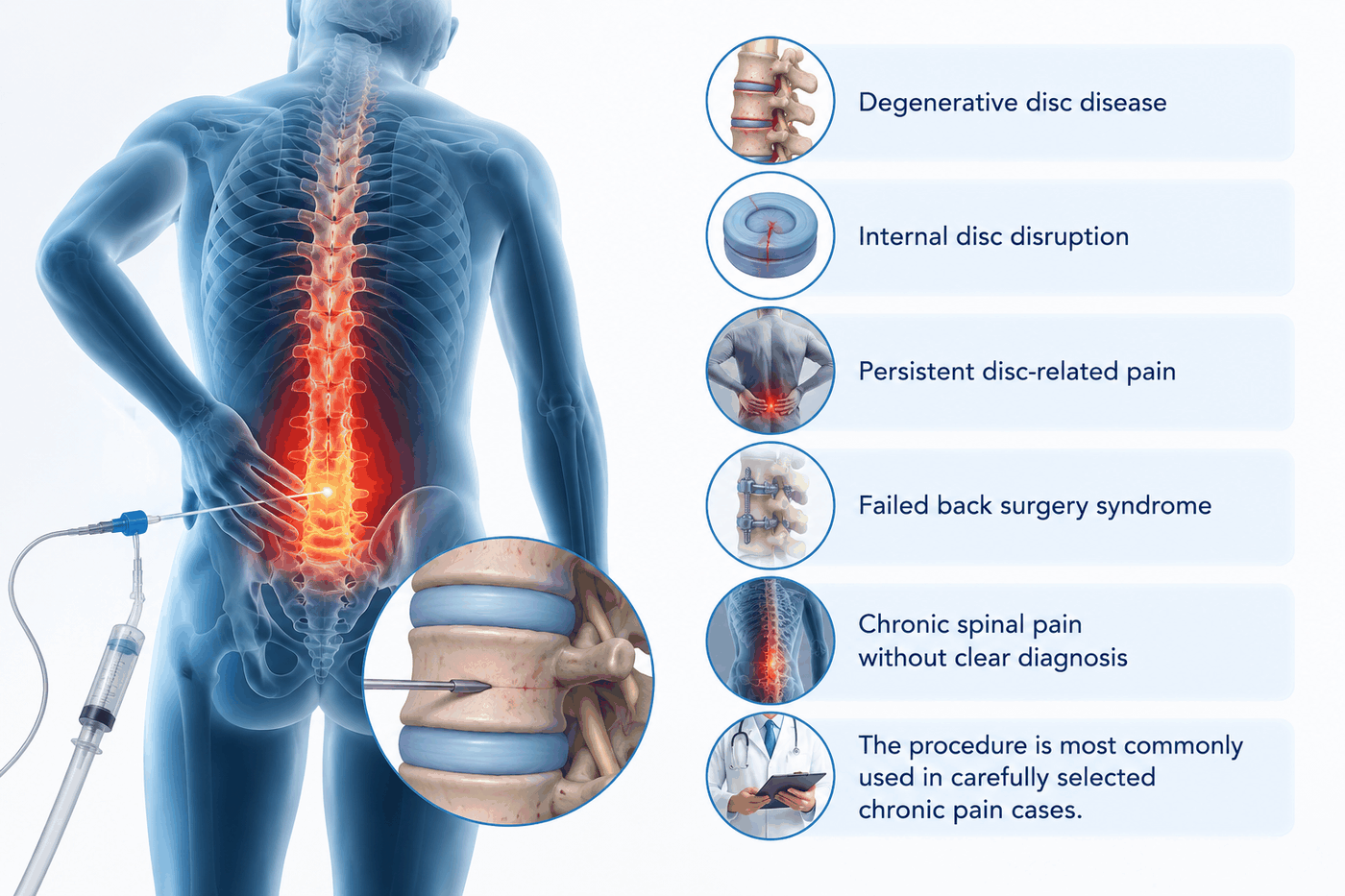
What Is Discography?
Discography combines a controlled pain-provocation test with contrast imaging of the disc. It evaluates function and symptom reproduction rather than replacing MRI.
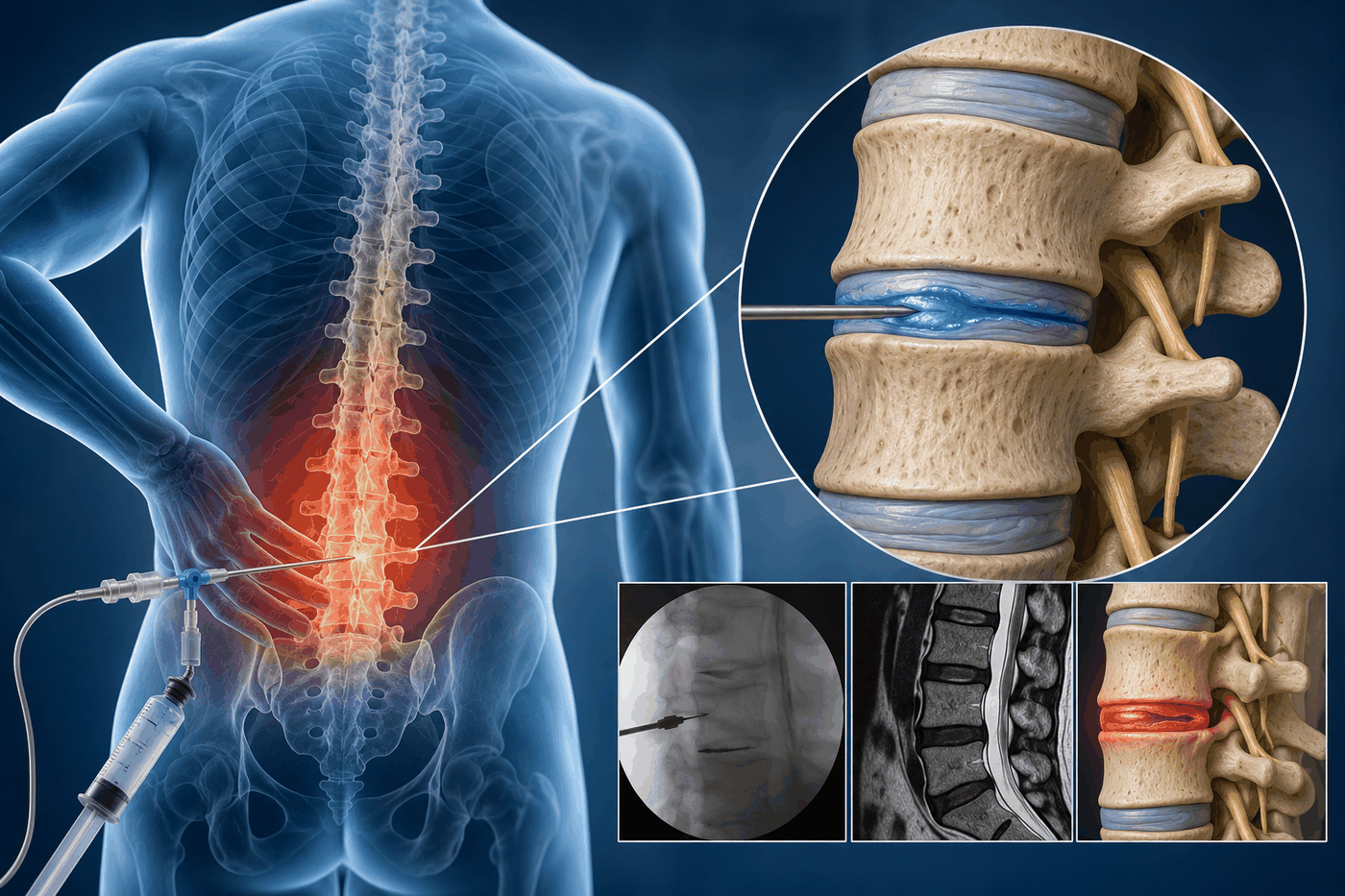
A needle is placed into the center of one or more discs. Contrast is injected while the patient reports the intensity and quality of any pain. Concordant pain resembles the patient’s usual symptom; discordant pain feels different and is less supportive of that disc as the source.
A nearby comparison disc may be tested to reduce false interpretation. CT after discography can show fissures or contrast patterns, but the final conclusion depends on pressure, pain behavior, imaging, psychosocial factors, and the overall clinical picture.
When Discography May Be Considered
The procedure should be ordered only when a clear, clinically important question cannot be answered adequately by less invasive methods.
Persistent Axial Spine Pain
The patient has chronic, function-limiting pain with a suspected disc source after an appropriate evaluation and conservative treatment.
Inconclusive Noninvasive Testing
MRI and examination do not provide enough confidence about which disc, if any, is responsible for the familiar pain.
Preoperative Level Selection
A spine surgeon may request discography when the result could change whether surgery is offered or which level is treated.
Complex Multilevel Degeneration
When several discs look abnormal, controlled comparison may help avoid assuming that every degenerative disc is painful.
Patterns That May Suggest Disc-Related Pain
These features are nonspecific and do not prove that a disc is the source.
- Deep axial low back or neck pain
- Pain aggravated by sitting, bending, lifting, or sustained loading
- Symptoms that are more central than nerve-root pain
- Pain with transitions such as rising from a chair
- Persistent limitations despite appropriate rehabilitation
- Several abnormal discs on MRI with unclear clinical significance
- A major treatment decision that depends on identifying a level
- Absence of a clearer joint, nerve, fracture, infection, or tumor source
How Candidacy Is Evaluated
Selective use reduces unnecessary risk and improves the chance that the result answers a meaningful question.
History and Functional Goals
Your clinician reviews where symptoms begin, whether pain travels, how long it has been present, what worsens or relieves it, and how it affects walking, work, sleep, and daily activity.
Focused Physical Examination
Strength, sensation, reflexes, movement, tenderness, gait, and nerve-tension signs help distinguish joint, disc, nerve, muscle, and other potential pain sources.
Imaging and Prior Records
MRI, CT, or X-rays are reviewed when results are likely to clarify anatomy or change the plan. Prior procedure reports and treatment responses may also be important.
Medication and Health Review
Blood thinners, diabetes, allergies, infection risk, pregnancy, implanted devices, and other medical conditions are discussed so benefits and risks can be considered safely.
The Discography Procedure
Communication during the injection is important. Sedation is typically limited so the patient can accurately describe any reproduced pain.
Step 1: Preparation
Antibiotic, medication, fasting, and transportation instructions are reviewed. The target discs and comparison plan are confirmed.
Step 2: Needle Placement
With the patient positioned and the skin numbed, needles are advanced into the selected discs using fluoroscopic guidance and sterile technique.
Step 3: Controlled Contrast Injection
Contrast is injected in a controlled manner while pressure, volume, resistance, and imaging appearance are recorded.
Step 4: Pain Comparison
The patient reports whether pain occurs, its intensity, and whether it matches the familiar everyday pain. A comparison disc may also be tested.
Step 5: Post-Discography Imaging
CT may be performed to show internal contrast patterns. Results are later interpreted alongside the history, examination, MRI, and treatment question.
According to Cleveland Clinic, a discogram usually takes about one hour from start to finish.
Recovery After Discography
Because the test pressurizes discs, temporary worsening of familiar pain is common. Follow the specific medication, activity, and infection-monitoring instructions.
Short-Term Pain Flare
Soreness may last for hours or several days. Use the approved comfort plan and avoid adding unreviewed medication.
Cleveland Clinic notes that most people can return to work, school, and routine activities after 24 hours, although soreness may take a few days to resolve. Contact your care team for a fever over 101 degrees Fahrenheit, which may signal infection.
Activity
Light activity may be recommended initially, followed by gradual return based on symptoms and the treating clinician’s instructions.
Result Review
The procedural report should describe pressure, volume, pain concordance, control response, and imaging—not only whether the disc looked abnormal.
Most people receive their results within a week, according to Cleveland Clinic.
Treatment Decision
Discography does not itself treat pain. The ordering clinician uses the result to reconsider surgery, continue nonsurgical care, or investigate another source.
Potential Benefits and Realistic Expectations
The main potential benefit is better decision-making in a narrow clinical situation. A positive test does not guarantee that a later treatment will succeed.
- Tests whether a disc reproduces the patient’s familiar pain
- Compares suspected and control levels
- May clarify complex multilevel MRI findings
- Can provide structural information through contrast and CT
- May change or refine a planned surgical approach
- Can help avoid treating a disc that is abnormal but not painful
Discography Risks and Limitations
Risks include infection of the disc, bleeding, nerve injury, headache, allergic reaction, pain flare, disc injury, and inaccurate or difficult-to-interpret results.
- Disc infection is uncommon but serious and requires urgent treatment
- Tell the team about blood thinners, infection, allergies, pregnancy, and prior contrast reaction
- Call for fever, chills, drainage, or severe worsening back pain
- Seek urgent care for new weakness, saddle numbness, or loss of bladder or bowel control
- Psychological distress, widespread pain, and other factors can affect pain reporting and interpretation
- The test should not be used as a screening study or as a substitute for a complete evaluation
Call 911 for severe weakness, a major allergic reaction, loss of consciousness, or another life-threatening emergency.
How Discography Guides the Next Step
Discography is best understood as one piece of evidence used to refine—not dictate—a treatment decision.
Nonsurgical Care
A negative or inconclusive test may support continued rehabilitation, medication review, behavioral support, or evaluation of another pain generator.
Surgical Planning
A concordant, technically valid study may be considered with MRI and clinical findings when a surgeon determines whether a disc procedure is reasonable.
Other Diagnostic Procedures
Facet, sacroiliac, nerve-root, or hip evaluation may be more appropriate when the symptom pattern points away from the disc.
Shared Decision-Making
Benefits, uncertainty, recovery demands, alternatives, and the patient’s goals should be reviewed before any major treatment that follows.
Get Clearer Answers Before a Major Spine Decision
California Pain Consultants can review whether discography is likely to answer a specific unresolved question and explain the procedure’s risks, limits, and alternatives.
Treatment at California Pain Consultants
At California Pain Consultants, discography is ordered only when it can answer a specific question. Your care team first reviews your MRI, examination, prior injections, and the treatment decision you are facing, and considers whether a less invasive test, such as a diagnostic facet injection, could answer it instead. When results point to a painful disc, options may include spinal disc decompression, percutaneous discectomy, surgical consultation, or continued nonsurgical care. Endplate-related pain may instead be evaluated for basivertebral nerve ablation.
We see patients at four clinics across San Diego County:
San Diego, CA 92123Get Directions
San Diego, CA 92128Get Directions
La Mesa, CA 91942Get Directions
Chula Vista, CA 91911Get Directions
Procedures are performed at the Comprehensive Pain ASC in Rancho Bernardo and the EPC Surgery Center in La Mesa. We accept most insurances. Call (858) 571-3630 or request your appointment to review whether discography would clarify your next step.
Book Your AppointmentTrusted Information and Related Care
Medical references: NCBI Bookshelf: Provocative discography · NCBI Bookshelf: Lumbar provocative discography.
Related California Pain resources: Degenerative disc disease · All treatment options · Conditions and treatments.
This article is for general education and does not replace an individualized medical evaluation. Recommendations depend on the diagnosis, health history, current medications, imaging, examination, and personal goals.
Frequently Asked Questions About Discography
Find clear, medically responsible answers about Discography, who may be a candidate, what to expect, and when to contact your healthcare team.
What is discography, and how does it work?
Discography is a diagnostic procedure that pressurizes one or more spinal discs with contrast while the patient reports whether the sensation matches familiar pain. Postprocedure imaging may help show internal disc structure, but the test does not itself treat pain.
Why would a doctor order a discogram?
A discogram may be ordered when chronic, disabling back or neck pain seems to come from a disc, but MRI and examination cannot show which disc is responsible. It is most often used when the result could change a major decision, such as whether spine surgery is offered or which level would be treated. It is not a routine test.
Who may be a candidate for discography?
A candidate has a carefully defined pain pattern, inconclusive or multiple-level imaging findings, and a planned decision that depends on identifying a symptomatic disc. Infection, bleeding risk, severe psychological distress, or inability to provide reliable feedback may make testing inappropriate.
How should I prepare for discography?
The clinician will review imaging, medications, allergies, infection risk, and fasting instructions. Sedation is typically limited so you can describe symptoms accurately, and transportation home is generally required.
What happens during discography?
Under fluoroscopic guidance, needles are placed into selected discs, including comparison levels when appropriate. Contrast is injected in a controlled fashion while pressure, pain intensity, pain quality, and imaging findings are recorded.
Is a discogram painful?
It can be uncomfortable, because the test intentionally pressurizes discs to see whether one reproduces your usual pain. Sedation is kept light so you can describe what you feel accurately. A painful disc may produce pain similar to your everyday symptoms. Soreness afterward is common and usually settles over a few days with the comfort plan provided.
How long does it take to recover from a discogram?
Cleveland Clinic notes that most people can return to work, school, and routine activities after 24 hours, although soreness may take a few days to go away. You will need someone to drive you home. Call your care team for fever, chills, drainage, or severe back pain, which may signal a rare infection. A flare of familiar pain can occur for several days.
What are the risks of discography?
The most serious risk is infection of the disc, which is uncommon but requires urgent treatment. Other risks include bleeding, nerve injury, headache, allergic reaction to contrast, and a temporary pain flare. Tell your care team about blood thinners, allergies, and infections beforehand, and seek urgent care for new weakness or bladder changes. Because disc puncture may carry longer-term concerns, the test is reserved for situations in which the result is likely to influence care.
What do discogram results mean?
A positive or concordant result means a disc reproduced your familiar pain at a controlled pressure while a comparison disc did not. A negative result suggests the tested disc is less likely to be the main source. Results are interpreted with your MRI, examination, and history, and they guide rather than dictate the next treatment decision.
Does discography treat back pain?
No. Discography is a diagnostic test only and does not relieve pain by itself. Its purpose is to provide information that helps you and your care team choose a treatment, such as a disc procedure, surgery, or continued nonsurgical care. Some patients avoid an unnecessary operation because the test shows an abnormal disc is not painful.
How does discography fit into a broader treatment plan?
Discography may help refine planning before fusion, disc replacement, or another significant intervention, but it does not prove that a procedure will succeed. Shared decision-making should include alternative explanations and nonsurgical options.
When should I call my healthcare team or seek urgent care after discography?
Contact the care team promptly for fever, chills, drainage, severe or progressively worsening back pain, new numbness, or weakness. Seek emergency care for new bowel or bladder dysfunction, saddle numbness, progressive paralysis, chest pain, or trouble breathing.