
Recognizing Red Flag Symptoms and When to Seek Emergency Care
Dealing with this in San Diego? Same-day appointments are often available at our 4 clinics.
While most shoulder discomfort stems from muscular strains or joint wear, certain symptoms demand urgent medical evaluation. Because the shoulder area shares nerve pathways with the chest and upper abdomen, shoulder pain can occasionally serve as a warning sign for a life-threatening medical emergency. Understanding the importance of pain relief for shoulder issues can help in seeking timely treatment.
Seek emergency medical care immediately (call 911) if your left shoulder pain is accompanied by:
- Chest tightness, pressure, or crushing chest pain
- Shortness of breath or difficulty breathing
- Unexplained sweating or dizziness
- Pain radiating to the jaw, neck, back, or down the left arm
- Numbness, weakness, or a sudden change in arm color/temperature
In these situations, shoulder pain may actually be referred pain from a cardiac event, such as a heart attack.
Emergency evaluation is also required following severe physical trauma. If a fall or high-impact injury leaves your shoulder visibly deformed, if you cannot move your arm away from your body at all, or if you experience rapid swelling and excruciating pain, go to an emergency room or urgent care facility right away. For a deeper breakdown of safely navigating severe symptoms, you can review Consumer Reports on stopping shoulder pain.
Dislocated vs. Separated Shoulder Differences
Trauma to the upper body often leads to two distinct structural injuries that are frequently confused: a dislocated shoulder and a separated shoulder.
- Dislocated Shoulder: This injury involves the main socket joint of the shoulder (the glenohumeral joint). It occurs when the ball-shaped head of the upper arm bone (humerus) pops out of the shoulder blade socket (glenoid fossa). Dislocations cause intense pain, an inability to move the arm, and an obvious hollow or square shape under the skin of the outer shoulder.
- Separated Shoulder: This injury does not involve the main ball-and-socket joint. Instead, it affects the acromioclavicular (AC) joint, where the top of the shoulder blade connects to the collarbone (clavicle). A fall directly onto the point of the shoulder often tears the ligaments supporting this joint, creating a visible “step-off” bump on top of the shoulder.
Both conditions require prompt medical assessment. A dislocated shoulder usually requires a medical professional to perform a “closed reduction”—a carefully guided procedure to slip the humerus back into its socket. Attempting to force a dislocation back into place without proper training can damage adjacent nerves, blood vessels, and joint cartilage.
5 Effective At-Home Changes for Pain Relief for Shoulder
When red flag symptoms are ruled out and you are dealing with minor strains, overuse irritation, or early joint inflammation, small routine adjustments can deliver significant pain relief for shoulder discomfort. At California Pain Consultants, we emphasize early conservative self-care to calm irritated tissues before chronic pain patterns take root.
If you are looking for localized topical solutions, check out The Definitive Guide to Balm for Shoulder Pain Relief for a breakdown of effective botanical and over-the-counter topical gels.
Quick Change 1: Master Cold and Heat Therapy Timing
Temperature therapy is highly effective, but timing matters. Applying heat to an acutely inflamed joint can worsen swelling, while applying ice to a chronically stiff muscle can heighten tension.
- First 24 to 48 Hours (Acute Injury & Swelling): Rely on cold therapy. Apply an ice pack wrapped in a thin towel for 15 to 20 minutes every 3 to 4 hours. Cryotherapy numbs localized nerve endings and constricts blood vessels to reduce swelling. Topical cooling sprays or formulations containing 10% menthol can also deliver rapid, localized cryotherapy effects—in fact, consumer studies show up to 94% of users feel noticeably faster relief with athlete-grade cryotherapy sprays.
- After 48 Hours (Chronic Stiffness & Muscle Spasms): Once initial swelling subsides, transition to moist heat. Apply a warm heating pad or warm water bottle for 15 to 20 minutes to boost blood circulation, deliver nutrients to recovering tissues, and relax tight surrounding musculature.
Quick Change 2: Adjust Sleep Position and Support
Sleeping directly on an injured shoulder compresses inflamed bursae and tendons, restricting local blood flow and causing night pain that disrupts deep sleep cycles.
- Back Sleeping (Recommended): Sleep on your back with a pillow or folded blanket placed under the elbow and upper arm of your painful side. This elevates the limb slightly, placing the shoulder in a neutral position and taking tension off the rotator cuff.
- Side Sleeping Adjustments: If you must sleep on your non-injured side, place a firm pillow between your arms to hug, preventing the upper arm from dropping across your body and pulling on the back of the shoulder joint. Avoid sleeping on your stomach or sleeping with your arms stretched overhead.
- Supportive Pillows: Using a contoured memory foam pillow helps preserve proper spinal alignment between your neck and upper back. Explore our Ultimate Checklist for Back and Shoulder Support for detailed tips on optimizing your sleeping setup.
Quick Change 3: Perform Gentle Stretching and Ergonomic Fixes
Complete immobilization can cause shoulder joint tissues to tighten up. Unless you have an unreduced dislocation or acute fracture, gently moving the joint within a pain-free range of motion prevents stiffness.
- Crossover Arm Stretch: Gently bring your affected arm across your chest at shoulder height. Use your opposite hand to lightly pull the arm closer to your body until you feel a soft stretch in the back of the shoulder. Hold for 30 seconds, breathe deeply, and repeat 3 to 4 times daily.
- Doorway Corner Stretch: Stand in a doorway, place your forearms against the frame with elbows bent at 90 degrees, and step one foot forward gently until you feel a stretch across your chest and the front of your shoulders.
- Ergonomic Modifications: Rest your forearms on chair armrests or rest your hands in your pockets while standing to relieve the downward gravitational pull of the arms on the shoulder girdle. Avoid heavy lifting and overhead reaching until your symptoms improve.
Comparing Medications, Injections, and Surgical Options
When self-care alone does not fully resolve your discomfort, medical treatments can help break the cycle of inflammation and pain. Understanding how these options differ allows us to build a tailored management plan for your lifestyle.
Over-the-counter nonsteroidal anti-inflammatory drugs (NSAIDs) such as ibuprofen (400–800 mg) or naproxen sodium provide effective systemic relief by halting inflammatory chemical pathways. Acetaminophen (325–500 mg) can help control pain signals, though it does not target joint inflammation directly. However, oral NSAIDs should not be taken daily for longer than a week without medical supervision to prevent gastrointestinal and renal complications.
For targeted, short-term remission, corticosteroid injections directly into inflamed subacromial spaces or joints can offer significant relief. Clinical data synthesized in the NCBI Systematic Review on NSAIDs vs Corticosteroids demonstrates that corticosteroid injections are significantly more effective than oral NSAIDs in achieving complete shoulder pain remission at 4 to 6 weeks (relative risk, 0.64). However, corticosteroid benefits are short-term (typically under 12 weeks), and repeated injections must be limited to no more than 2 to 4 times per year to protect tendon integrity and cartilage health over time.
Phase-Specific Solutions for Pain Relief for Shoulder
Frozen shoulder (adhesive capsulitis) affects roughly 2% to 5% of the general population—particularly middle-aged individuals and those with diabetes. It involves a thickening and tightening of the shoulder capsule, progressing through distinct clinical phases that demand phase-appropriate treatment:
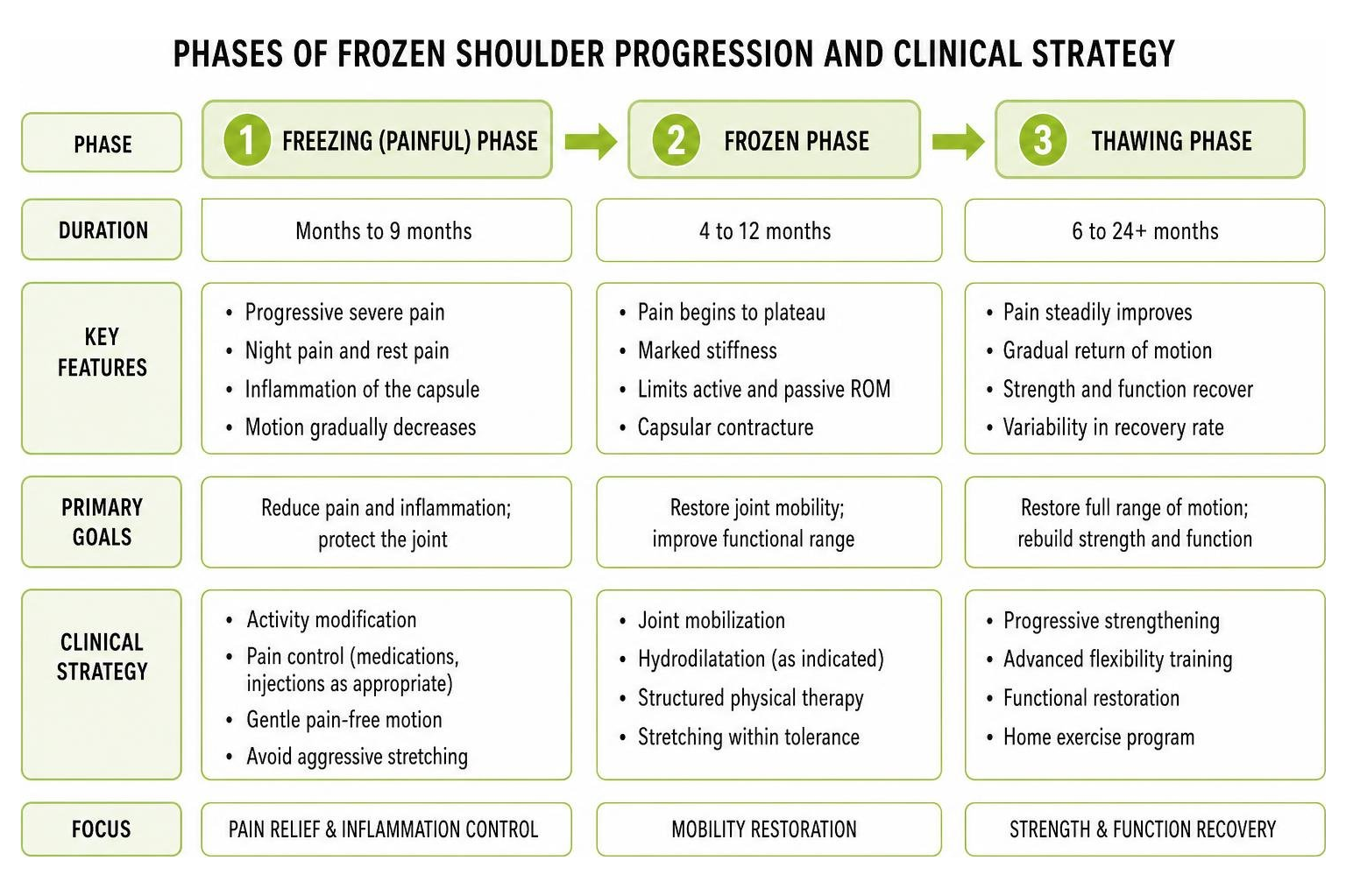
- The Freezing (Painful) Phase: Marked by progressive severe pain and night discomfort. Gentle motion is maintained, but aggressive stretching must be avoided. Painful inflammation must be suppressed chemically first. Consult the Mayo Clinic on frozen shoulder treatment for diagnostic guidelines.
- The Frozen Phase: Pain begins to plateau, but global joint stiffness severely restricts active and passive movements. Interventional procedures such as hydrodilatation—injecting sterile saline and anti-inflammatory solution under pressure to expand the tight joint capsule—can restore functional joint volume.
- The Thawing Phase: Range of motion gradually returns, requiring progressive physical therapy to rebuild strength and flexibility.
As outlined in recent literature on Phase-specific treatment strategies, forcing aggressive manual physical therapy during the active freezing phase without adequate anti-inflammatory coverage can aggravate joint capsule inflammation and worsen overall outcomes. Up to 50% of patients without standardized treatment still suffer from pain or stiffness 7 years after disease onset, making structured medical care critical.
Advanced Interventions for Refractory Pain Relief for Shoulder
For severe, persistent shoulder pain that fails standard conservative remedies, specialized interventional pain techniques offer dramatic relief without requiring major surgery:
- Ultrasound-Guided Suprascapular Nerve Block (SSNB): The suprascapular nerve provides roughly 70% of the sensory innervation to the shoulder joint. Precise, real-time ultrasound-guided local anesthetic delivery around this nerve calms joint pain signals. Modern clinical trials highlight the benefit of combining continuous SSNB with daily bedtime oral gabapentin (300 mg). This multimodal approach targets central and peripheral nerve pathways simultaneously, yielding near 100% patient satisfaction and accelerated functional gains, as shown in Springer research on continuous suprascapular block and gabapentin.
- Manipulation Under Anesthesia (MUA): Performed in an outpatient surgical facility, a physician gently moves the shoulder joint through its natural range while you are under brief anesthesia, releasing stubborn dense capsular scar tissue adhesions without incisions.
- Arthroscopic Capsular Release: A minimally invasive procedure where an orthopedic surgeon uses small keyhole incisions and a camera to snip away contracted joint capsule tissue.
The Role of Physical Therapy and Injury Prevention
Physical therapy is a cornerstone of recovery and long-term joint health. A structured physical therapy program focuses on restoring both active range of motion (movements you perform using your own muscle strength) and passive range of motion (movements achieved when a physical therapist gently moves your relaxed arm).
Rehabilitation typically progresses through distinct steps:
- Chemical Suppression: First, joint inflammation is suppressed using targeted icing, short-term NSAIDs, or interventional injections.
- Flexibility and Stretching: Gentle pendulum movements, wall climbs, and crossover stretches expand joint capacity without triggering guarding.
- Rotator Cuff Strengthening: Targeted exercises using light dumbbells or resistance bands strengthen the four key rotator cuff muscles (supraspinatus, infraspinatus, teres minor, subscapularis) and scapular stabilizers.
- Functional Ergonomics: Improving daily posture, workstation setup, and biomechanics prevents future mechanical impingement.
Visiting a physical therapist once or twice weekly for 4 to 6 weeks establishes a solid foundation for long-term home exercise habits.
Specialized Care for Persistent Muscle Pain
When shoulder distress is driven by persistent muscle knots, myofascial trigger points, or chronic muscle spasms in the trapezius and levator scapulae, localized medical therapies offer relief. If you are struggling with chronic muscular tightness, working with a specialized Shoulder Muscle Pain Doctor allows you to access targeted trigger point injections, dry needling techniques, and specialized muscle release protocols.
Frequently Asked Questions About Shoulder Pain
| Condition | Primary Symptoms | Recommended Initial Action |
|---|---|---|
| Rotator Cuff Tendinitis | Dull ache outer shoulder, pain lifting arm overhead | Rest, cold therapy, light crossover stretches |
| Subacromial Bursitis | Sharp pain with overhead reaching, local tenderness | Cold compress 15 min, short-term oral NSAIDs |
| Frozen Shoulder | Severe night pain, marked loss of active & passive ROM | Medical evaluation, gentle ROM, targeted nerve blocks |
| Shoulder Osteoarthritis | Deep joint ache, grinding/crepitus, stiffness after rest | Warm heat therapy, low-impact exercise, medical care |
| Shoulder Dislocation | Deformed joint, severe acute pain, arm mobility loss | Immediate emergency room closed reduction |
What are the most common causes of shoulder pain?
The shoulder’s exceptional range of motion comes at the cost of structural instability. The most common causes of pain include rotator cuff tendinitis or tears, subacromial bursitis, shoulder impingement syndrome (where bone spurs pin soft tissues during overhead motion), scapulohumeral osteoarthritis, and frozen shoulder (adhesive capsulitis). Repetitive overhead work, sports throwing, poor desk ergonomics, and age-related wear and tear are major contributing factors.
How long does it take for shoulder pain to heal with home treatment?
Minor muscular sprains and mild overuse irritation generally improve within 1 to 2 weeks of disciplined rest, ice application, and posture modifications. Structural conditions like rotator cuff tendinitis or bursitis typically require 4 to 6 weeks of targeted physical therapy and home exercises. If your shoulder pain persists beyond 7 to 10 days despite home treatment, schedule a medical consultation.
When is surgery necessary for a shoulder injury?
Non-surgical conservative care succeeds in up to 90% of shoulder pain cases. Surgery is typically reserved for full-thickness rotator cuff tears in active individuals, structural labral tears, recurring joint instability from major dislocations, severe advanced osteoarthritis requiring joint replacement, or severe frozen shoulder cases that have failed non-surgical treatments like hydrodilatation or interventional nerve blocks.
Conclusion
Finding reliable pain relief for shoulder conditions requires a balanced, phased approach. Starting with simple at-home adjustments—such as mastering cold and heat timing, adjusting your sleeping position, utilizing supportive pillows, and maintaining pain-free movement—can resolve minor joint irritation. However, when discomfort persists, seeking an accurate diagnosis is essential to protecting long-term mobility.
At California Pain Consultants, our board-certified pain management physicians specialize in comprehensive, non-surgical solutions tailored to your life. From advanced diagnostic evaluations and physical therapy integration to targeted ultrasound-guided nerve blocks and regenerative care, we serve patients across San Diego, Kearny Mesa, Chula Vista, Rancho Bernardo, La Mesa, and Miramar, California.
If shoulder pain is interfering with your sleep, work, or daily comfort, explore our comprehensive guide on Comprehensive Rotator Cuff and Shoulder Pain Relief or contact our compassionate medical team today to schedule your personalized consultation.