
How to Start Healing a Thoracic Back Sprain
Dealing with this in San Diego? Same-day appointments are often available at our 4 clinics.
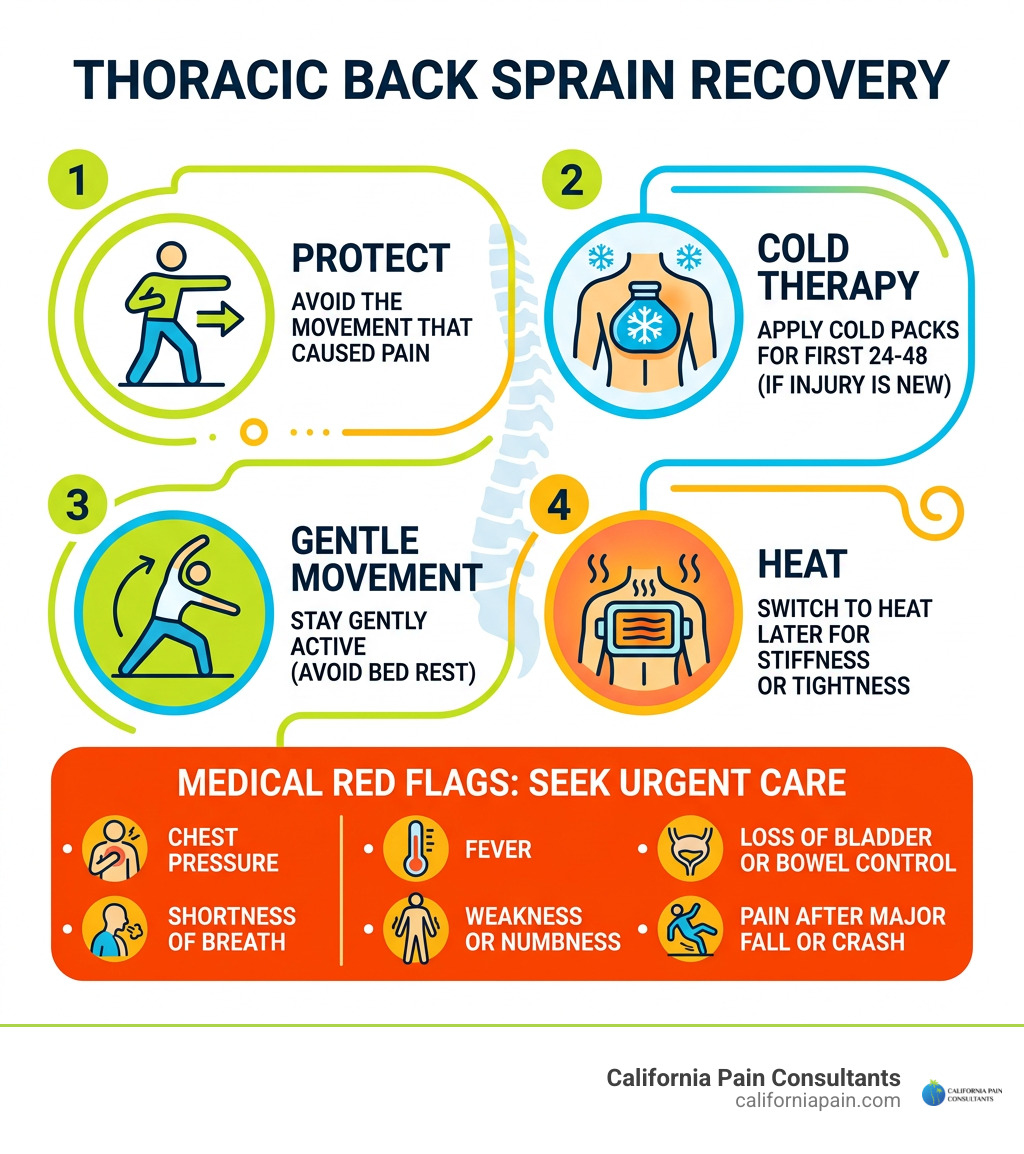
A thoracic back sprain is an overstretching or tear of ligaments in the middle back, between the base of the neck and the bottom of the rib cage. Start recovery by avoiding the movement that caused the pain, using cold packs for the first 24 to 48 hours if the injury is new, and staying gently active rather than remaining in bed. Switch to heat later if muscle tightness and stiffness are the bigger problems.
Seek urgent care for mid-back pain with chest pressure, shortness of breath, fever, weakness, numbness, loss of bladder or bowel control, or pain after a major fall or crash. These symptoms can point to something more serious than a ligament injury.
The thoracic spine is supported by the rib cage, so it moves less than the neck and low back. Still, heavy lifting with a twist, a sudden awkward movement, repetitive work, and long hours of slouched sitting can strain the tissues that support it. Mid-back musculoskeletal pain affects an estimated 17% of people over a lifetime.
With the right mix of relative rest, pain control, gradual mobility, and strengthening, many thoracic sprains improve without surgery. The goal is not to “push through” sharp pain. It is to restore comfortable movement and reduce the chance that a short-term injury becomes lasting pain.
I am Dr. Zach Cohen, a double board-certified anesthesiologist and chronic pain physician who helps patients assess and manage spine-related pain, including thoracic back sprain symptoms. In the sections ahead, I will explain practical recovery steps and when personalized non-surgical care may be appropriate.
Important thoracic back sprain terms:
What Is a Thoracic Back Sprain and How Does It Happen?
The thoracic spine consists of 12 vertebrae (T1 to T12) connected to your rib cage. Strong fibrous bands called ligaments bind these bony segments together, stabilizing your upper and middle back while protecting vital spinal pathways. When excess mechanical force stretches or tears these bands, a sprain occurs.
Ligament Sprain vs. Muscle Strain
People often confuse sprains and strains because both create pain, swelling, and movement restriction. However, the injured tissue types are structurally distinct:
- Sprain: Damage to a ligament (the tough connective tissue anchoring bone to bone).
- Strain: Damage to a muscle or tendon (the contractile tissue anchoring muscle to bone).
Recognizing whether you are dealing with a ligament tear or distinguishing a pulled muscle in back tissues is essential for selecting the right rehabilitation strategy. While strains often heal quickly due to robust muscular blood flow, ligaments receive less direct blood supply and require careful, graded stabilization to prevent joint laxity. Reviewing understanding general back pain causes helps clarify how spinal biomechanics influence both injury types.
| Feature | Thoracic Ligament Sprain | Thoracic Muscle Strain |
|---|---|---|
| Injured Structure | Ligaments (bone-to-bone) | Muscles or Tendons (muscle-to-bone) |
| Common Trigger | Sudden twisting, impact trauma, over-rotation | Overuse, heavy lifting, sudden contraction |
| Pain Sensation | Sharp, deep, localized joint ache | Dull, burning, generalized muscular ache |
| Spasm Behavior | Secondary reactive protective spasm | Primary muscle fiber tightening |
| Vascular Supply | Low vascularity (longer recovery) | High vascularity (faster cellular repair) |
Common Causes of a Thoracic Back Sprain
Because the rib cage forms a protective cage around the thoracic region, mid-back sprains occur less frequently than lumbar or cervical injuries. However, when excessive forces overpower spinal stabilization, ligament fibers yield. According to Mechanical Back Strain overview data, mechanical spine issues stem from a combination of sudden trauma and repetitive postural stresses (Yusupov et al., 2026).
Typical causes include:
- Traumatic Force & Sudden Twisting: Sports involving high rotational torque—such as golf, tennis, rowing, or gymnastics—can suddenly overstretch thoracic ligaments during an aggressive swing or pivot.
- Improper Lifting Mechanics: Lifting heavy loads away from your center of gravity while rotating your upper body places severe tensile strain on the mid-back ligaments.
- Chronic Postural Creep: Spending 8 to 10 hours daily hunched over computer screens causes ligamentous creep. Over time, prolonged thoracic kyphosis slackens and weakens connective bands, making them vulnerable to acute tearing during simple everyday motions.
Evaluating these biomechanical factors is key when decoding your discomfort from upper back pain.
Key Symptoms and When to Seek Medical Attention
Primary Signs and Deep-Breathing Pain
A mid-back sprain rarely presents as a simple, quiet ache. Because every thoracic vertebra connects directly to a rib via the costovertebral joints, thoracic ligament damage often causes discomfort during respiration.
Common primary signs include:
- Pain on Deep Inhalation: As your lungs fill, your rib cage moves in a bucket-handle motion. This normal expansion pulls on the inflamed thoracic ligaments, causing sharp mid-back or wrapping chest pain.
- Localized Point Tenderness: Direct pressure over the interspinous ligaments between the thoracic vertebrae triggers localized discomfort.
- Reactive Muscle Spasms: Surrounding muscle groups (rhomboids, middle trapezius, erector spinae) contract forcefully into a rigid “splint” to shield the injured ligament from moving.
- Restricted Rotational Mobility: Turning your upper body to check blind spots or reach behind you provokes catching pain.
To explore conservative comfort methods for these symptoms, read our overview of upper back pain relief strategies and review the Clinical Gate on thoracic sprain presentation for detailed clinical perspectives.
Red-Flag Symptoms Requiring Immediate Evaluation
While most mid-back sprains are self-limiting, the thoracic spine houses the spinal cord and sits adjacent to major internal organs. It is essential to differentiate mechanical pain from systemic or neurological emergencies through careful clinical screening.
Seek immediate emergency medical care if you experience any of the following “red flag” symptoms:
- Radiating chest pain or crushing chest pressure accompanied by nausea, sweating, or jaw pain.
- Sudden shortness of breath or pain that escalates rapidly regardless of body position.
- Numbness, tingling, or weakness radiating into your abdomen, legs, or groin.
- Unexplained fever, chills, or sudden unintentional weight loss accompanying back pain.
- Loss of bowel or bladder control (signs of potential spinal cord compression or cauda equina involvement).
For more details on differentiating musculoskeletal issues from urgent medical concerns, see our guide to understanding when back pain requires clinical evaluation.
Step-by-Step Home Recovery and Initial Care
Acute Phase Management: Ice vs. Heat
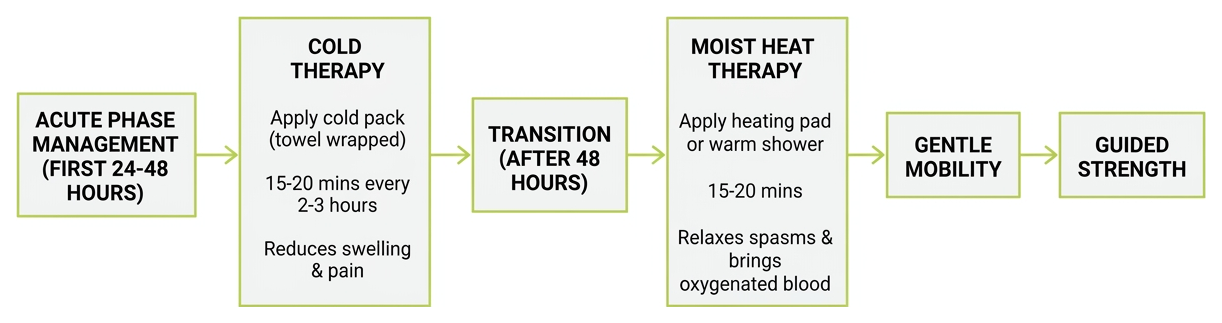
Managing an acute thoracic sprain requires applying thermal modalities correctly based on the injury phase:
- First 24 to 48 Hours (Cold Therapy): Apply a cold pack wrapped in a thin towel for 15 to 20 minutes every 2 to 3 hours. Cold constricts local capillaries, reducing inflammatory swelling, bruising, and acute nerve pain.
- After 48 Hours (Superficial Heat Therapy): Once primary swelling stabilizes, transition to moist heat (such as a warm heating pad or warm shower) for 15 to 20 minutes at a time. Heat dilates blood vessels, bringing oxygenated blood to repair injured tissues while relaxing secondary muscle spasms.
Review the Upper and Middle Back Strain Care Instructions alongside our practical framework on how to reduce back pain in 7 easy steps to structure your daily routine.
Gentle Mobility and Active Rest Protocols
Strict bed rest is counterproductive for spinal recovery. Prolonged immobility stiffens facet joints, weakens paraspinal muscles, and slows ligament healing. Instead, adopt a strategy of relative rest—staying gently active while avoiding heavy lifting, contact sports, and forceful spinal rotation.
Start these non-strenuous exercises once acute, sharp pain begins to ease:
- Diaphragmatic Breathing: Sit tall in a supported chair. Place your hands over your lower ribs. Inhale slowly through your nose, expanding your ribs sideways without letting your shoulders hike up. Exhale smoothly. This gently mobilizes the costovertebral joints without overloading your ligaments.
- Seated Thoracic Extension: Sit with your hands behind your head or crossed over your chest. Gently arch your upper back backward over the chair’s backrest until you feel a mild stretch. Hold for 3 to 5 seconds, then return to neutral. Repeat 8 to 10 times.
- Gentle Cat-Cow Transitions: On all fours with hands under shoulders and knees under hips, smoothly transition between gentle spine flexion and mild extension. Avoid pushing through end-range pain.
Learn additional safe movements in our guides on how to relieve a pulled mid back muscle using simple stretches and how to learn upper back stretches.
Medical Diagnosis and Conservative Treatment Options
Clinical Examination and Imaging Guidelines
When home remedies do not resolve your symptoms within 7 to 10 days, a comprehensive medical evaluation is recommended. At California Pain Consultants, our board-certified physicians perform detailed physical examinations to identify the source of mid-back pain.
Clinical evaluation includes:
- Palpation: Checking individual interspinous ligaments, facet joints, and paraspinal muscles to locate tenderness and trigger points.
- Range of Motion & Neurologic Testing: Assessing active thoracic rotation, extension, and lateral flexion, alongside deep tendon reflexes and sensation checks.
- Diagnostic Imaging Indications:
- X-rays: Indicated if there is a history of trauma, suspected vertebral compression fracture, or underlying structural deformity like Scheuermann kyphosis.
- Magnetic Resonance Imaging (MRI): Reserved for cases with progressive neurological deficits, suspected disc involvement, or persistent severe pain lasting beyond 4 to 6 weeks. MRI clearly visualizes soft-tissue structures, highlighting ligament tears, bone marrow edema, and spinal cord status.
For more on clinical assessments, refer to the diagnostic review on Musculoskeletal Key on Thoracic Sprain or Strain.
Targeted Physical Therapy and Non-Surgical Interventions
If pain persists or recurrent spasms limit daily tasks, structured medical interventions help restore function without surgery:
- Targeted Physical Therapy: A tailored rehabilitation program focuses on scapular stabilization, thoracic mobility, and deep core strengthening (targeting the transverse abdominis and multifidus). Re-establishing balanced muscular support unloads healing thoracic ligaments.
- Trigger Point Injections: Secondary muscle knotting frequently causes severe referred pain. Targeted trigger point injections can deactivate hyperirritable muscle nodules, quickly relieving persistent spasms.
- Interventional Pain Management: In cases with co-existing facet joint irritation or costovertebral inflammation, precise, ultrasound-guided or fluoroscopic joint injections provide localized pain relief so you can comfortably participate in physical therapy.
Explore how our specialists design restorative care programs by reviewing our structured back pain physical therapy protocols and learning about unlocking comfort through musculoskeletal pain treatments.
Preventing Re-Injury and Long-Term Spinal Health
Posture, Ergonomics, and Movement Mechanics
Preventing chronic ligament strain requires identifying and correcting everyday physical stressors:
- Ergonomic Workstation Setup: Adjust your computer monitor so the top third sits directly at eye level. Keep your elbows supported at 90-degree angles and position your hips slightly higher than your knees. Use a lumbar support pillow or thoracic wedge to maintain a natural spinal curve.
- The 30-Minute Posture Reset: Avoid sitting statically for hours. Stand up, roll your shoulders back, and perform three gentle chest-opening stretches every half hour to alleviate ligamentous tension.
- Safe Lifting Mechanics: Never bend forward from the waist to lift an object. Bend your hips and knees, brace your core, keep the load close to your chest, and pivot with your feet rather than twisting your thoracic spine.
Discover simple workplace adjustments in our guides to stop the slouch and relieve upper back pain and how to relieve upper back strain with quick changes.
Long-Term Prognosis for a Thoracic Back Sprain
The long-term outlook for a thoracic ligament sprain is excellent. Most mild to moderate sprains resolve within 2 to 6 weeks with proper conservative care. More significant ligament tears naturally undergo tissue remodeling over 1 to 6 months.
Approximately 20 percent of acute back pain cases progress to chronic discomfort if underlying postural faults, poor lifting mechanics, and muscular imbalances remain uncorrected. Proactively rebuilding strength and joint mobility during recovery helps ensure your thoracic spine remains resilient and stable. For additional strategies on maintaining a healthy mid-back, explore our advice on effective middle back pain relief.
Frequently Asked Questions About Thoracic Spine Sprains
How long does a mid-back ligament injury take to heal?
Mild thoracic ligament sprains typically heal within 2 to 6 weeks. More severe or multi-ligament injuries may require 1 to 6 months of relative rest, physical therapy, and tissue remodeling before reaching full functional strength.
Why does taking a deep breath hurt with a mid-back sprain?
Your ribs articulate directly with the thoracic vertebrae via costovertebral and costotransverse joints. Deep inhalations cause your rib cage to expand upward and outward, pulling on adjacent inflamed thoracic ligaments.
Can poor desk posture trigger a mid-back sprain?
Yes. Chronic slouching (sustained thoracic kyphosis) places continuous tension on spinal ligaments. Over time, this leads to ligamentous laxity and micro-stretching, leaving tissues vulnerable to acute tearing during simple everyday movements.
Conclusion
A thoracic back sprain can interrupt your daily activities and make simple motions like breathing, sitting, and twisting painful. By adopting active recovery protocols—such as short-term cold therapy, relative rest, gentle mobility drills, and targeted physical rehabilitation—you can support proper ligament healing and prevent chronic discomfort.
If mid-back pain limits your daily routine, our team at California Pain Consultants is here to help. Serving patients across San Diego, Kearny Mesa, Chula Vista, Rancho Bernardo, La Mesa, and Miramar, our board-certified physicians provide personalized, non-surgical pain management plans to restore your mobility.
To begin your recovery, read our guide to specialized back pain treatment in San Diego and explore comprehensive care for back muscles today.
References
David Yusupov, Minh Quan T. Le, Todd May. “Mechanical Back Strain.” StatPearls Publishing, 2026. NBK542314.