
Build Stronger, Wider Lats With Safe Back Training
Dealing with this in San Diego? Same-day appointments are often available at our 4 clinics.
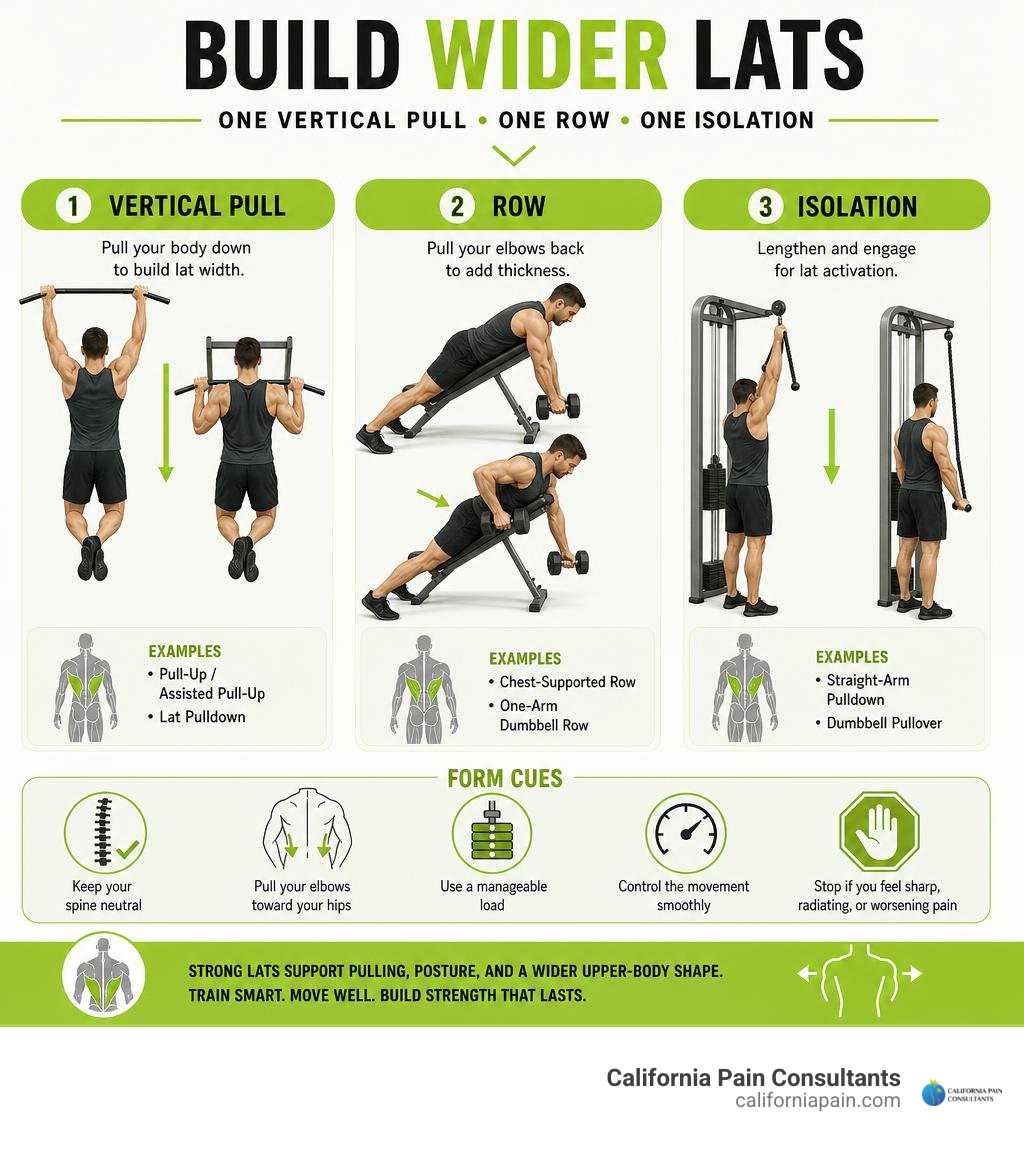
For stronger, wider lats, build each workout around one vertical pull, one row, and one controlled isolation movement. Start with a scalable exercise such as a front lat pulldown or band-assisted pull-up, add a chest-supported or one-arm dumbbell row, then finish with a straight-arm pulldown or dumbbell pullover. Keep your spine neutral, pull your elbows toward your hips, and stop any movement that causes sharp, radiating, or worsening pain.
Your latissimus dorsi, or lats, are the broad muscles that run from the middle and lower back to the upper arms. They help pull the arms down and back, support shoulder movement, and contribute to the wider upper-body shape often called a V-taper. Strong lats also matter beyond appearance: they help with lifting, reaching, pulling, and maintaining a more upright posture.
If chronic back, neck, or shoulder pain limits your training, the goal is not to push through it. Choose supported variations, use a manageable load, and focus on smooth control rather than momentum. This guide breaks down compound back and lat exercises step by step, including safer options for building strength without needlessly stressing sensitive joints.
I am Dr. Zach Cohen, a double board-certified physician in anesthesiology and chronic pain medicine with experience helping people modify exercise when pain affects movement. In this guide to back and lat exercises, I will focus on clear form cues and practical adjustments that support stronger training while respecting your body’s limits.
Back and lat exercises helpful reading:
Anatomy and Biomechanics of the Latissimus Dorsi
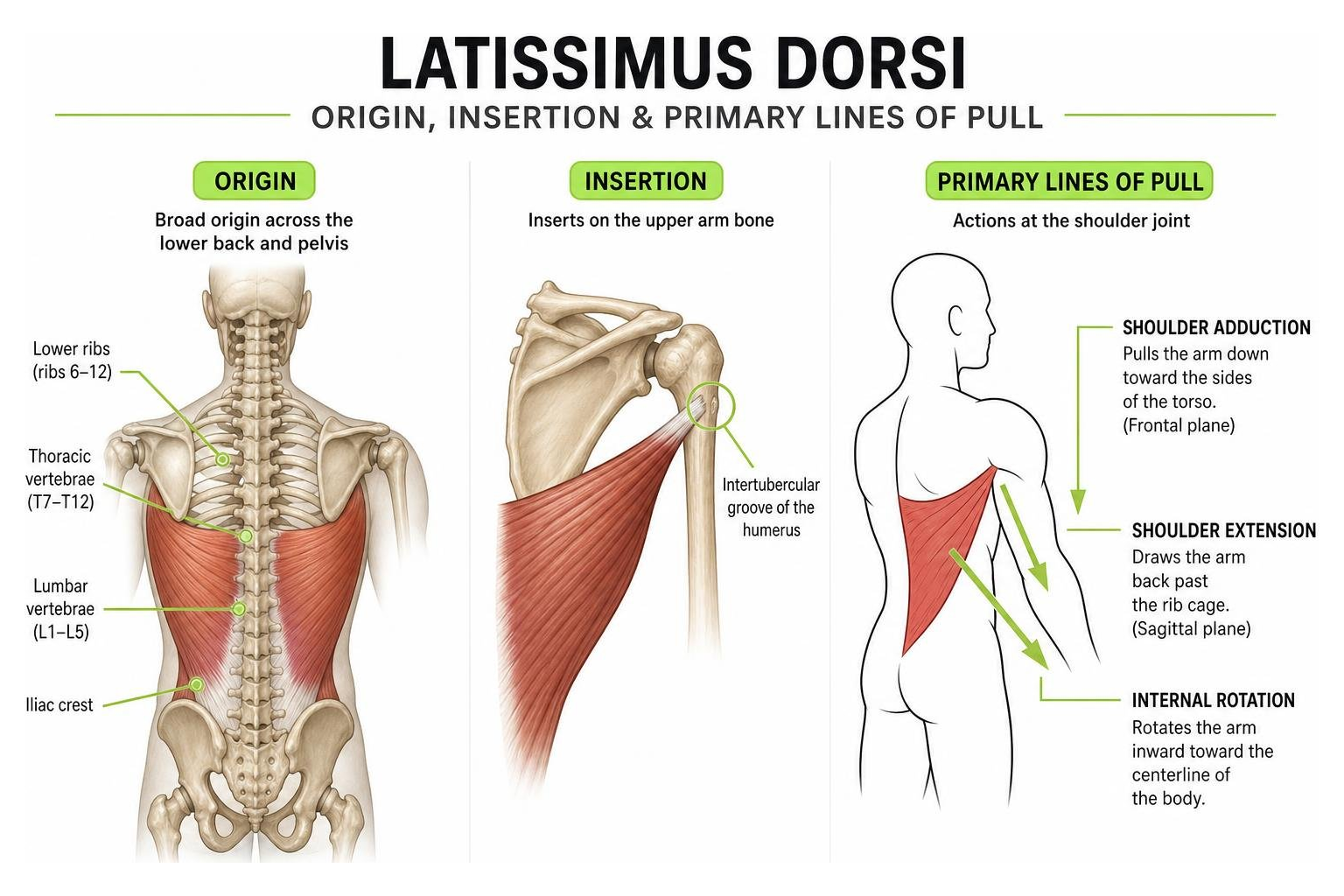
The latissimus dorsi muscles are the largest singular muscles in the upper body. Originating from the lower thoracic and lumbar vertebrae, the iliac crest of the pelvis, and the lower ribs, these broad, triangular muscles travel upward to insert directly into the intertubercular groove of the humerus (upper arm bone). If you want an in-depth clinical look at how these muscle fibers connect across the spine, review our detailed guide to latissimus dorsi muscle anatomy and function.
Because the lats cross both the shoulder joint and the back, their primary mechanical actions include:
- Shoulder Adduction: Pulling the arms downward toward the sides of the torso in the frontal plane (such as during a wide-grip pull-up).
- Shoulder Extension: Drawing the upper arm backward past the rib cage in the sagittal plane (such as during a standard dumbbell row).
- Internal Rotation: Rotating the arm bone inward toward the centerline of the body.
- Spinal Stabilization: Assisting the core and erector spinae in maintaining a rigid torso under heavy compressive loads.
Understanding this dual role in movement and spinal support is crucial. As we explore in the mighty lats a comprehensive guide to your latissimus dorsi muscles, the lats work alongside the teres major (often nicknamed the “lat’s little brother” high on the upper back) to control the humerus. During proper pulling movements, engaging the lower traps and serratus anterior helps you achieve clean scapular depression (pulling the shoulder blades down and back), preventing the shoulder joint from gliding forward or pinching sensitive tendons.
How Grip Variations Impact Back and Lat Exercises
Modifying your hand placement changes the biomechanical leverage of the upper body, distributing mechanical tension between the upper lats, lower lat fibers, rhomboids, and biceps.
- Overhand (Pronated) Grip: Placing hands slightly wider than shoulder-width maximizes frontal plane shoulder adduction. This variation strongly recruits the teres major and upper latissimus dorsi fibers, creating back width.
- Underhand (Supinated) Grip: An underhand grip places the biceps brachii into an optimal mechanical position for force production. This allows you to handle heavier loads while drawing the elbows closer to the hips, which emphasizes the lower lat fibers.
- Neutral (Palms-Facing) Grip: Neutral grips are exceptionally forgiving on the wrists, elbows, and glenohumeral joints. They allow your elbows to track naturally alongside the torso, facilitating a deep lat stretch without excessive shoulder rotation.
- Grip Width Nuances: A grip placed roughly 1.5 times the shoulder width offers an ideal balance of range of motion and muscle activation. Gripping excessively wide shortens the effective pulling distance, whereas gripping too narrow shifts mechanical load onto the forearms and biceps.
A landmark study examining High-Density Electromyography Excitation in Front vs. Back Lat Pull-Down Prime Movers demonstrated that pulling to the front elicits significantly greater concentric excitation across prime movers compared to behind-the-neck trajectories, confirming that grip comfort and natural joint alignment yield superior muscle recruitment.
The Best Back and Lat Exercises for Building Width and Thickness
Developing a dense, wide back requires a combination of vertical pulls (which emphasize shoulder adduction and width) and horizontal rows (which drive shoulder extension and mid-back thickness). Integrating multi-joint back compound exercises allows you to load these structures progressively while maintaining strict eccentric control.
| Exercise Vector | Primary Muscle Emphasis | Movement Plane | Key Spine Precaution |
|---|---|---|---|
| Vertical Pull (e.g., Lat Pulldown, Pull-Up) | Upper Lats, Teres Major, Biceps | Frontal / Scapular Plane | Avoid excessive lumbar hyperextension or swinging |
| Horizontal Row (e.g., Barbell Row, Cable Row) | Mid Lats, Rhomboids, Trapezius | Sagittal Plane | Keep hips hinged with a neutral, braced lumbar spine |
| Loaded Carry / Deadlift | Erector Spinae, Isometric Lat Bracing | Sagittal / Multi-Plane | Avoid rounding the lower back during initial lift-off |
Conventional Barbell Deadlift and Variations
While often viewed primarily as a lower-body lift, the deadlift requires tremendous isometric lat engagement to keep the bar positioned tight against the shins and thighs throughout the pull.
- Stand with feet hip-width apart, the barbell positioned over your midfoot.
- Hinge at the hips, keeping your spine straight and shoulders slightly in front of the bar.
- Grip the bar firmly, actively engage your lats by imagining “squeezing an orange in each armpit,” and drive through the floor to stand tall.
- If you have a history of lumbar sensitivity, switching to a trap bar deadlift or elevated Romanian deadlift reduces lower-back shear forces by allowing a more upright torso angle.
For a structured exercise breakdown, check out our detailed guide to latissimus dorsi exercises.
Pull-Ups and Chin-Ups
Pull-ups and chin-ups are closed-chain movements where your hands remain anchored to a fixed bar while your body travels through space. This closed-chain dynamic triggers high neuromuscular recruitment throughout the entire shoulder girdle and core.
- Grip the bar just outside shoulder width with an overhand (pull-up) or underhand (chin-up) grip.
- Begin by depressing your scapulae—pulling your shoulders away from your ears before bending your elbows.
- Drive your elbows down toward your rib cage until your chin clears the bar.
- Lower under control over a 2- to 3-second count into a full stretch.
- If you cannot yet complete full-ROM bodyweight repetitions, utilize resistance bands anchored under your foot or knee to practice controlled eccentric loading.
Recent exercise science published in PeerJ in 2025 demonstrated that stretch-focused partial repetitions (lengthened partials) yield upper-body muscle gains nearly identical to full-range-of-motion training. If you reach momentary failure on pull-ups, completing two to three controlled partial reps in the deep stretch at the bottom can safely extend the hypertrophic stimulus.
Bent-Over Barbell and Incline Rows
Horizontal rowing is the gold standard for adding mid-back thickness and lower lat density.
- Hinge forward at the hips to an angle between 30 and 45 degrees, maintaining a flat back and braced core.
- Pull the barbell or dumbbells smoothly toward your belly button, keeping your elbows angled roughly 45 degrees from your sides.
- To eliminate lower back strain entirely, perform chest-supported incline dumbbell rows set to a 45-degree angle. This setup eliminates momentum and protects the lumbar spine.
- Beginners looking for safe starting points can explore our guide to the 3 best dumbbell back exercises for beginners.
Cable Lat Pulldowns
The lat pulldown serves as an open-chain vertical pull that allows precise resistance adjustments for all fitness levels. As detailed in our breakdown of How to do the Lat Pulldown: Master the Pulldown Technique Today!, setup is critical:
- Adjust the thigh pad so your knees fit snugly underneath with your feet planted flat on the floor.
- Grasp the bar with a thumbless (open) grip slightly wider than your shoulders; treating your hands like simple “hooks” reduces bicep dominance.
- Lean back very slightly (approximately 10 to 15 degrees) to clear a straight path to your upper chest.
- Drive your elbows down and slightly outward, bringing the bar to the level of your collarbone before controlling the weight back up into a full overhead stretch.
Isolation and Unilateral Variations for Lat Growth
While compound movements form the bedrock of back development, isolation and single-arm movements allow you to fully stretch and contract the lats without grip or lower back fatigue becoming the limiting factor.
- Straight-Arm Cable Pulldown: Standing with a slight forward torso hinge, hold a straight bar or rope attachment with arms straight (elbows softly unlocked). Pull the attachment down in an arc to your upper thighs by contracting your lats. This eliminates bicep involvement completely.
- Dumbbell Lat Pullover: Lying flat on a bench or directly on the floor, hold a dumbbell overhead with both hands. Lower the weight behind your head in a controlled arc to feel a deep stretch along your rib cage, then pull through the lats to return the weight above your chest.
Pairing these upper back movements with posterior chain core work is essential for structural stability, as outlined in our guide: no more weak back master your back and glute workout routine.
Key Dumbbell Back and Lat Exercises at Home
Building an impressive, strong back does not require high-end commercial gym machinery. You can achieve complete muscle recruitment using free weights at home:
- Single-Arm Dumbbell Row: Place one hand and knee on a bench (or hinge freely with one hand braced against a sturdy surface). Drive your elbow backward toward your hip pocket, pausing briefly at the top to prevent rotational torso twisting.
- Kettlebell or Dumbbell Gorilla Row: Assume a wide, grounded hip hinge with two weights on the floor between your feet. Row one weight upward while actively pressing down into the resting weight with the opposite arm, creating exceptional core and lat tension.
- Incline Bench Dumbbell Pullover: Lie back on an incline bench set to 30 degrees to maintain continuous tension throughout the extended range of motion.
For comprehensive home training splits, consult the ultimate back and bicep workout from home to hero.
Spine-Safe Execution and Form Corrections
At California Pain Consultants, we regularly see active adults and athletes whose workout progress is derailed by preventable mechanical errors. Protecting your spinal discs and shoulder capsules requires avoiding a few common pitfalls:
- Eliminate Behind-the-Neck Pulls: Pulling a bar behind the head forces the shoulder joint into extreme external rotation and horizontal abduction. As explored in Behind the Head Lat Pulldown: Guide to Form & Safety – RevivoHub, this drastically narrows the subacromial space, substantially increasing the risk of shoulder impingement and rotator cuff inflammation. Always pull in front of your body along the natural scapular plane.
- Avoid Excessive Torso Swinging: Leaning back aggressively during rows or pulldowns shifts tension into the lumbar spine and uses momentum rather than muscular effort. Keep your core braced and maintain a steady torso angle.
- Do Not Lead with the Hands: Grasping the bar too tightly often causes the forearms and biceps to fatigue before the lats are fully stimulated. Focus on driving through the elbows to maximize lat recruitment.
- Protect the Lumbar Spine: When dealing with discomfort, swap unsupported bent-over barbell lifts for chest-supported machine rows, neutral-grip cable rows, or targeted exercises for lower back pain.
Programming Frequency, Volume, and Rep Ranges
Research indicates that training the back 1 to 2 times per week with a cumulative volume of 10 to 20 hard working sets per week is optimal for balanced strength and hypertrophy. Distributing volume across two weekly sessions allows adequate recovery for the central nervous system and connective tissues.
- Strength & Power: 3 to 5 sets of 4 to 6 reps with 2–3 minutes of rest.
- Hypertrophy (Muscle Growth): 3 to 4 sets of 8 to 12 reps with 60–90 seconds of rest.
- Muscular Endurance & Prehab: 2 to 3 sets of 12 to 15+ reps with 45–60 seconds of rest.
To expand your full-body routine, explore our complete library of exercise for back protocols.
Frequently Asked Questions About Lat Training
What is the single best exercise for lat width?
The wide-grip pull-up and wide-grip front lat pulldown are widely considered the most effective exercises for developing lat width. Both movements emphasize frontal-plane shoulder adduction, directly targeting the upper lat fibers and the teres major.
Why are behind-the-neck pulldowns considered dangerous?
Behind-the-neck pulldowns place the shoulder joint into extreme external rotation and abduction while requiring unnatural cervical spine flexion. This position compresses the subacromial space, predisposing lifters to rotator cuff strains, shoulder impingement syndrome, and neck injuries without offering any hypertrophy advantage over front pulldowns.
How often should you train your lats each week?
For optimal strength, growth, and tissue recovery, train your lats 1 to 2 times per week. Spacing sessions 48 to 72 hours apart ensures muscle fibers repair efficiently while accumulating the 10 to 20 hard weekly sets needed for consistent progression.
Conclusion
Building a strong, resilient, and wide back requires a smart balance of vertical pulling, horizontal rowing, and joint-friendly isolation exercises. By applying strict form cues, leading with your elbows, maintaining a neutral spine, and progressing your loads gradually, you can achieve a classic V-taper physique while protecting your spine from unnecessary wear and tear.
If chronic back stiffness, nerve pain, or joint discomfort is holding you back from reaching your fitness goals, the board-certified medical team at California Pain Consultants is here to help. Serving patients across San Diego, Kearny Mesa, Chula Vista, Rancho Bernardo, La Mesa, and Miramar, California, we specialize in comprehensive, non-surgical pain management solutions designed to restore mobility and help you move without limitation.
To take the next step toward a pain-free, active lifestyle, explore our complete collection of structured back workouts or contact our team today to schedule an evaluation.