
Find the Right Non Surgical Spinal Care Path
Dealing with this in San Diego? Same-day appointments are often available at our 4 clinics.
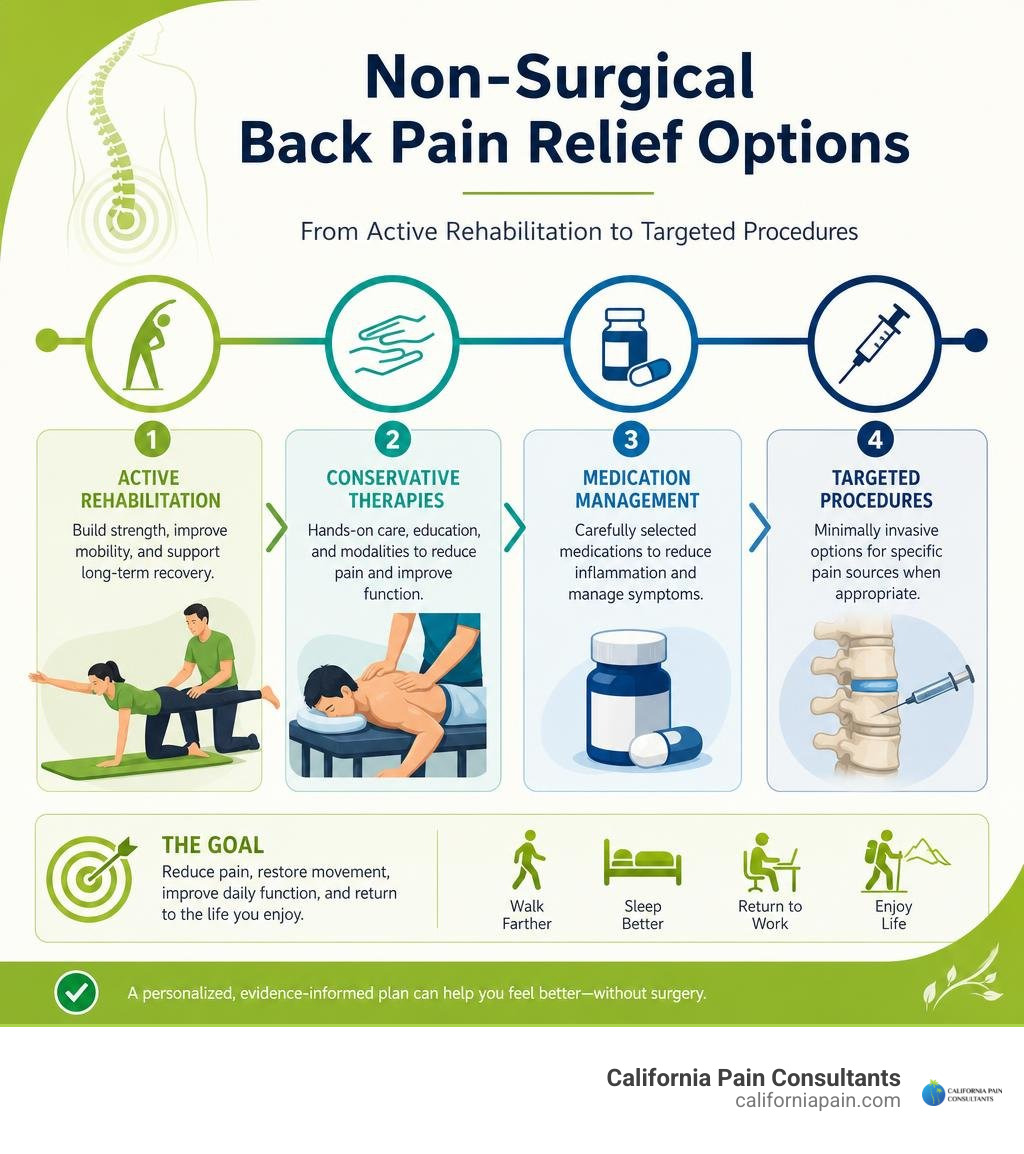
Non surgical spinal care can help reduce back or neck pain, improve movement, and support daily function without jumping straight to surgery. The best starting point is a clinical evaluation that identifies the likely pain source, checks for nerve-related warning signs, and builds a plan around active treatment – usually education, guided exercise, physical therapy, and, when appropriate, carefully selected medications or procedures.
For many people, the goal is not simply to “fix” an MRI finding. It is to walk farther, sleep better, return to work or hobbies, and rely less on treatments that do not create lasting progress.
Terms such as spinal decompression, traction, manual therapy, epidural injection, and spinal manipulation can sound alike, but they are not interchangeable. Some options have stronger research support than others. For example, exercise and individualized rehabilitation are core conservative treatments, while expensive motorized decompression programs have much more limited evidence of benefit over standard traction or physical therapy.
I am Dr. Zach Cohen, a double board-certified anesthesiologist and chronic pain physician with training in interventional spine care, minimally invasive procedures, medication management, and multidisciplinary rehabilitation. In this guide to Non surgical spinal care, I will translate the terms, evidence, and safety questions that can help you make a clearer treatment decision.
Know your Non surgical spinal care terms:
Understanding Non Surgical Spinal Care: Core Concepts and Modalities
When spinal discomfort strikes, navigating the medical vocabulary can feel overwhelming. Many patients present to our clinics in San Diego, Kearny Mesa, Chula Vista, Rancho Bernardo, La Mesa, and Miramar wondering how to interpret complex MRI reports or determine which conservative modalities are truly supported by scientific literature.
Non-surgical spine management exists on a broad spectrum, ranging from hands-on physical conditioning and manual joint alignment to targeted clinical procedures. At its foundation, conservative care aims to resolve mechanical dysfunction, relieve neural irritation, and restore functional mobility without the structural disruption of an operating room.
Understanding your specific diagnosis is key to selecting the proper modality:
- Discogenic Pain: Discomfort stemming directly from structural alterations within the intervertebral disc, such as tears in the annulus fibrosus or internal disc disruption.
- Radiculopathy (Sciatica): Irritation or mechanical compression of a spinal nerve root, leading to sharp, shooting pain, numbness, or weakness radiating into the lower extremities.
- Neurogenic Claudication: Cramping, aching, or heaviness in the legs provoked by prolonged walking or standing, caused by narrowing within the spinal canal.
- Facet Joint Syndrome: Localized spinal stiffness and ache arising from degenerative wear in the small stabilizing joints connecting adjacent vertebrae.
To build an effective recovery strategy, patients often consult the ultimate guide to non-surgical pain management to understand how multidisciplinary protocols work together to alleviate both acute and persistent symptoms.
Non Surgical Spinal Care Through Manual Therapy and Manipulation
Manual therapy is one of the most widely utilized hands-on conservative interventions. In 2022, approximately 11.0 percent of U.S. adults received chiropractic care during the past year, compared to 7.4 percent in 2002. However, manual care encompasses distinct mechanical techniques that operate differently:
- Spinal Manipulation: A high-velocity, low-amplitude (HVLA) controlled thrust applied to a joint at the end of its passive range of motion. The patient cannot actively stop this thrust. Research documented by the Spinal Manipulation: What You Need To Know | NCCIH indicates that for acute low-back pain, spinal manipulation offers modest pain relief that is clinically comparable to nonsteroidal anti-inflammatory drugs (NSAIDs).
- Spinal Mobilization: Gentle, low-velocity oscillatory movements or sustained stretches applied within a joint’s natural anatomical range. The patient can actively resist or halt the movement at any point.
For chronic back symptoms, moderate-quality evidence across 47 clinical trials involving over 9,200 participants indicates that short-term pain relief from spinal manipulation or mobilization is comparable to other recommended conservative therapies, such as exercise programs.
According to formal guidelines in the Clinical Practice Guideline: Chiropractic Care for Low Back Pain, an evidence-based initial conservative trial for acute and subacute conditions typically consists of 2 to 3 visits per week for 2 to 4 weeks (up to a maximum of 12 visits). If functional gains are documented, care may transition to self-directed rehabilitation rather than open-ended passive treatment.
Mechanical Traction and Spinal Decompression Therapy
Motorized traction has a long history in spine care. Over recent decades, traditional static or intermittent traction has evolved into specialized computerized devices marketed as “non-surgical spinal decompression.”
During these sessions, a patient lies fully clothed on a motorized table fitted with pelvic and trunk harnesses. A computer regulates distraction forces, cycling between tension and relaxation phases across 30- to 45-minute sessions over a 5- to 7-week treatment course.
The purported physiological mechanism is the generation of negative intradiscal pressure. By mechanically unweighting the lumbar segments, the procedure aims to create a vacuum effect that retracts herniated disc material and draws nutrient-rich fluids, water, and oxygen into the disc matrix.
While exploring beyond the blade effective non-surgical treatments for spine pain is a logical step for many patients, it is critical to look closely at the scientific evidence before investing substantial resources into motorized decompression protocols.
Non-Surgical Decompression vs. Conservative Physical Rehabilitation
To understand whether motorized decompression justifies its frequent out-of-pocket costs, we must objectively compare it against active, exercise-based physical therapy.
| Clinical Dimension | Motorized Spinal Decompression | Manual Therapy & Guided Exercise | Structured Medical Management |
|---|---|---|---|
| Primary Mechanism | Computer-controlled mechanical distraction creating negative disc pressure | Joint mobilization, motor control re-education, and core strengthening | Oral pharmacotherapy, diagnostic imaging, and interventional procedures |
| Scientific Evidence Base | Very low to low-quality trials; mostly small case series | Moderate to high-quality trials confirming functional restoration | Moderate to high-quality trials for acute symptom stabilization |
| Typical Treatment Protocol | 20 to 28 motorized sessions over 5 to 7 weeks | 8 to 12 supervised clinical sessions paired with home exercise | 2 to 4 clinical visits with diagnostic reassessment benchmarks |
| Active vs. Passive | Completely passive treatment modality | Active patient participation and neuromuscular retraining | Combination of passive interventions and self-management |
| Long-Term Independence | Low; often promotes reliance on specialized equipment | High; equips patients with lasting self-management tools | Moderate; depends on transition to active physical therapy |
When reviewing conservative options in our non-surgical pain relief clinic guide 2026, evaluating the clinical validity behind promotional claims ensures realistic expectations.
Intradiscal Pressure and Mechanical Traction Claims
Commercial advertising for motorized spinal decompression machines often highlights an “86% success rate.” However, peer-reviewed medical literature tells a more nuanced story:
- Study Quality Limitations: Much of the literature cited by equipment manufacturers relies on small-scale, non-blinded observational pilot studies rather than high-powered, sham-controlled randomized clinical trials (RCTs).
- Prone vs. Supine Discrepancies: Promotional materials frequently conflate research conducted on specific prone-position devices (such as VAX-D) with generalized supine traction tables.
- Transient Benefit: In one randomized trial examining motorized decompression against TENS therapy, initial improvements observed at the end of the treatment course dropped significantly when patients were re-evaluated at 6 months.
- Adverse Event Risks: Although rare, aggressive mechanical distraction carries potential risks. Clinical reports have documented instances where patients experienced sudden progression of disc herniation during motorized axial traction, requiring urgent surgical discectomy.
While laboratory measurements show that mechanical distraction can drop intradiscal pressure from -25 mm Hg to -160 mm Hg under forces between 50 and 100 pounds, high-quality clinical trials demonstrating that this translates to superior long-term functional recovery compared to standard physical therapy remain limited.
Individualized Exercise and Manual Protocols for Lumbar Stenosis
Degenerative lumbar spinal stenosis affects approximately 30% of older adults according to radiographic and clinical data from the Framingham study, making it the most frequent indication for spine surgery in individuals over 65.
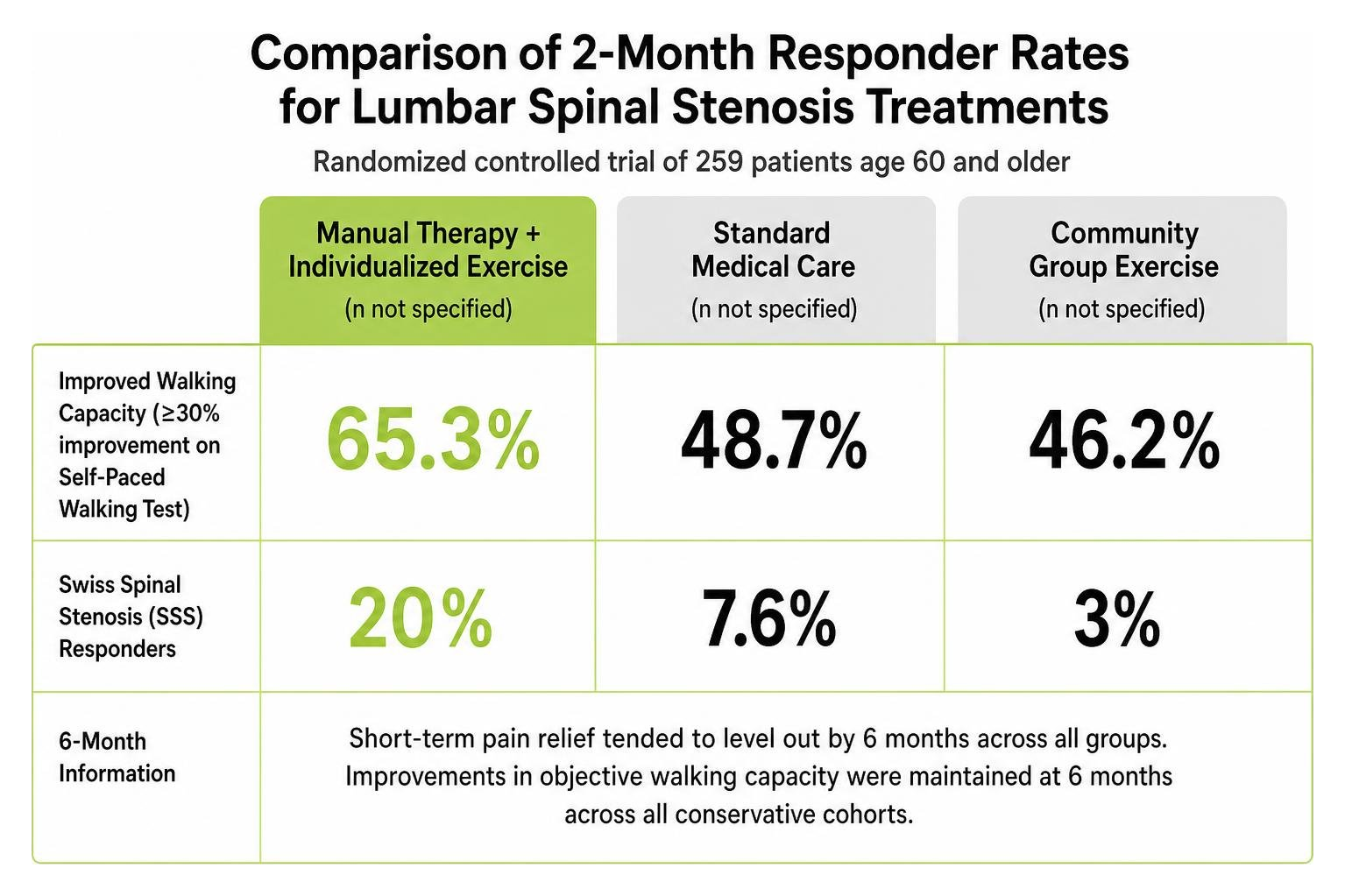
High-quality research published in Comparing the Effectiveness of Nonsurgical Treatments for Lumbar Spinal Stenosis in Reducing Pain and Increasing Walking Ability – NCBI Bookshelf sheds light on how non-surgical options compare in clinical practice. In a randomized controlled trial of 259 patients aged 60 and older:
- Walking Capacity: At 2 months, 65.3% of patients receiving manual therapy combined with individualized exercise achieved a clinically meaningful improvement (≥30%) on the Self-Paced Walking Test, compared to 48.7% receiving standard medical care and 46.2% participating in community group exercise.
- Symptom Relief: The manual therapy and individualized exercise group had significantly more Swiss Spinal Stenosis (SSS) responders (20%) than medical care (7.6%) or group exercise (3%).
- Long-Term Endurance: While short-term pain relief tended to level out by 6 months across all groups, improvements in objective walking capacity were maintained at 6-month follow-up across all conservative cohorts.
These findings highlight that clinic-based, individualized active care directly improves functional mobility and walking tolerance in older adults.
Advanced Interventional and Structured Non-Operative Pathways
When standard physical therapy alone does not sufficiently relieve debilitating symptoms, patients do not need to leap immediately into major surgical fusions. Advanced interventional pain management offers a bridge that stabilizes acute pain, breaks the inflammatory cascade, and allows patients to participate fully in physical rehabilitation.
Evaluating Structured Non Surgical Spinal Care and Centralized Pain
Managing chronic spine symptoms requires addressing the biological and neurological changes that occur over time. Regardless of where an initial tissue injury begins, persistent nociceptive input can transition into a centralized, neuroplastic pain state within 6 to 12 months. When central sensitization takes hold, the nervous system amplifies pain signals even after initial soft-tissue healing has occurred.
As outlined in the clinical manual Defined Non-Operative Spine Care for Adults with Spinal Deformity, a truly structured conservative program must look beyond single modalities and evaluate systemic physiological domains:
- Sleep Stabilization: Achieving at least 6 cumulative hours of restorative sleep per 24-hour cycle for a minimum of 6 consecutive weeks to reduce systemic neuro-inflammation.
- Bone Mineral Density Optimization: Screening patients over age 50 using Dual-energy X-ray Absorptiometry (DXA) scans (evaluating femoral neck, total hip, and lumbar spine) and FRAX calculations to address underlying osteoporosis.
- Active Rehabilitation: Utilizing physiotherapeutic scoliosis-specific exercises (PSSE) and dynamic motor control training rather than passive bed rest.
- Pain Neuroscience Education: Employing cognitive desensitization techniques and stress reduction to recalibrate the central nervous system.
Surgeries performed in the presence of unaddressed centralized pain and high physiologic distress have substantially higher rates of poor functional outcomes, underscoring the vital role of comprehensive non-operative prehabilitation.
Interventional Pain Procedures and Regenerative Approaches
Targeted clinical procedures can provide precise diagnostic clarity and therapeutic relief when conservative exercises are limited by severe pain:
- Epidural Steroid Injections (ESIs): Fluoroscopically guided injections that deliver localized anti-inflammatory corticosteroids directly into the epidural space around irritated nerve roots, reducing radicular leg pain.
- Facet Joint Injections & Medial Branch Blocks: Diagnostic and therapeutic numbing agents placed around the sensory nerves of arthritic spinal joints.
- Radiofrequency Ablation (RFA): A specialized procedure using thermal energy to temporarily desensitize the medial branch nerves, providing lasting relief from facet joint arthritis for 6 to 18 months.
- Regenerative Medicine: Emerging autologous therapies, such as platelet-rich plasma (PRP) applied within regenerative medicine protocols, aimed at supporting natural healing responses in compromised tendons, ligaments, and degenerate joints.
By combining precision interventions with structured physical re-education, many patients successfully resolve debilitating symptoms and avoid minimally invasive spine surgery or complex reconstructive operations.
Candidate Selection, Contraindications, and Clinical Safety
Selecting the right treatment path requires a thorough diagnostic workup. A comprehensive clinical assessment at our back pain treatment san diego centers ensures that conservative modalities are applied safely and appropriately.
Ideal Candidates vs. Absolute Contraindications
Non-surgical care is the recommended first-line approach for most mechanical spine conditions. However, mechanical distraction and aggressive manual therapies are not appropriate for everyone.
Ideal Candidates for Conservative Care:
- Patients with acute or subacute lumbar disc herniations without progressive muscle weakness.
- Individuals diagnosed with neurogenic claudication secondary to mild-to-moderate spinal stenosis.
- Patients experiencing localized facet arthropathy or sacroiliac joint dysfunction.
- Individuals seeking structured rehabilitation prior to or following interventional procedures.
Absolute Contraindications for Motorized Spinal Decompression & Mechanical Traction:
- Pregnancy: Mechanical harness forces and pelvic pressure can compromise maternal and fetal safety.
- Spinal Structural Instability: High-grade spondylolisthesis, unstable fractures, or post-surgical structural failure.
- Advanced Osteoporosis: Severe bone demineralization or low Hounsfield units (HU < 80 on CT), which elevates fracture risk during mechanical loading.
- Vascular Pathologies: Documented abdominal aortic aneurysms (AAA) or severe peripheral arterial disease.
- Spinal Malignancy or Active Infections: Metastatic tumors, discitis, or spinal osteomyelitis.
- Progressive Neurological Deficits: Rapidly worsening motor loss, foot drop, or bowel/bladder dysfunction (cauda equina syndrome), which require urgent surgical consultation.
Conservative Support and Spinal Bracing Guidelines
Spinal orthoses and lumbar braces can serve as helpful adjuncts during acute flare-ups or specific functional tasks. When utilized properly, a supportive brace temporarily unloads mechanical pressure from healing discs and facet joints while providing proprioceptive feedback that prevents excessive twisting or bending.
However, bracing should not replace active muscular conditioning. Clinical consensus suggests wearing an adult supportive brace for 4 to 6 hours daily during high-demand physical tasks rather than continuous 24-hour use. This structured window prevents muscular atrophy while delivering functional stability. Pairing an active recovery routine with supportive back brace options ensures your spine remains supported while you rebuild core muscular endurance.
Frequently Asked Questions About Non-Surgical Spine Treatment
What is the main difference between spinal decompression and traditional traction?
While both modalities apply mechanical distraction to the spine, modern non-surgical spinal decompression utilizes computer-controlled tension curves and customized harness angles designed to target specific vertebral segments. Traditional traction typically applies steady or rhythmic pulling forces that can trigger muscular guarding. However, high-quality clinical trials showing that motorized decompression delivers superior long-term functional recovery compared to traditional traction or standard physical therapy remain limited.
How do I know if I am an appropriate candidate for conservative spine care?
Most patients experiencing back or neck pain, sciatica, or joint stiffness are excellent candidates for conservative care. You are an ideal candidate if you do not exhibit red-flag symptoms such as sudden bowel or bladder incontinence, unremitting night pain, unexplained weight loss, or rapidly advancing muscle weakness. A comprehensive diagnostic workup—combining clinical neurological testing with MRI or CT imaging when indicated—will confirm whether a conservative treatment course is safe and appropriate.
What should I do if non-surgical spinal treatments do not resolve my symptoms?
If you have completed a 6- to 12-week trial of structured non-surgical care without measurable improvement in pain or functional mobility, a multidisciplinary reassessment is recommended. This involves reviewing your diagnostic imaging, re-evaluating for centralized pain mechanisms or co-existing joint pathologies (such as hip osteoarthritis mimicking lumbar spine pain), and considering advanced interventional pain management procedures before discussing surgical options.
Conclusion
Navigating spinal conditions requires balancing evidence-based conservative therapies against commercial marketing claims. While high-cost motorized decompression tables are frequently promoted with dramatic success rates, peer-reviewed clinical research demonstrates that individualized exercise, manual joint mobilization, and targeted medical interventions remain the cornerstone of lasting functional recovery.
At California Pain Consultants, our double board-certified physicians specialize in comprehensive, non-surgical pain management across our clinics in San Diego, Kearny Mesa, Chula Vista, Rancho Bernardo, La Mesa, and Miramar. We believe in crafting personalized, multifaceted treatment programs tailored to your specific mechanical and neurological presentation—restoring your mobility and helping you return to the activities you love with confidence.