
Fast Relief for an Ache in Hips When Sitting
Dealing with this in San Diego? Same-day appointments are often available at our 4 clinics.
An ache in hips when sitting often improves when you change position often, support your feet and lower back, and gently move the hips instead of trying to stretch through sharp pain.
- Stand and walk for 1 to 2 minutes every 30 to 60 minutes.
- Keep both feet flat, avoid crossing your legs, and raise a low seat if your knees sit higher than your hips.
- Try a gentle seated figure-four stretch or a few slow hip movements.
- Add simple glute and core work, such as bridges, to help support the hip over time.
Long periods in a chair keep the hip bent and can tighten the front hip muscles while the glutes and core become less active. Research links prolonged workplace sitting with an 82% higher likelihood of hip pain. This matters when one in four adults sits more than eight hours a day, especially for people working from home on couches, kitchen chairs, or poorly fitted desks.
Brief stiffness that eases after a short walk is often related to position and muscle tightness. But deep groin pain, catching, numbness, worsening pain, or trouble bearing weight can point to a joint, nerve, or tendon issue that needs a clinical evaluation.
I am Dr. Zach Cohen, a double board-certified anesthesiologist and chronic pain physician who treats joint, nerve, and spine conditions with personalized non-surgical and interventional care. In evaluating an ache in hips when sitting, I focus on the pain pattern, mobility, and possible sources of irritation so the next steps fit the person, not just the symptom.
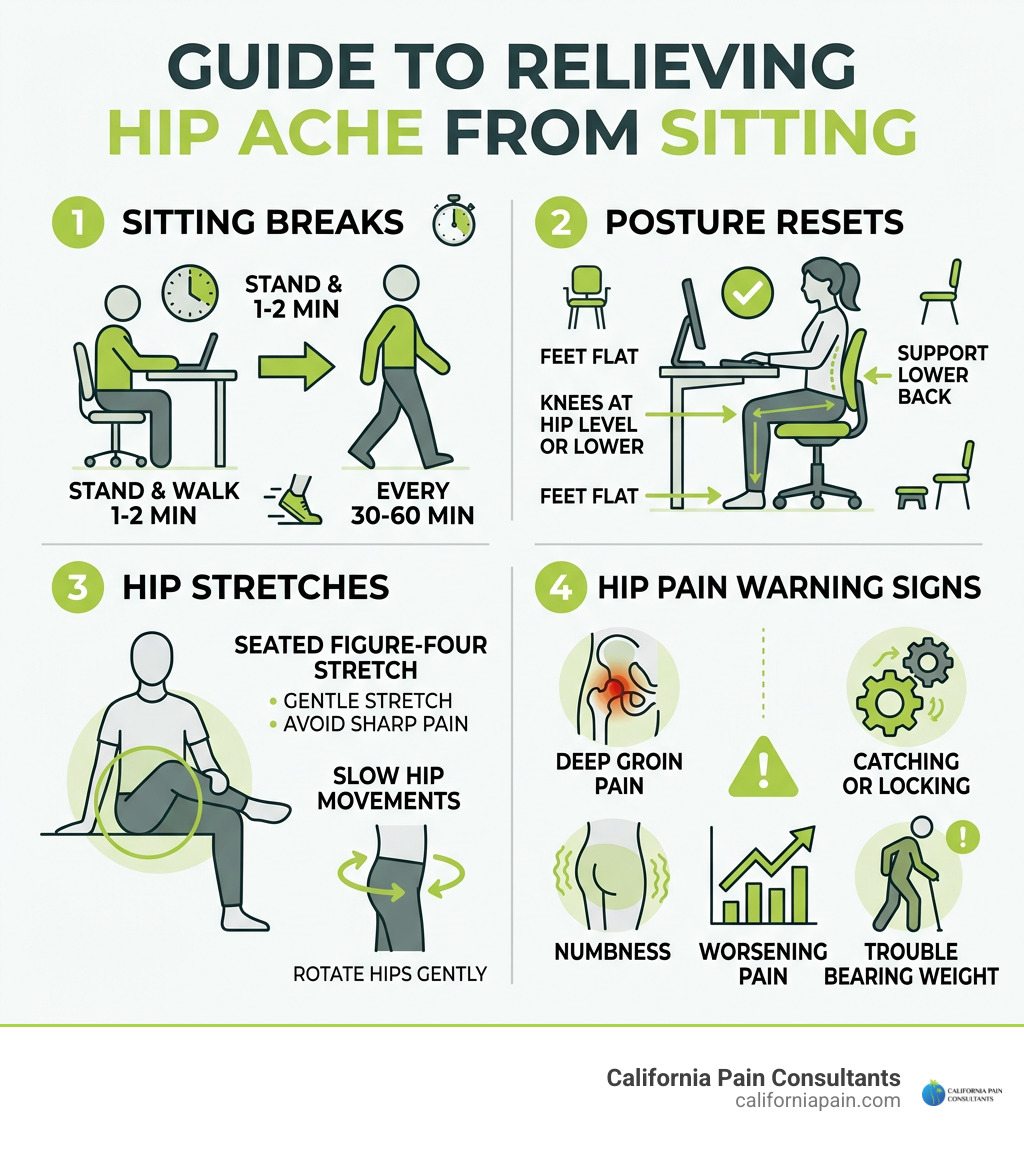
Simple ache in hips when sitting word guide:
What Causes an Ache in Hips When Sitting?
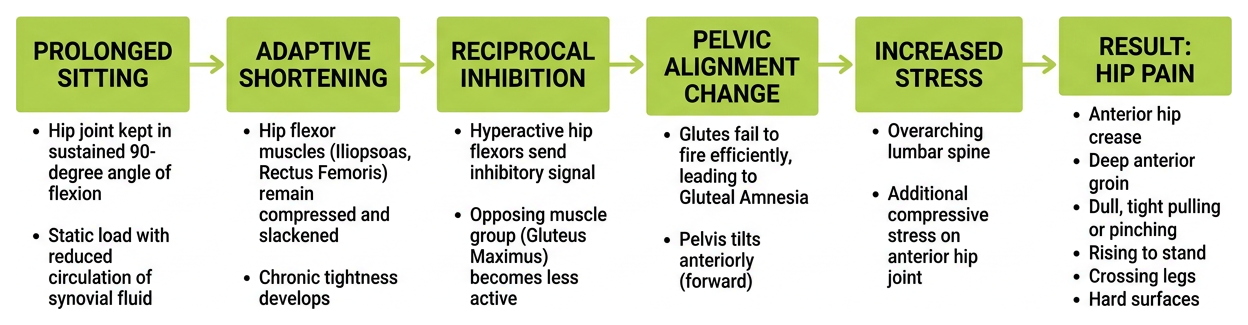
Sitting keeps the hip joint in a sustained 90-degree angle of flexion. While the human hip is designed for a dynamic range of motion—walking, squatting, climbing, and running—extended immobility creates uneven mechanical stress across the joint capsule, surrounding tendons, and lubricating bursa sacs.
When you remain seated for hours, the static load reduces the circulation of synovial fluid within the joint socket. Synovial fluid acts as natural motor oil and cartilage nutrition; without regular joint movement to disperse it, joint friction increases. Meanwhile, surrounding soft tissues adapt to the shortened posture, altering the alignment of the pelvis.
| Condition Type | Primary Pain Location | Typical Sensation | Distinctive Sitting Triggers |
|---|---|---|---|
| Muscular Imbalance / Flexor Tightness | Anterior hip crease, upper thigh | Dull, tight pulling or pinching | Rising to stand after >30 minutes seated |
| Trochanteric Bursitis / Gluteal Tendon | Outer hip, lateral thigh | Burning, localized tenderness | Sitting on firm chairs, crossing legs, lying on side |
| Hip Osteoarthritis | Deep anterior groin, inner thigh, buttock | Deep, stiff, toothache-like ache | Prolonged sitting, first 10 steps in the morning |
| Piriformis / Sciatic Referral | Deep central buttock, back of thigh | Throbbing, tingling, shooting numbness | Sitting on hard surfaces or sitting on a back-pocket wallet |
According to an evidence-based overview of hip pain causes, discomfort can originate within the intra-articular hip joint itself or refer from regional musculature and the lumbar spine. Distinguishing between muscular, structural, and neurological drivers is the first step toward effective relief.
Muscle Imbalances and Hip Flexor Shortening
The primary hip flexor muscle group—comprising the psoas major and iliacus (collectively known as the iliopsoas) alongside the rectus femoris—remains in a compressed, slackened state while you sit. Over time, this causes adaptive shortening. Clinical biomechanics research shows that hip flexor stiffness can increase by up to 25% after just 4 hours of uninterrupted sitting.
When hip flexors become chronically tight, they trigger a neurological phenomenon known as reciprocal inhibition. In simple terms, hyperactive front hip muscles send an inhibitory signal to their opposing muscle group on the posterior side: the gluteus maximus. This leads to gluteal amnesia, where the glutes fail to fire efficiently during standing and walking. When the glutes underperform, the pelvis tilts anteriorly (forward), overarching the lumbar spine and placing additional compressive stress on the anterior hip joint.
Joint Impingement, Bursitis, and Labral Stress
Extended sitting is especially aggravating for structural conditions within the hip capsule:
- Femoroacetabular Impingement (FAI): Occurs when subtle anatomical bone overgrowths on the femoral head (cam) or the acetabular socket rim (pincer) pinch against each other during deep hip flexion. Sitting in low chairs forces the hip into extreme flexion angles, worsening this pinch.
- Acetabular Labral Tears: The labrum is a ring of tough cartilage that seals and stabilizes the ball-and-socket joint. Chronic pinching from sitting can irritate an existing tear, causing a deep groin ache or clicking sensations.
- Greater Trochanteric Pain Syndrome (Bursitis and Gluteal Tendinopathy): While historically assumed to be isolated bursitis, research reveals up to 90% of lateral hip pain involves gluteal tendon irritation. Sitting cross-legged or on hard chairs compresses the bursa and tendons against the outer hip bone.
Understanding these mechanical pathways allows us to apply targeted, step-by-step hip pain treatments that decompress irritated structures.
Piriformis Syndrome and Nerve Referral
Discomfort felt in the buttock while seated often stems from the piriformis muscle or the lumbar spine:
- Piriformis Syndrome: The piriformis muscle runs deep in the buttock, extending from the sacrum to the top of the femur. When seated on hard chairs or slouching, the piriformis can spasm and compress the adjacent sciatic nerve. This produces a deep buttock ache, burning sensations, or tingling radiating down the posterior leg. Explore our comprehensive piriformis syndrome guide for in-depth insights into this condition.
- Lumbar Radiculopathy: Bulging spinal discs or spinal stenosis in the lower back can irritate the L4, L5, or S1 nerve roots, sending referred pain directly into the hip and buttock during seated spinal loading.
How Seating Ergonomics and Posture Aggravate Hip Ache
Your chair and seating posture directly dictate the amount of intra-articular pressure inside your hip socket. When posture collapses, the pelvis rocks backward into a posterior pelvic tilt, flattening the natural inward curve of the lower back and concentrating your upper body weight directly onto the hip joints and sit bones (ischial tuberosities).
A 2025 survey revealed that 58% of remote workers reported musculoskeletal pain directly tied to non-ergonomic home workstations, such as working from soft sofas, dining chairs, or beds. These setups lack lumbar support and proper seat pan depth, forcing the body into continuous postural strain.
Essential Desk Adjustments and Seating Mechanics
To minimize hip compression throughout the workday, set up your workstation using these clinical benchmarks:
- The Open-Angle Rule: Adjust your seat height so your hips rest slightly higher than your knees—aiming for an angle of 90 to 100 degrees at the hip crease. This prevents extreme hip flexion and unloads the anterior joint capsule.
- Support the Lumbar Curve: Place a small lumbar support cushion in the small of your lower back to maintain a neutral pelvic position.
- Firm, Contoured Seat Pan: Avoid overly plush chairs that allow the pelvis to sink below the knees. Use an ergonomic cushion with a coccyx cut-out if you experience tailbone or sit-bone tenderness.
- Stable Foot Positioning: Keep both feet resting flat on the floor. If your desk height requires raising your chair, use an angled footrest to maintain lower limb support.
For additional practical lifestyle adjustments, review our guide to natural strategies for sore hip relief.
Detrimental Sitting Habits to Break Immediately
Small postural habits create asymmetrical torque across the pelvic ring. Stop these three habits immediately:
- Crossing Your Legs: Crossing one leg over the other rotates the hip internally or externally under load, overstretching the lateral gluteal tendons and placing uneven pressure on the acetabulum.
- Sitting on a Back-Pocket Wallet or Phone: Placing objects in a back pocket elevates one side of the pelvis, causing functional scoliosis and severe unilateral compression on the piriformis and hip joint.
- Slouching or Perching on the Seat Edge: Perching forward tightens the iliopsoas, while slouching backward strains the lower lumbar discs and deep gluteal nerves.
Practical Strategies and Exercises for Fast Hip Relief
Relieving sitting-related hip discomfort requires a combined approach: decompressing tight anterior flexors, restoring joint mobility, and activating dormant posterior stabilizers. As outlined in clinical insights on hip pain from sitting, dynamic movement and low-load stretching offer immediate relief without aggravating delicate joint tissues.
Immediate Desk Stretches to Stop an Ache in Hips When Sitting
These stretches can be performed beside your desk in under three minutes:
1. Seated Figure-4 Stretch (Piriformis & Gluteal Release)
- Sit upright on the edge of your chair with feet flat.
- Cross your right ankle over your left knee, creating a “4” shape.
- Keep your spine straight and gently hinge forward at the hips until you feel a comfortable stretch in the outer right hip and buttock.
- Hold for 20 to 30 seconds while taking slow, deep breaths. Repeat on the opposite side.
2. Half-Kneeling Hip Flexor Stretch (Iliopsoas Lengthening)
- Step your left foot forward and place your right knee on a cushioned mat or towel.
- Tuck your pelvis slightly under (posterior tilt) and squeeze your right glute.
- Shift your weight forward slightly until you feel a gentle opening across the front of your right hip.
- Avoid arching your lower back. Hold for 30 seconds per side.
3. Seated Hamstring & Nerve Mobilizer
- Extend one leg straight out with your heel on the floor and toes pointed upward.
- Sit tall and hinge forward from your hips, keeping your back flat, until a mild stretch is felt behind the thigh.
- Hold for 20 seconds; switch legs.
Discover additional targeted routines in our collection of targeted hip relief exercises.
Targeted Strengthening and Glute Activation Drills
Stretching tight muscles is only half the battle. To prevent the ache from returning, you must wake up deactivated gluteal and core stabilizers using proven ways to kick hip pain fast:
Hourly Movement Snacks and Micro-Break Protocols
Research demonstrates that taking a brief 1- to 2-minute movement break every 60 minutes is more effective at preventing joint stiffness than completing a single long workout at the end of an 8-hour sedentary day.
Set a timer to follow this 60-second reset sequence every hour:
- Stand Up & Walk: Take a quick lap around your workspace (30 seconds).
- Standing Glute Squeeze: Stand tall and actively contract both glutes for 5 seconds; repeat 3 times.
- Pelvic Rocking: Perform 5 gentle standing hip circles in each direction to stimulate synovial fluid circulation.
Clinical Treatments and Non-Surgical Care Options
When home ergonomics and daily stretches do not resolve hip pain within a few weeks, an underlying joint, tendon, or nerve condition may require professional clinical management. Reviewing our resource on understanding hip arthritis relief options can help clarify chronic degenerative patterns.
At California Pain Consultants, our double board-certified physicians specialize in comprehensive, non-surgical pain management. Serving San Diego, Kearny Mesa, Chula Vista, Rancho Bernardo, La Mesa, and Miramar, California, our team utilizes advanced diagnostics—including high-resolution musculoskeletal ultrasound and digital fluoroscopy—to pinpoint the exact pain generator.
Advanced Interventional and Regenerative Therapies
Depending on the underlying pathology, modern interventional medicine provides precise, minimally invasive relief options:
- Ultrasound-Guided Corticosteroid Injections: Deliver targeted anti-inflammatory medication directly into the intra-articular hip space, trochanteric bursa, or iliopsoas sheath to rapidly alleviate inflammation.
- Platelet-Rich Plasma (PRP) Therapy: Concentrated growth factors derived from your own blood are injected into injured gluteal tendons or labral margins to accelerate natural tissue repair.
- Targeted Nerve Blocks and Radiofrequency Ablation (RFA): For chronic, severe hip joint arthritis, diagnostic sensory nerve blocks targeting the articular branches of the femoral and obturator nerves can provide substantial, long-lasting pain reduction without surgery.
- Customized Physical Therapy Protocols: Integrated physical rehabilitation focusing on joint mobilization, neuromuscular re-education, and pelvic stabilization.
Learn more about these approaches through our specialized interventional pain management for hip pain.
Red Flag Symptoms Requiring Urgent Evaluation
While most hip discomfort from sitting is mechanical and manageable conservatively, certain symptoms indicate a more serious condition requiring immediate medical assessment:
- Inability to bear weight on the affected leg.
- Sudden, severe catching or locking of the joint that prevents movement.
- Numbness, tingling, or weakness radiating past the knee into the foot.
- Persistent nocturnal pain that wakes you from deep sleep.
- Joint swelling accompanied by unexplained fever, chills, or redness.
Frequently Asked Questions About Hip Pain from Sitting
Why do I get a sharp ache in hips when sitting and then standing?
When sitting for extended periods, your hip flexors adaptively shorten while your gluteal muscles temporarily power down. Research indicates that hip extension strength can decrease by 20% to 30% immediately upon standing after prolonged sitting. The moment you stand, your hip joint is rapidly forced from static flexion into full extension under full body weight. This sudden mechanical transition strains stiff flexors, pulls on irritated tendons, and pinches underlying capsules, producing a sharp ache that usually eases after the first several steps.
How can I tell if my hip ache is arthritis or muscular tightness?
Muscular tightness typically produces a pulling sensation across the front or side of the hip that gradually improves with light stretching and walking. In contrast, hip osteoarthritis typically presents as a deep, dull ache located in the anterior groin or inner thigh. Arthritis is characterized by morning joint stiffness lasting 30 to 60 minutes, limited internal rotation (difficulty putting on socks or shoes), and pain that intensifies with weather changes or heavy weight-bearing activities.
Can a standing desk completely eliminate hip discomfort?
A standing desk is a valuable tool, but standing statically for 8 hours introduces its own set of biomechanical issues, including lower back fatigue, gluteal cramping, and foot strain. The goal is postural variation rather than total standing. We recommend alternating between sitting and standing every 45 to 60 minutes. Pair this transition with dynamic walking breaks to ensure consistent joint lubrication.
Conclusion
An ache in hips when sitting is a clear signal from your body that prolonged static loading, muscle imbalances, or localized joint inflammation require attention. By optimizing your seating ergonomics, breaking up sitting intervals with 60-second movement snacks, and performing targeted glute strengthening drills, you can decompress your hips and restore comfortable daily mobility.
If hip pain persists despite ergonomic adjustments and home exercises, you do not have to live with chronic discomfort. At California Pain Consultants, our compassionate, double board-certified physicians provide cutting-edge non-surgical care across our locations in San Diego, Kearny Mesa, Chula Vista, Rancho Bernardo, La Mesa, and Miramar, California.
Explore our comprehensive hip pain relief guide or contact our team today to schedule an evaluation and take your first step toward lasting, non-surgical relief.